Reptiles and Amphibians
Texas Horned Lizard
Phrynosoma cornutum
The Texas state reptile, once common in yards and schoolyards and now largely gone from the eastern half of the state.
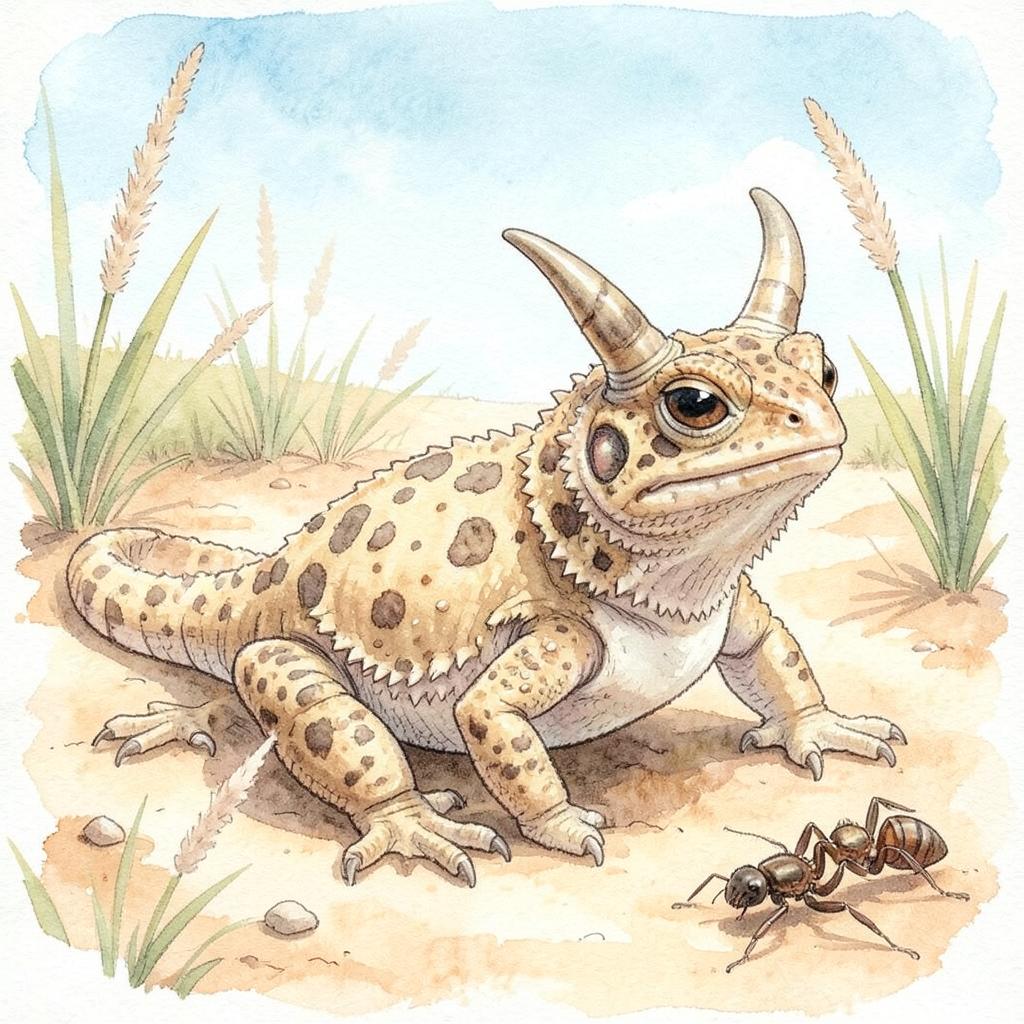
Illustrated Species Ambassador
Bandera — Texas Horned Lizard
I'm Bandera, an illustrated ambassador for the Texas horned lizard. I am the Texas state reptile, and I used to be common in yards and schoolyards.
- One fact worth knowing
- The Texas horned lizard has largely disappeared from the eastern half of Texas, closely tracking the loss of harvester ants — its dominant prey — to fire ants and pesticides.
- What I depend on
- I depend on harvester ants, on bare sunny ground for basking and burying, and on open native grassland rather than dense turf.
- My greatest threat
- My greatest threat is the loss of harvester ants to fire ants and pesticides.
- One way you can help
- Treat fire ant mounds individually instead of broadcasting pesticide, leave harvester ant mounds alone — they are food, not a pest — and never collect or keep a horned lizard, which is illegal in Texas.
This ambassador is an original illustration created for this project. It is an educational character, not a documentary image, and its statements follow the sourced record on this page. Artwork and rights record
Why this species matters
The horned lizard is the clearest example most Texans will encounter of a species vanishing from ordinary places within a single generation. Its decline is tied to a food supply people removed almost by accident.
If it disappears: Losing it would mean the loss of a specialist ant predator and a species deeply tied to Texas identity — and would confirm that fire ants and broadcast pesticides have restructured the state's ground-level food web.
Cultural and regional note: Designated the Texas state reptile in 1993 and long a familiar part of Texas childhood; the decline has been widely noticed by the public.
Conservation status
- IUCN Red List
- Least ConcernThe range-wide assessment does not reflect severe declines in the eastern portion of the Texas range.Last verified 2026-09-08
- Texas
- Threatened (state listed)Protected in Texas since 1967; collection or possession is illegal.Last verified 2026-09-08
- Oklahoma
- Species of greatest conservation needLast verified 2026-09-08
Population
No range-wide count exists. The species remains common in parts of west Texas and the plains but has disappeared from most of central and east Texas where it was formerly abundant.
Trend: Decreasing
As reported: Texas Parks and Wildlife Department distribution reporting and Texas Horned Lizard Watch data, 2000s–2020s
Source: Texas Parks and Wildlife Department; IUCN Red List
Uncertainty: Distribution change, not a population number, is the metric available. Any specific total should be treated as unsupported.
Historical: Widespread and familiar across most of Texas within living memory, including in towns and schoolyards.
Fragmentation: Eastern populations are now isolated remnants.
Range and distribution
Historic range: From Kansas and Colorado south through Oklahoma and most of Texas into northern Mexico.
Current range: Retained across west and south Texas and the southern plains; largely absent from central and east Texas.
Range contraction: Roughly the eastern third of the Texas range has been lost.
Regions occupied
- West and south Texas
- Oklahoma
- Kansas
- New Mexico
- Northern Mexico
Habitat
Primary habitat: Open, arid and semi-arid country with loose sandy or loamy soil and sparse, patchy vegetation.
Breeding habitat: Buries eggs in loose soil.
Feeding habitat: Forages at harvester ant mounds and along ant foraging trails.
Habitat dependencies
- Abundant harvester ants — the dominant prey item
- Bare ground for basking and burying
- Absence of dense turfgrass and heavy pesticide use
Biology and ecology
A specialist ant predator, and prey for hawks, roadrunners, snakes, and coyotes.
Important adaptations: Cryptic coloration, a crown of horns, the ability to inflate the body, and — remarkably — the ability to squirt blood from the eye sockets to deter canine predators.
- Size
- About 2.5–5 inches long.
- Weight
- Roughly 1–3 ounces.
- Lifespan
- Around 5–8 years.
- Diet
- Predominantly harvester ants, supplemented with beetles, grasshoppers, and termites.
- Reproduction
- Lays eggs in a shallow soil nest in early summer.
- Offspring
- Typically 15–30 eggs.
- Breeding frequency
- One clutch a year.
- Age at maturity
- About 2 years.
Primary threats
Loss of prey
Red imported fire ants displace native harvester ants, and horned lizards cannot survive on fire ants. This is the central driver of decline.
Pesticides
Broadcast insecticides used against fire ants also destroy harvester ant colonies, worsening the problem.
Habitat loss
Urbanization, dense turfgrass lawns, and row-crop agriculture remove the bare, sparse ground lizards need.
Illegal collection
Historic collection for the pet trade and curio sales depleted many local populations.
Road mortality
Lizards bask on warm road surfaces and are frequently killed.
Invasive grasses
Introduced grasses form dense sod that eliminates the bare ground horned lizards require.
Conservation and recovery
Programs and efforts
- Texas Horned Lizard Watch citizen-science monitoring
- Captive breeding and reintroduction by the Fort Worth Zoo, San Antonio Zoo, and Dallas Zoo
- Harvester ant habitat restoration on reintroduction sites
- Texas Parks and Wildlife Department Wildlife Diversity Program
Protected areas
- Mason Mountain Wildlife Management Area
- Muse Wildlife Management Area
- Private ranch reintroduction sites
Legal protections
- Texas state threatened listing — possession, collection, and sale are illegal
Measurable progress
- Zoo-bred hatchlings have been released and documented surviving on Texas reintroduction sites
Continuing challenges
- Fire ants cannot easily be removed at landscape scale
- Restoring harvester ants requires restoring the habitat first
How people can help
What individuals can do
- Do not use broadcast fire ant pesticides; treat individual mounds instead
- Leave harvester ant mounds alone — they are the lizard's food supply, not a pest
- Keep areas of bare, sunny ground and native grasses rather than solid turfgrass
- Never collect or keep a horned lizard; it is illegal in Texas
What communities can do
- Adopt native landscaping standards in parks and school grounds
- Report sightings to Texas Horned Lizard Watch
Educational actions
- Use the horned lizard to teach how removing one insect can remove a vertebrate
Habitat support
- Plant native bunchgrasses with open ground between clumps rather than continuous sod
Organizations and programs to learn about
- Texas Parks and Wildlife Department
- Fort Worth Zoo
- Horned Lizard Conservation Society
Educational notes
- A rare case where the IUCN global status and the local reality differ sharply — worth teaching directly.
- The blood-squirting defense makes this a memorable entry point into predator-prey adaptations.