Mammals
Mexican Long-nosed Bat
Leptonycteris nivalis
A migratory nectar-feeding bat that pollinates agaves along a corridor from central Mexico to the mountains of west Texas.
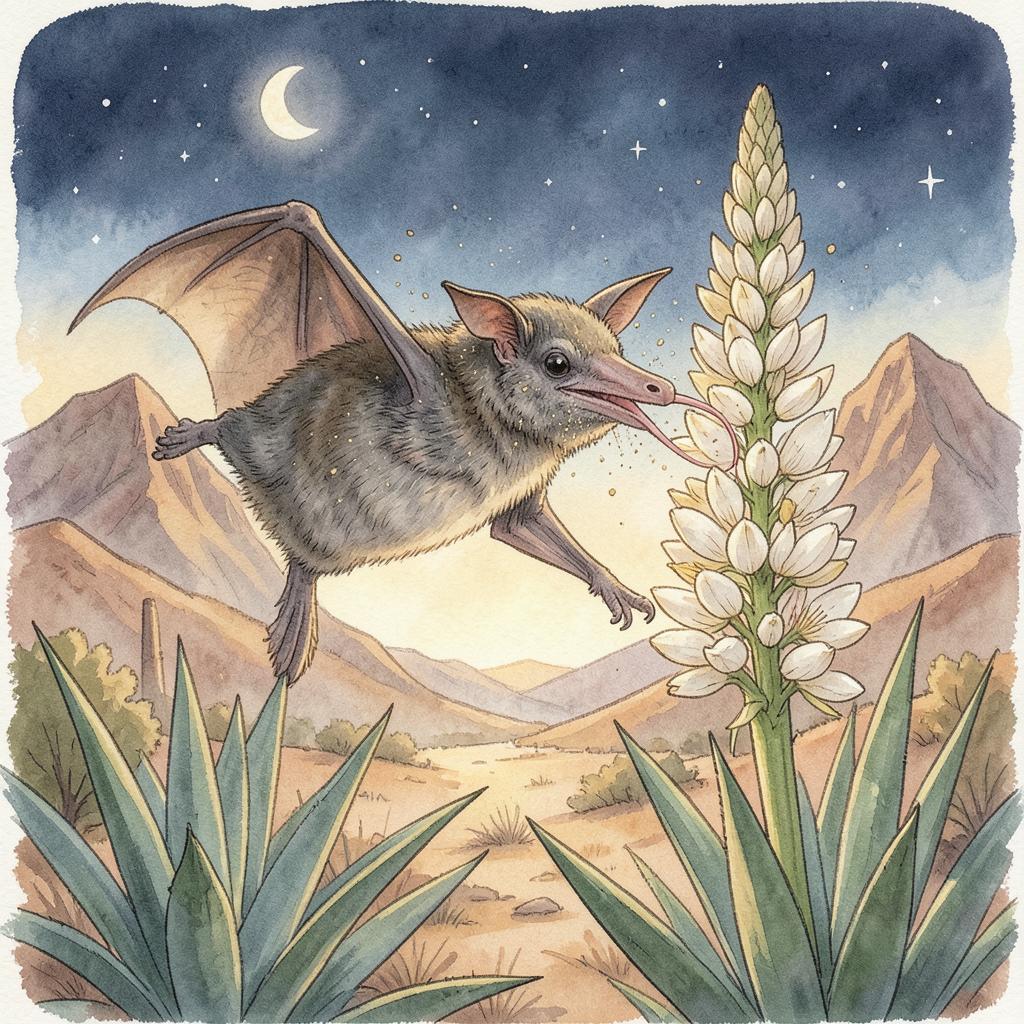
Illustrated Species Ambassador
Maguey — Mexican Long-nosed Bat
I'm Maguey, an illustrated ambassador for the Mexican long-nosed bat. I follow agave blossom north from central Mexico to the mountains of west Texas.
- One fact worth knowing
- The Mexican long-nosed bat is a principal pollinator of agaves — including the species used for tequila and mezcal — and of columnar cacti along its migration corridor.
- What I depend on
- I depend on agaves flowering in sequence the whole length of my migration route, and on undisturbed cave and mine roosts along the way.
- My greatest threat
- My greatest threat is the loss of agave forage and disturbance at my roosts.
- One way you can help
- Choose bat-friendly certified tequila and mezcal, let agaves on your property flower rather than cutting the stalks, and stay out of caves that may hold maternity roosts.
This ambassador is an original illustration created for this project. It is an educational character, not a documentary image, and its statements follow the sourced record on this page. Artwork and rights record
Why this species matters
This bat links the mountains of west Texas to central Mexico through a chain of blooming agaves. If any long stretch of that chain is broken by land clearing or agave harvest, the migration fails even where both endpoints are intact.
If it disappears: Agave reproduction across the corridor would decline, weakening desert plant communities and the wild genetic stock that commercial agave depends on.
Cultural and regional note: Agaves harvested for tequila and mezcal are usually cut before flowering, which removes the bat's food; bat-friendly agave programs address this directly.
Conservation status
- IUCN Red List
- EndangeredLast verified 2026-09-08
- U.S. Endangered Species Act
- EndangeredListed 1988.Last verified 2026-09-08
- Mexico (NOM-059)
- ThreatenedLast verified 2026-09-08
- Texas
- Endangered (state listed)Last verified 2026-09-08
Population
No reliable total exists. The species is known from a small number of large maternity roosts, and counts at those roosts have shown substantial declines; the U.S. portion of the population is concentrated at a single Big Bend-area roost.
Trend: Decreasing
As reported: USFWS recovery documentation and IUCN assessment
Source: U.S. Fish and Wildlife Service; IUCN Red List
Uncertainty: Colony counts fluctuate year to year with agave bloom availability, which makes short-term changes hard to interpret.
Fragmentation: Dependence on very few known roosts means loss of one site could remove a large share of the species.
Range and distribution
Historic range: From central Mexico north along the Sierra Madre into west Texas and southern New Mexico.
Current range: Same broad corridor, but with fewer known occupied roosts.
Migration: Follows a seasonal 'nectar corridor' of sequentially blooming agaves and cacti northward in spring and summer and south again in fall.
Range contraction: Known occupied roosts in the United States have declined to a very small number.
Regions occupied
- Big Bend region, Texas
- Southern New Mexico
- Mexico from Nuevo León and Coahuila south to Morelos
Habitat
Primary habitat: Desert scrub, montane woodland, and pine-oak forest with abundant flowering agaves.
Breeding habitat: Maternity colonies in caves, mines, and rock shelters.
Feeding habitat: Nectar and pollen from agave flower stalks, and columnar cactus flowers.
Habitat dependencies
- Sequential agave bloom along the migration route
- Undisturbed cave and mine roosts
Biology and ecology
A principal pollinator of agaves, including species used for tequila and mezcal, and of columnar cacti along the migration corridor.
Key relationships: Coevolved with agaves, whose tall night-blooming flower stalks are adapted to bat pollination.
Important adaptations: Long snout and a brush-tipped extendable tongue for reaching deep into agave flowers.
- Size
- About 3 inches long with a wingspan near 14 inches.
- Weight
- Approximately 0.6–1 ounce.
- Lifespan
- Not firmly established for this species.
- Diet
- Nectar and pollen, with some fruit and insects.
- Reproduction
- Females form maternity colonies and give birth in late spring or early summer.
- Offspring
- A single pup per year.
- Breeding frequency
- One pup annually.
- Age at maturity
- Approximately 1 year.
Primary threats
Loss of forage plants
Agave harvest for spirits and clearing for grazing removes flowering stalks the bats depend on.
Roost disturbance
Human entry into caves and mines can cause maternity colonies to abandon a site.
Habitat loss
Conversion of desert scrub and woodland reduces both roosts and forage.
Climate change
Shifts in bloom timing can desynchronize the nectar corridor from the migration.
Persecution
Bats are sometimes killed in the mistaken belief that nectar bats are vampire bats.
Conservation and recovery
Programs and efforts
- USFWS recovery planning for Leptonycteris nivalis
- Bat-friendly agave and tequila certification allowing a portion of plants to flower
- Binational roost monitoring between U.S. and Mexican agencies
- Agave restoration planting along the migratory corridor
Protected areas
- Big Bend National Park
- Chihuahuan Desert protected areas in Mexico
Legal protections
- Endangered Species Act listing
- Texas state endangered listing
- Mexican NOM-059 protection
Measurable progress
- Bat-friendly agave certification has brought producers into pollinator conservation
- The related lesser long-nosed bat was delisted in 2018 after recovery, showing the approach can work
Continuing challenges
- Very few known roosts
- Corridor spans an international border
- Agave economics work against letting plants flower
How people can help
What individuals can do
- Choose bat-friendly certified tequila and mezcal
- Plant native agaves and night-blooming desert plants and let them flower
- Never enter caves or mines that may hold maternity roosts
What communities can do
- Support agave restoration planting along the migration corridor
- Protect known roost caves from recreational entry
Educational actions
- Use the nectar corridor to teach migration as a chain of dependencies rather than two endpoints
Habitat support
- Leave flowering agave stalks standing on rural property
Organizations and programs to learn about
- Bat Conservation International
- USFWS Southwest Region
- Texas Parks and Wildlife Department
Educational notes
- One of the few bats listed under the Endangered Species Act primarily because of the loss of a plant.
- A rare example where a consumer purchasing choice maps directly onto a species' food supply.