Urban Wildlife at Risk
Mexican Free-tailed Bat
Tadarida brasiliensis
The bat that fills Texas skies at dusk, forming some of the largest gatherings of mammals anywhere on earth — including beneath a bridge in downtown Austin.
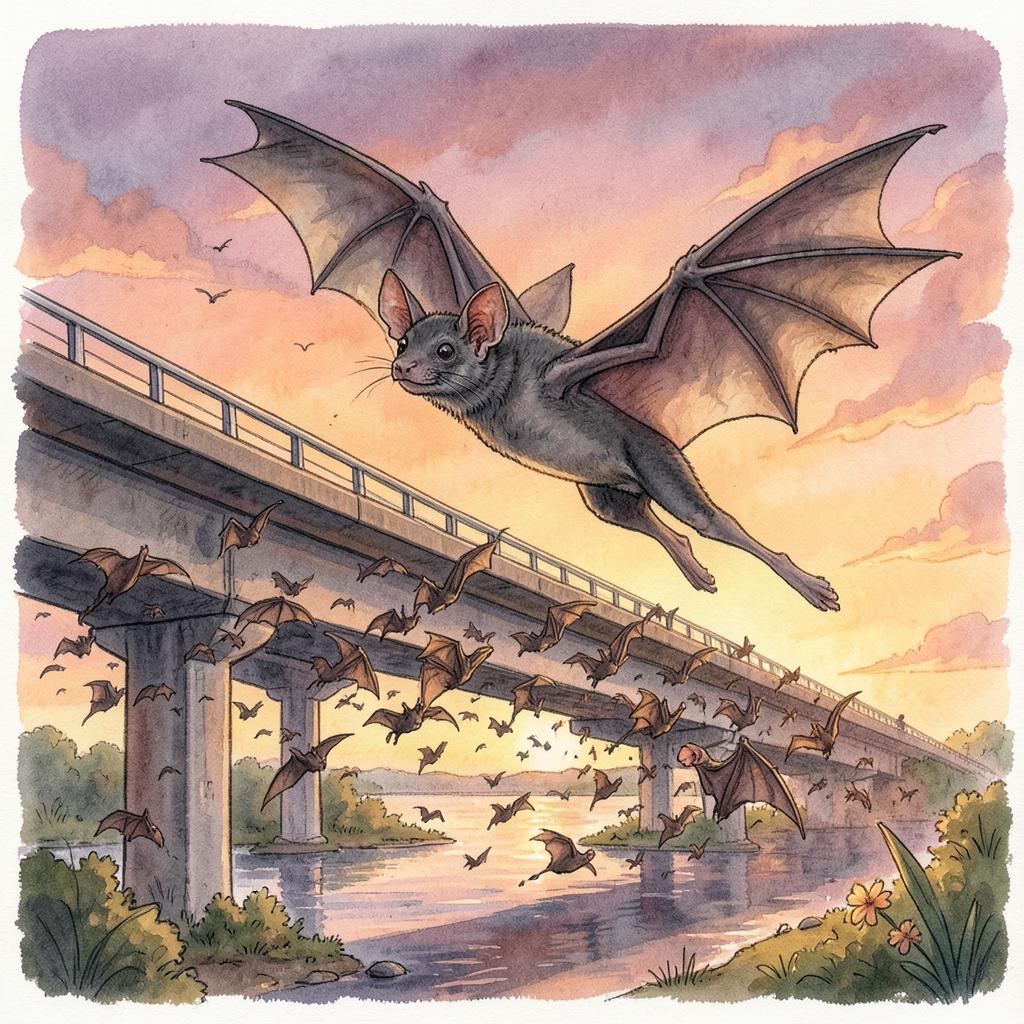
Illustrated Species Ambassador
Bridget — Mexican Free-tailed Bat
I'm Bridget, an illustrated ambassador for the Mexican free-tailed bat. On summer evenings we pour out from under bridges and cave mouths in columns you can see from a long way off.
- One fact worth knowing
- Mexican free-tailed bats form enormous colonies in Texas caves and under urban bridges, and consume very large quantities of night-flying insects, including crop pests.
- What I depend on
- I depend on large undisturbed roosts — caves and bridge crevices — and on insect-rich airspace over farmland and water.
- My greatest threat
- My greatest threat is roost disturbance and loss, along with pesticide effects on the insects I eat.
- One way you can help
- Watch evening emergences from the designated viewing areas rather than at the roost itself, and support keeping bridge and cave roosts protected during maternity season.
This ambassador is an original illustration created for this project. It is an educational character, not a documentary image, and its statements follow the sourced record on this page. Artwork and rights record
Why this species matters
This bat is proof that wildlife and cities can share space to spectacular effect. Austin's bridge colony draws large numbers of visitors each summer and contributes measurably to the local economy, while the same bats save regional agriculture substantial pest control costs.
If it disappears: Agriculture across the southern plains would lose a major natural check on crop pest moths, with direct increases in pesticide use.
Cultural and regional note: The Congress Avenue Bridge colony began accidentally after a 1980 bridge renovation created ideal crevices. Initial public reaction was fearful, and sustained education turned it into one of Austin's best-known attractions — a documented case of public opinion reversing.
Conservation status
- IUCN Red List
- Least ConcernThe species is abundant overall, but because millions concentrate in a very small number of roosts, a single roost loss can affect an enormous share of the population.Last verified 2026-09-08
- Texas
- The official state flying mammal; not listedLast verified 2026-09-08
- U.S. Endangered Species Act
- Not listedLast verified 2026-09-08
Population
Many millions across the range. Bracken Cave near San Antonio hosts one of the largest known bat colonies in the world, and the Congress Avenue Bridge colony in Austin numbers in the hundreds of thousands to over a million in late summer.
Trend: Unknown
As reported: Bat Conservation International and Texas Parks and Wildlife colony monitoring
Source: Bat Conservation International; Texas Parks and Wildlife Department; IUCN Red List
Uncertainty: Colony estimates are made using thermal imaging and radar and carry wide error bars. Historic figures for some caves were later found to be overstated; treat all colony numbers as approximate.
Historical: Some Texas cave colonies are believed to have been substantially larger before DDT-era pesticide impacts and roost disturbance.
Fragmentation: Extremely concentrated. A large share of the entire North American population uses a small number of caves and bridges, which is the species' central vulnerability.
Range and distribution
Historic range: Southern United States through Mexico, Central America, and much of South America.
Current range: Same range, with large migratory colonies in Texas and the southwest.
Migration: Many North American colonies migrate to Mexico for winter, while some southern colonies remain year-round.
Regions occupied
- Texas and the southwestern United States
- Mexico
- Central America
- South America
Habitat
Primary habitat: Caves, bridges, culverts, and buildings for roosting; forages high over farmland, cities, and open country.
Breeding habitat: Females form enormous maternity colonies where pups are packed at high density on cave ceilings.
Feeding habitat: Feeds at high altitude — sometimes over 10,000 feet — on migrating moths and other insects.
Habitat dependencies
- A small number of very large roost structures
- High-altitude insect availability
- Undisturbed maternity roosts during the pup season
Biology and ecology
One of the most significant agricultural pest controllers in North America, consuming enormous quantities of corn earworm and other crop pest moths as they migrate at altitude.
Important adaptations: Long narrow wings built for fast, high, long-distance flight — among the fastest level-flying birds or bats measured. A mother returning to a colony of millions can locate her own pup by call and scent.
- Size
- About 3.5 inches long.
- Weight
- Roughly 11 to 14 grams.
- Lifespan
- Up to about 18 years.
- Diet
- Moths, beetles, flying ants, and true bugs — including large numbers of crop pest moths.
- Reproduction
- A single pup per year, born in a dense maternity colony.
- Offspring
- One.
- Breeding frequency
- Once yearly.
- Age at maturity
- Around one year.
Primary threats
Roost disturbance
Because millions concentrate in few roosts, disturbance, vandalism, or destruction of a single cave or bridge affects an outsized share of the population.
Wind turbines
Free-tailed bats fly high and fast and are among the species most frequently killed at wind energy facilities.
Pesticides
Feeding on agricultural pest moths exposes the bats to accumulated insecticides.
Habitat conversion
Development near major roosts affects foraging habitat and can lead to roost exclusion.
Climate change
Changes in insect migration timing and drought affect food availability.
Public fear and exclusion
Bats are still killed or excluded from buildings out of unfounded fear, particularly around rabies concerns.
White-nose syndrome
This species has been found carrying the fungus, though it does not appear to suffer the mass mortality seen in hibernating Myotis species.
Conservation and recovery
Programs and efforts
- Bat Conservation International protection and ownership of Bracken Cave Preserve
- Austin Congress Avenue Bridge colony management and public education
- Bat-friendly bridge design guidance for transportation departments
- Wind energy curtailment agreements during high-risk periods
- Texas Parks and Wildlife bat conservation and public outreach programs
Protected areas
- Bracken Cave Preserve, Texas
- Old Tunnel State Park, Texas
- Carlsbad Caverns National Park, New Mexico
Legal protections
- Texas state protection against killing bats except in specific circumstances
- Protection of roosts on public land
Measurable progress
- Bracken Cave was purchased and protected from adjacent development
- Austin's bridge colony transformed public perception of bats and generates substantial tourism
- Bat-friendly bridge design is now incorporated into some transportation projects
Continuing challenges
- Extreme roost concentration is an inherent vulnerability
- Wind energy mortality is significant
- Fear-based exclusion continues
How people can help
What individuals can do
- Visit a public bat emergence — Congress Avenue Bridge in Austin or Old Tunnel State Park — and bring someone who is afraid of bats
- Never handle a bat found on the ground; report it to animal control instead
- If bats roost in your building, use humane exclusion outside the maternity season and install a bat house first
- Reduce pesticide use, which reaches bats through their prey
What communities can do
- Ask transportation departments to include bat-friendly crevices in new bridge designs
- Support wind energy curtailment agreements
Educational actions
- Use Austin's bridge colony to teach that public attitudes toward wildlife can genuinely change
Habitat support
- Support protection of major cave roosts from adjacent development
Organizations and programs to learn about
- Bat Conservation International
- Texas Parks and Wildlife Department
- Merlin Tuttle's Bat Conservation
Educational notes
- The official flying mammal of Texas.
- Among the fastest bats in level flight, and one of the highest-flying.
- A mother can find her own pup among millions by call and scent.
- Abundant overall, yet vulnerable because so many gather in so few places.
Sources and references
- IUCN Red List — Tadarida brasiliensis — IUCN
- Bat Conservation International — Bracken Cave Preserve — Bat Conservation International
- Texas Parks and Wildlife Department — Bats — TPWD