Birds
Whooping Crane
Grus americana
North America's tallest bird, rebuilt from about 15 birds in the 1940s to a wild flock that migrates 2,500 miles to the Texas coast.
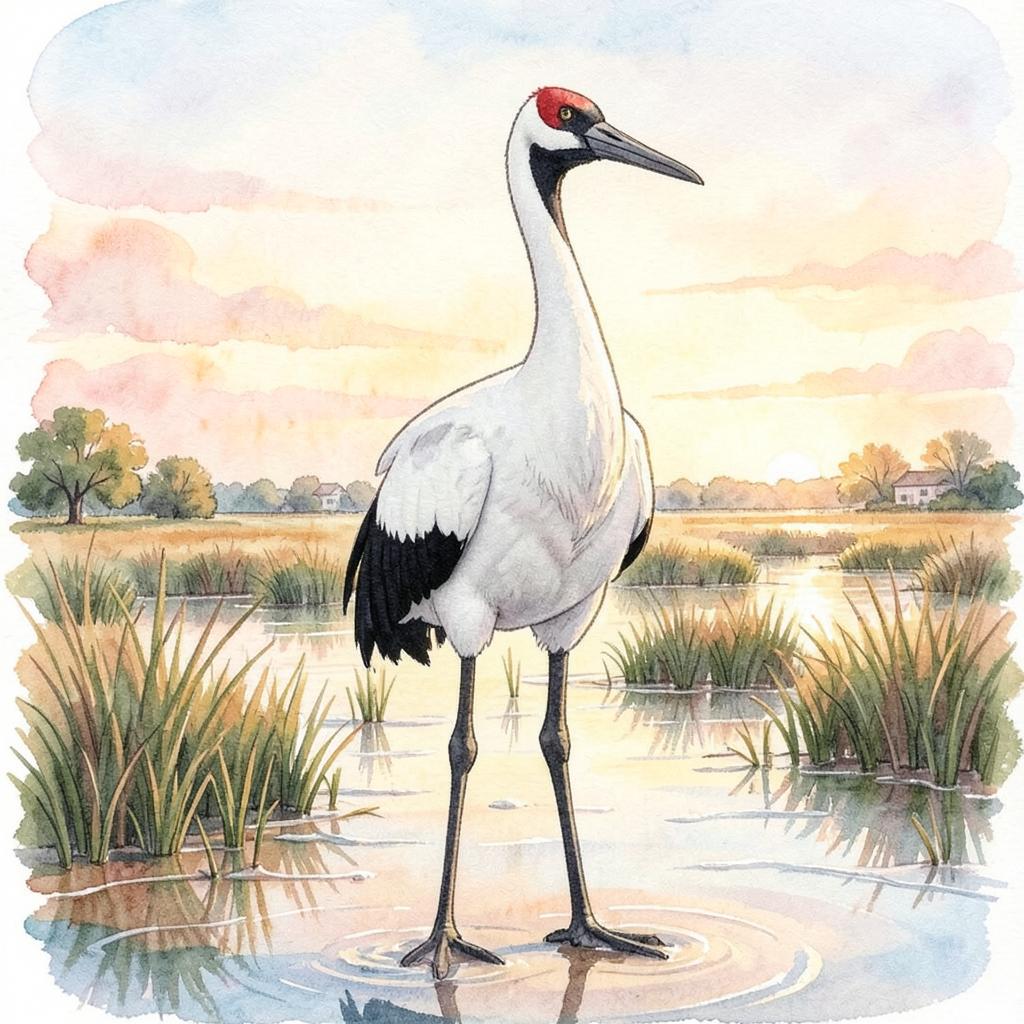
Illustrated Species Ambassador
Aransas — Whooping Crane
I'm Aransas, an illustrated ambassador for the whooping crane. I stand about five feet tall and migrate some 2,500 miles to the Texas coast each year.
- One fact worth knowing
- North America's tallest bird was rebuilt from about fifteen birds in the 1940s into a wild migratory flock that winters on the Texas coast.
- What I depend on
- I depend on shallow freshwater marsh and coastal salt marsh, on freshwater inflow that keeps coastal salinity low, and on safe stopover wetlands along the flyway.
- My greatest threat
- My greatest threat is wetland loss, together with collisions with power lines.
- One way you can help
- Keep a long, quiet distance from cranes at roosting and feeding sites, report banded birds to state wildlife agencies, and learn to tell whooping cranes from sandhill cranes and snow geese before hunting.
This ambassador is an original illustration created for this project. It is an educational character, not a documentary image, and its statements follow the sourced record on this page. Artwork and rights record
Why this species matters
The whooping crane is one of the clearest illustrations that a species can be pulled back from the very edge. Its recovery has depended on protecting water and wetlands across an entire continent, which means the crane's health reads as a report card on thousands of miles of shared landscape.
If it disappears: Losing the crane would mean the flyway's wetlands failed — and would end the longest-running and most public recovery effort in North American bird conservation.
Conservation status
- IUCN Red List
- EndangeredLast verified 2026-09-08
- U.S. Endangered Species Act
- EndangeredListed 1967.Last verified 2026-09-08
- CITES
- Appendix ILast verified 2026-09-08
- Canada (SARA)
- EndangeredLast verified 2026-09-08
Population
Roughly 540 birds in the wild Aransas-Wood Buffalo population, plus smaller reintroduced flocks in the eastern United States and Louisiana and about 150 birds in captivity.
Trend: Increasing
As reported: USFWS and Canadian Wildlife Service winter survey reporting, 2023–2024
Source: U.S. Fish and Wildlife Service; Canadian Wildlife Service
Uncertainty: Winter survey estimates are published with confidence intervals; the figure above is the midpoint of the reported range.
Historical: Reduced to roughly 15–16 birds in the wild flock in 1941.
Fragmentation: One self-sustaining wild flock plus reintroduced flocks that have not yet reached self-sustaining reproduction.
Range and distribution
Historic range: Wetlands and prairie from the Arctic to central Mexico and east to the Atlantic coast.
Current range: Nests in and around Wood Buffalo National Park, Canada; winters at Aransas National Wildlife Refuge on the central Texas coast.
Migration: About 2,500 miles each way through Saskatchewan, the Dakotas, Nebraska, Kansas, Oklahoma, and Texas.
Range contraction: Breeds today in a single natural location.
Regions occupied
- Northwest Territories and Alberta, Canada
- Great Plains migration corridor
- Texas Gulf Coast
- Louisiana
- Wisconsin and Florida (reintroduced)
Habitat
Primary habitat: Shallow freshwater marsh, sedge meadow, and coastal salt marsh.
Breeding habitat: Shallow boreal wetlands and bogs with bulrush cover.
Feeding habitat: Winter feeding on blue crabs, clams, and wolfberry in tidal flats and shallow bays.
Seasonal differences: Uses agricultural fields, wetlands, and river sandbars as migration stopovers.
Critical habitat: Critical habitat designated at Aransas and several migration-corridor sites.
Habitat dependencies
- Freshwater inflow that keeps coastal marsh salinity low
- Safe stopover wetlands along the flyway
Biology and ecology
A large wetland omnivore and one of the most closely tracked indicators of wetland health across the central flyway.
Important adaptations: Loud, far-carrying call from an elongated trachea; strong site fidelity to both nesting and wintering territories.
- Size
- About 5 feet tall with a 7.5-foot wingspan.
- Weight
- Approximately 14–17 pounds.
- Lifespan
- Around 22–30 years in the wild.
- Diet
- Blue crabs, clams, frogs, insects, small fish, waste grain, and wolfberry.
- Reproduction
- Long-term pair bonds; nests built on wetland mounds.
- Offspring
- Two eggs, but usually only one chick survives to fledging.
- Breeding frequency
- One nesting attempt a year.
- Age at maturity
- Around 4–5 years.
Primary threats
Habitat loss
Drainage of wetland stopover and wintering habitat along the central flyway.
Altered streamflow
Reduced freshwater inflow raises salinity in Aransas marsh and reduces blue crab availability.
Collisions
Power line strikes are a leading cause of death during migration.
Illegal shooting
Deliberate shootings still occur along the migration route despite full legal protection.
Drought and sea level
Drought reduces crab and wolfberry food; sea-level change threatens the wintering marsh.
Small population
A single catastrophic event on the wintering grounds could affect most of the wild flock at once.
Conservation and recovery
Programs and efforts
- International Whooping Crane Recovery Team (U.S. and Canada)
- Captive breeding at multiple institutions
- Eastern migratory and Louisiana non-migratory reintroductions
- Power line marking along known flight corridors
Protected areas
- Aransas National Wildlife Refuge, Texas
- Wood Buffalo National Park, Canada
- Quivira and Salt Plains refuges along the flyway
Legal protections
- Endangered Species Act
- Migratory Bird Treaty Act
- Canada's Species at Risk Act
- CITES Appendix I
Measurable progress
- Growth from roughly 15 birds to more than 500 in the wild flock
- Establishment of additional reintroduced flocks
Continuing challenges
- Reintroduced flocks still have poor natural reproduction
- Coastal water supply conflicts
- Continued illegal shootings
How people can help
What individuals can do
- Keep a long, quiet distance from cranes at roosting and feeding sites
- Report sightings of banded cranes to state wildlife agencies
- Learn to distinguish whooping cranes from sandhill cranes and snow geese before hunting
What communities can do
- Advocate for marking power lines near known crane flight paths
- Support freshwater inflow policy for coastal bays
Educational actions
- Track the annual Aransas winter count as a live example of population monitoring
Habitat support
- Support wetland protection and restoration along the central flyway
Organizations and programs to learn about
- USFWS Aransas National Wildlife Refuge
- International Crane Foundation
- Canadian Wildlife Service
Educational notes
- A strong case study in long-term recovery under sustained protection.
- Useful for teaching how upstream water use affects downstream habitat.