Freshwater Species
Texas Fatmucket
Lampsilis bracteata
A freshwater mussel found only in central Texas rivers, filtering water for decades in one spot and dying when the river stops flowing.
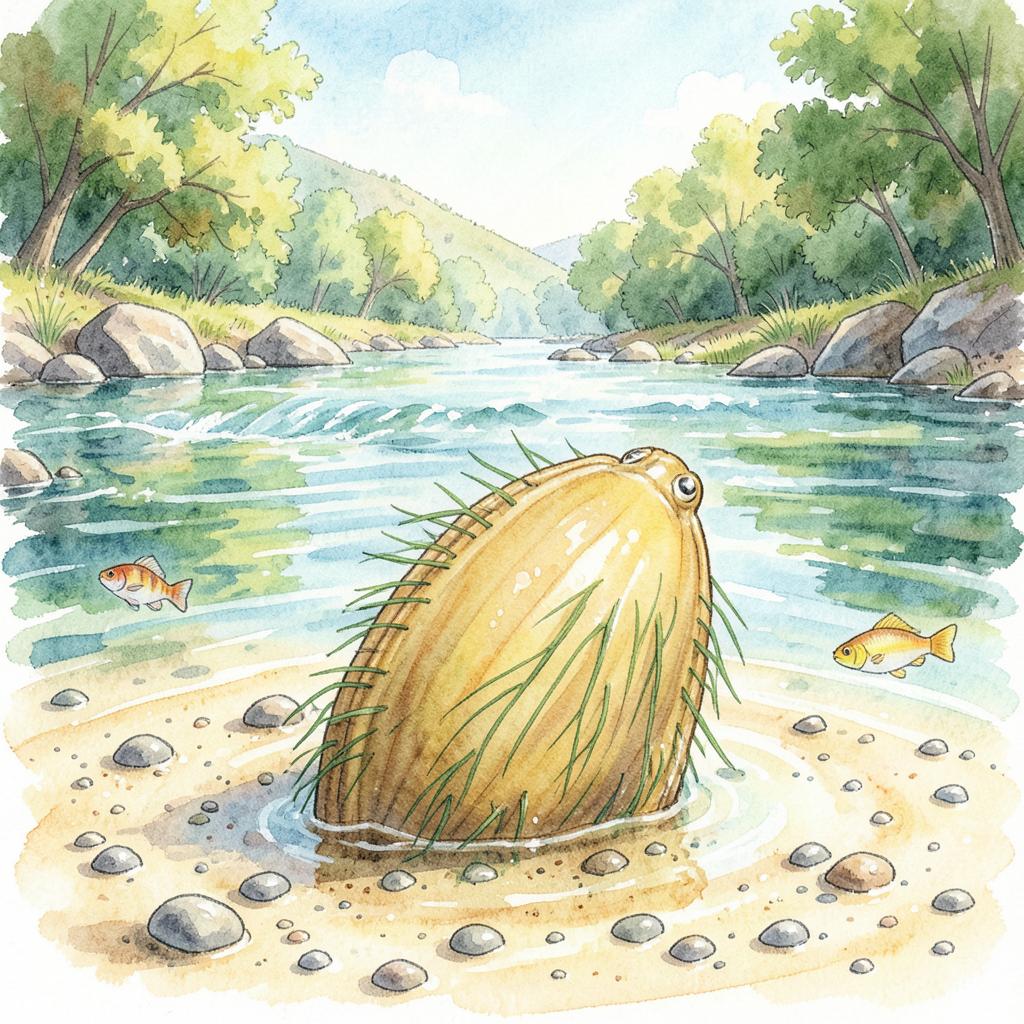
Illustrated Species Ambassador
Bracten — Texas Fatmucket
I'm Bracten, an illustrated ambassador for the Texas fatmucket. I live half-buried in river gravel, and I cannot walk away when the water stops.
- One fact worth knowing
- The Texas fatmucket is found only in central Texas rivers. A dense mussel bed measurably improves water clarity by filtering algae, bacteria, and fine particles.
- What I depend on
- I depend on perennial flowing water, stable silt-free gravel and sand, and host fish — mainly sunfish and basses — that carry my larvae.
- My greatest threat
- My greatest threat is drought, river drying, and sedimentation.
- One way you can help
- Conserve water during drought so rivers keep their base flow, never collect mussels or shells from Texas rivers, and clean, drain and dry boats and gear to avoid spreading zebra mussels.
This ambassador is an original illustration created for this project. It is an educational character, not a documentary image, and its statements follow the sourced record on this page. Artwork and rights record
Why this species matters
Freshwater mussels are the most imperiled group of animals in North America, and they are also the natural filtration system of a river. A healthy bed of mussels cleans water continuously, without cost, for decades. When they are gone, that service ends and nothing replaces it.
If it disappears: Central Texas rivers would lose long-lived natural filtration and a species found nowhere else on earth.
Conservation status
- U.S. Endangered Species Act
- EndangeredUSFWS finalized listing for several central Texas mussels in 2024, with designated critical habitat. Verify the final rule and critical habitat units before publication.Last verified 2026-09-08
- Texas
- State threatenedLast verified 2026-09-08
- IUCN Red List
- EndangeredLast verified 2026-09-08
- NatureServe
- ImperiledLast verified 2026-09-08
Population
Known from a limited number of stream reaches in the Colorado and Guadalupe basins, with most surveyed sites holding small numbers of individuals and little evidence of consistent recruitment.
Trend: Decreasing
As reported: USFWS species status assessment and Texas Parks and Wildlife Department survey work
Source: U.S. Fish and Wildlife Service; Texas Parks and Wildlife Department
Uncertainty: Mussel populations are assessed by occupied reach and density per survey effort, not by total count.
Historical: Formerly more widespread through the Colorado, Guadalupe, and San Antonio river systems.
Fragmentation: Remaining populations are isolated in separate stream reaches with no connection during low flow.
Range and distribution
Historic range: Central Texas streams in the Colorado and Guadalupe river basins.
Current range: Scattered reaches of the Llano, San Saba, Concho, Pedernales, and upper Guadalupe systems.
Range contraction: Lost from a substantial portion of surveyed historic sites.
Regions occupied
- Colorado River basin, Texas
- Guadalupe River basin, Texas
- Edwards Plateau streams
Habitat
Primary habitat: Stable gravel, cobble, and sand substrate in flowing reaches of clear central Texas rivers.
Breeding habitat: Larvae must attach to the gills of a suitable host fish to complete development.
Feeding habitat: Filter feeds on algae, bacteria, and organic particles suspended in the water.
Critical habitat: Critical habitat has been designated in the recent listing rule; confirm current units.
Habitat dependencies
- Perennial flowing water — mussels cannot move when a pool dries
- Host fish, principally sunfish and basses, for larval development
- Stable, silt-free substrate
Biology and ecology
Filters large volumes of water, stabilizes stream bottoms, and creates habitat structure. A dense mussel bed measurably improves water clarity.
Key relationships: Obligate dependence on host fish species; losing the host fish ends mussel reproduction even if adult mussels survive.
Important adaptations: Females display a fleshy mantle lure that mimics a small fish or insect to attract the host fish close enough to receive the larvae.
- Size
- Shell up to roughly 3 inches.
- Lifespan
- Can exceed 20 years.
- Diet
- Suspended algae, bacteria, and detritus.
- Reproduction
- Females brood larvae, called glochidia, and release them to attach to a host fish's gills, where they develop before dropping off as juveniles.
- Offspring
- Large numbers of glochidia, very few of which reach a host fish.
- Breeding frequency
- Annually.
- Age at maturity
- Several years.
Primary threats
Drought
Central Texas rivers increasingly stop flowing in summer; mussels cannot move and die in place when pools dry.
Water withdrawal
Groundwater pumping and surface diversion reduce base flow in Edwards Plateau streams.
Sedimentation
Runoff from development, road construction, and grazing smothers substrate and clogs filtering gills.
Dams and impoundments
Reservoirs convert flowing habitat to still water and block host fish movement.
Water quality
Nutrient and chemical pollution affect a species that filters everything in the water column.
Loss of host fish
If the host fish species disappear from a reach, mussel reproduction stops entirely.
Climate change
Longer and more severe drought increases the frequency of complete stream drying.
Conservation and recovery
Programs and efforts
- USFWS listing and recovery planning for central Texas mussels
- Texas Parks and Wildlife Department mussel survey and monitoring program
- Captive propagation research at Texas state fish hatcheries and university labs
- Emergency salvage of mussels from drying reaches during severe drought
- Riparian restoration and sediment control on Edwards Plateau ranchland
Protected areas
- State park and river reaches within the Colorado and Guadalupe basins
- Designated critical habitat units
Legal protections
- Endangered Species Act
- Texas state threatened listing prohibiting collection
- Designated critical habitat
Measurable progress
- Captive propagation techniques for Texas mussels have advanced significantly
- Survey work has located previously unknown populations
Continuing challenges
- Drought cannot be managed directly
- Water in Texas is fully allocated and demand is rising
- Recovery depends on private landowner participation
How people can help
What individuals can do
- Never collect mussels or shells from Texas rivers — it is illegal for listed species and removes long-lived individuals
- Conserve water during drought; river base flow depends on it
- Clean, drain, and dry boats and gear to avoid spreading invasive zebra mussels
What communities can do
- Support riparian buffers and erosion control along central Texas streams
- Back environmental flow standards in regional water planning
Educational actions
- Use the mantle lure to teach how sophisticated an apparently simple animal can be
Habitat support
- Volunteer for riverbank stabilization and native riparian planting
Organizations and programs to learn about
- Texas Parks and Wildlife Department
- USFWS Austin Ecological Services Field Office
- local river authorities
Educational notes
- Freshwater mussels are the most endangered group of animals in North America.
- A single mussel can filter many gallons of water per day; a bed provides continuous free water treatment.
- The mantle lure is one of the more remarkable examples of mimicry in North American wildlife.