Global Endangered Species
Temminck's Ground Pangolin
Smutsia temminckii
Africa's most widespread pangolin, increasingly targeted by international trafficking as Asian pangolin populations collapse.
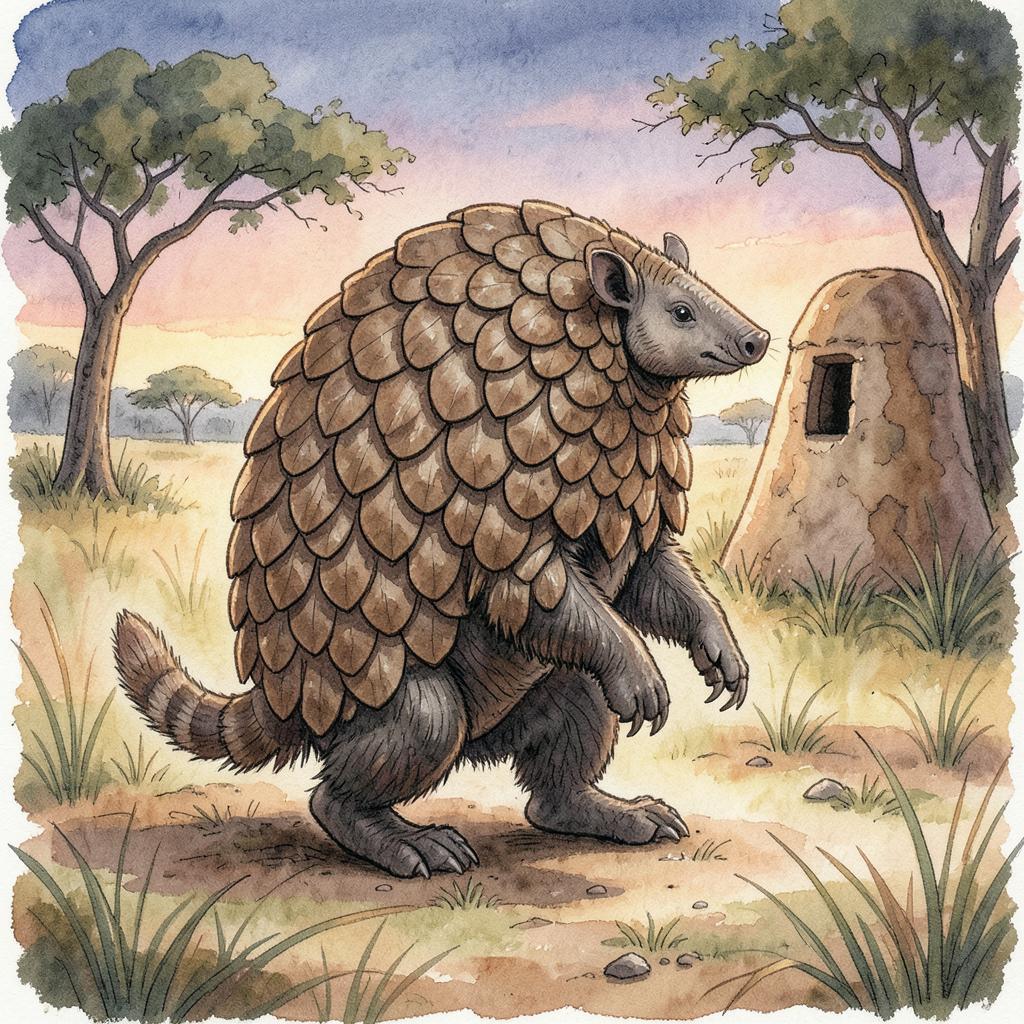
Illustrated Species Ambassador
Nkosi — Temminck's Ground Pangolin
I'm Nkosi, an illustrated ambassador for Temminck's ground pangolin. I walk on my hind legs across open savanna, keeping my digging claws off the dirt.
- One fact worth knowing
- Temminck's ground pangolin is Africa's most widespread pangolin, and is increasingly targeted by international trafficking as Asian pangolin populations collapse.
- What I depend on
- I depend on ant and termite colonies, on burrows — often ones aardvarks dug — and on fencing that is not electrified at the height that kills pangolins.
- My greatest threat
- My greatest threat is trafficking, along with electric fencing and bushmeat hunting.
- One way you can help
- Never buy pangolin scales, leather or curios; if you manage fenced land in range countries, raise the lowest electrified strand above pangolin height.
This ambassador is an original illustration created for this project. It is an educational character, not a documentary image, and its statements follow the sourced record on this page. Artwork and rights record
Why this species matters
As Asian pangolin populations collapsed, trafficking pressure shifted to Africa. Temminck's ground pangolin shows how demand in one part of the world reaches across continents to a species that had not previously been targeted at scale.
If it disappears: African savannas would lose a specialized insect predator and soil-turning digger, and the world would lose another of only eight pangolin species.
Cultural and regional note: Pangolins hold cultural significance in several southern African traditions, and in some regions live animals were traditionally presented to leaders — a practice that conservation programs now work to redirect toward release.
Conservation status
- IUCN Red List
- VulnerableLast verified 2026-09-08
- CITES
- Appendix IAll pangolin species moved to Appendix I in 2016.Last verified 2026-09-08
- National
- Protected under national wildlife law across most range statesLast verified 2026-09-08
Population
No reliable population estimate exists. The IUCN documents a suspected decline of roughly 30 to 40 percent over three generations, with the species now rare or absent across parts of its former range.
Trend: Decreasing
As reported: IUCN Red List assessment
Source: IUCN Red List; IUCN SSC Pangolin Specialist Group
Uncertainty: Densities are naturally low and the animal is nocturnal and solitary, so field estimates are unreliable and vary widely between studies.
Historical: Historically distributed across a very large area of eastern and southern Africa.
Fragmentation: Populations are increasingly isolated in protected areas and low-density rangeland.
Range and distribution
Historic range: From Chad and Sudan south through East Africa to South Africa and west to Namibia and Angola.
Current range: Broadly the same range with substantial local losses, particularly near dense human settlement.
Range contraction: Locally extirpated in agricultural and heavily settled areas.
Regions occupied
- South Africa, Namibia, Botswana, Zimbabwe
- Zambia, Malawi, Mozambique
- Tanzania, Kenya, Uganda
- South Sudan, Chad, Central African Republic
Habitat
Primary habitat: Savanna, woodland, floodplain grassland, and arid scrub with abundant ants and termites.
Breeding habitat: Gives birth in a burrow, often one dug by aardvarks or other animals.
Feeding habitat: Excavates ant and termite nests, feeding almost exclusively on a limited number of species.
Habitat dependencies
- Ant and termite colonies
- Available burrows, often created by aardvarks
- Absence of electrified fencing at the height that kills pangolins
Biology and ecology
A major consumer of ants and termites, and a soil aerator through its digging.
Important adaptations: Walks upright on its hind legs with the tail as a counterbalance, keeping the front claws free for digging. Rolls into an impenetrable ball when threatened.
- Size
- Head and body roughly 20 to 24 inches, plus a heavy tail.
- Weight
- Typically 15 to 40 pounds — the largest African pangolin.
- Lifespan
- Estimated up to about 20 years.
- Diet
- Ants and termites, with strong preferences for particular species.
- Reproduction
- A single pup after a gestation of several months; the pup rides on the mother's tail base.
- Offspring
- One.
- Breeding frequency
- Roughly once per year or less.
- Age at maturity
- About two years.
Primary threats
Wildlife trafficking
African pangolin scales are increasingly seized in shipments bound for Asian markets as Asian populations decline.
Electric fencing
Electrified game and livestock fencing is a major documented cause of death: a pangolin touching a low strand curls around it and is unable to release, dying from prolonged shock.
Bushmeat hunting
Local hunting for meat continues across much of the range.
Habitat loss
Agricultural expansion and settlement reduce and fragment savanna habitat.
Road mortality
Slow-moving nocturnal animals are frequently killed on roads.
Traditional use
Body parts are used in some traditional practices, adding to offtake.
Slow reproduction
One offspring per year makes recovery from any sustained loss very slow.
Conservation and recovery
Programs and efforts
- African Pangolin Working Group research, rescue, and rehabilitation
- CITES Appendix I enforcement and cross-border anti-trafficking operations
- Wildlife-friendly fencing guidance raising the lowest electrified strand out of the pangolin risk zone
- Rehabilitation and release programs for confiscated animals, with post-release monitoring
- Detection dog units at airports and border posts in southern Africa
Protected areas
- Kruger National Park, South Africa
- Kafue and South Luangwa, Zambia
- Etosha and Namibian conservancies
- Community conservancies across East Africa
Legal protections
- CITES Appendix I
- National protected species status across most range states
- Prosecution under organized wildlife crime statutes in South Africa
Measurable progress
- Rehabilitation programs have successfully returned confiscated pangolins to the wild with documented survival
- Fence modification guidance has been adopted by a growing number of reserves
- Sting operations have produced significant prosecutions in South Africa
Continuing challenges
- Demand continues to grow
- The species is extremely difficult to survey
- Rehabilitation is labor-intensive and expensive per animal
How people can help
What individuals can do
- Never buy pangolin products, including scales, leather, or curios
- If you manage land with electric fencing in range countries, raise the lowest strand above pangolin height
- Report roadside pangolins to wildlife authorities rather than handling them
What communities can do
- Support wildlife-friendly fencing standards on game and livestock properties
- Fund rescue and rehabilitation facilities
Educational actions
- Use the electric fence problem to teach that ordinary infrastructure can be a leading cause of death
Habitat support
- Support savanna conservancies and community conservation programs
Organizations and programs to learn about
- African Pangolin Working Group
- IUCN SSC Pangolin Specialist Group
- TRAFFIC
- national parks authorities
Educational notes
- Walks on its hind legs, unlike most other pangolins.
- Electric fencing is a leading cause of death in southern Africa — a solvable engineering problem.
Related educational project
Pango's Secret Armor: The Little Creature Who Needed Big Friends
A children's educational story from Crowned Compass Publishing introducing young readers to pangolins. The story is fiction; the scientific record above is maintained separately from it.
Learn about this project →Sources and references
- IUCN Red List — Smutsia temminckii — IUCN
- CITES Appendices — CITES
- African Pangolin Working Group — African Pangolin Working Group