Mammals
Sunda Pangolin
Manis javanica
A scaled, ant-eating mammal of Southeast Asia driven toward extinction by the most intense illegal wildlife trade of any mammal group.
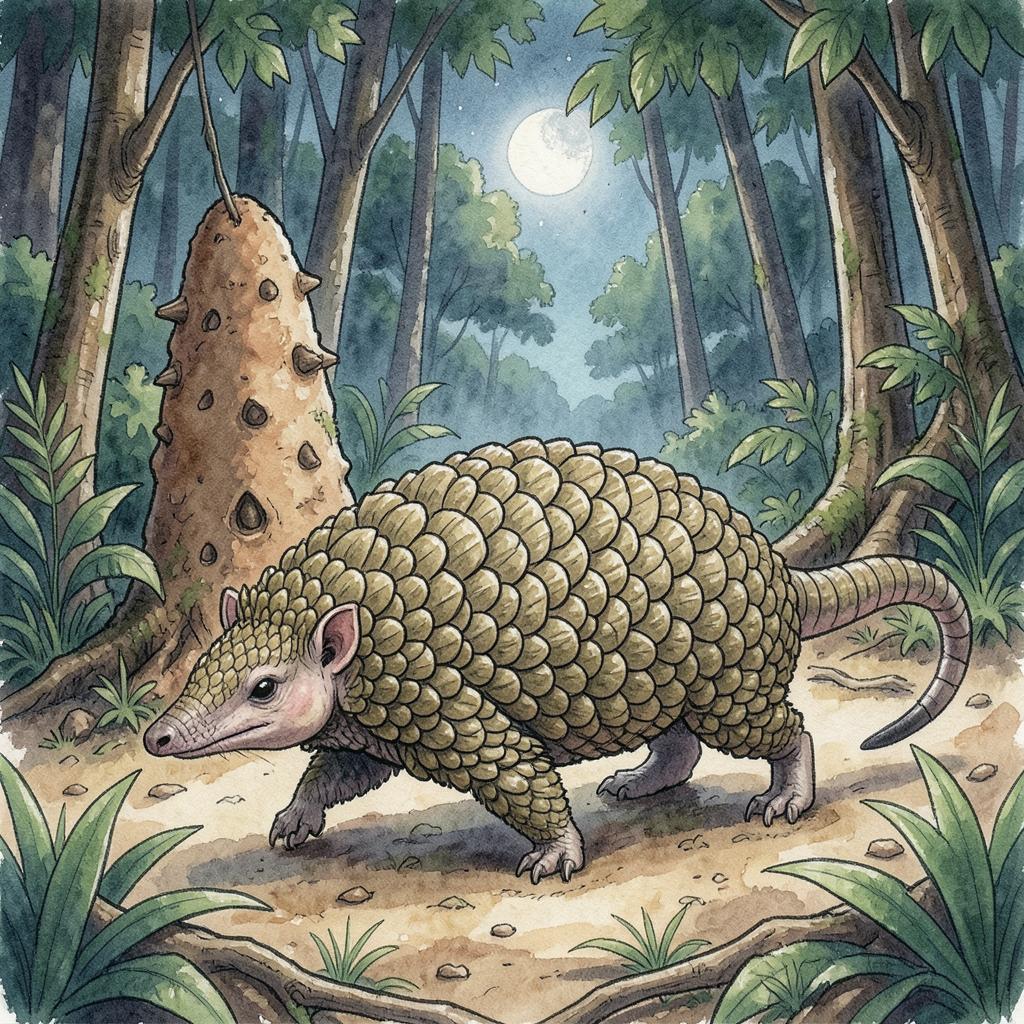
Illustrated Species Ambassador
Rimba — Sunda Pangolin
I'm Rimba, an illustrated ambassador for the Sunda pangolin. I have no teeth at all — I gather ants and termites with a long sticky tongue.
- One fact worth knowing
- Pangolins are the most heavily trafficked mammal group in the world. A single Sunda pangolin can eat tens of millions of ants and termites in a year.
- What I depend on
- I depend on abundant ant and termite colonies, undisturbed burrows and hollows to shelter in, and forest that is actually patrolled.
- My greatest threat
- My greatest threat is poaching and wildlife trafficking.
- One way you can help
- Never buy pangolin products, including scales sold as medicine or pangolin leather, and report suspected pangolin products to wildlife trade authorities.
This ambassador is an original illustration created for this project. It is an educational character, not a documentary image, and its statements follow the sourced record on this page. Artwork and rights record
Why this species matters
Pangolins are widely described as the most trafficked wild mammals in the world. Their scales are keratin, the same material as fingernails, and have no proven medicinal value — meaning an entire order of mammals is being emptied out of the forest for a claim that does not hold up.
If it disappears: Losing pangolins would remove the primary specialist predator of ants and termites across Southeast Asian forest, with poorly understood consequences for insect outbreaks and soil turnover.
Cultural and regional note: Demand is driven by traditional medicine markets and luxury meat consumption; both uses are documented in seizure records and enforcement reporting.
Conservation status
- IUCN Red List
- Critically EndangeredAssessed as Critically Endangered since 2014.Last verified 2026-09-08
- CITES
- Appendix IAll eight pangolin species were moved to Appendix I in 2016, prohibiting commercial international trade.Last verified 2026-09-08
- U.S. Endangered Species Act
- EndangeredListed as a foreign endangered species.Last verified 2026-09-08
Population
No reliable global population estimate exists. Assessors instead use trade seizure volumes and steep local declines, with a suspected population reduction of roughly 80 percent over three generations.
Trend: Decreasing
As reported: IUCN Red List assessment for Manis javanica
Source: IUCN Red List; IUCN SSC Pangolin Specialist Group
Uncertainty: Pangolins are nocturnal, solitary, and burrow-dwelling, which makes direct counting impractical. Any specific global number should be treated as unsupported.
Historical: Once common across lowland Southeast Asian forest; now rare or locally absent across much of that range.
Range and distribution
Historic range: Mainland and island Southeast Asia from Myanmar and Thailand through Malaysia, Indonesia, and the Philippines' western islands.
Current range: Fragmented remnants of the historic range, with severe depletion in accessible areas.
Range contraction: Extirpated or nearly so from many accessible lowland forests due to hunting pressure rather than habitat loss alone.
Regions occupied
- Myanmar
- Thailand
- Laos
- Cambodia
- Vietnam
- Malaysia
- Indonesia
- Singapore
- Brunei
Habitat
Primary habitat: Primary and secondary tropical forest, and increasingly plantations and gardens near forest.
Breeding habitat: Gives birth in burrows or tree hollows.
Feeding habitat: Ants and termites taken from mounds, rotting wood, and soil.
Habitat dependencies
- Abundant ant and termite colonies
- Undisturbed burrow and hollow sites
- Effective anti-poaching enforcement
Biology and ecology
A major consumer of ants and termites — a single pangolin can eat tens of millions of insects a year — and a soil aerator through digging.
Important adaptations: The only mammals covered in overlapping keratin scales; they roll into a sealed ball for defense, which protects them from predators but makes them trivially easy for people to collect.
- Size
- About 30–35 inches long including a long prehensile tail.
- Weight
- Approximately 10–22 pounds.
- Lifespan
- Poorly established in the wild; captive individuals have lived roughly 20 years.
- Diet
- Ants and termites, gathered with a long sticky tongue; pangolins have no teeth.
- Reproduction
- Breeding is not strongly seasonal; gestation is roughly 6 months.
- Offspring
- Usually a single pup, rarely two.
- Breeding frequency
- Approximately once a year.
- Age at maturity
- About 1–2 years.
Primary threats
Wildlife trafficking
Pangolins are hunted for scales and meat and moved through organized international smuggling networks; multi-tonne scale seizures have been recorded repeatedly.
Overharvest
Local hunting for subsistence and sale removes animals faster than a one-pup-per-year species can replace them.
Habitat loss
Conversion of lowland forest to oil palm and agriculture reduces remaining refuge.
Defensive behavior
Rolling into a ball makes them defenseless against human collection.
Poor captive survival
Specialized diets mean rescued pangolins often die in captivity, limiting rehabilitation as a fallback.
Conservation and recovery
Programs and efforts
- IUCN SSC Pangolin Specialist Group research and action planning
- CITES Appendix I trade prohibition and national enforcement
- Rescue and rehabilitation centres in Vietnam, Thailand, and Indonesia
- Detection-dog and port enforcement programs targeting scale shipments
Protected areas
- Protected forest reserves across Malaysia, Indonesia, Vietnam, and Thailand
Legal protections
- CITES Appendix I
- National protection laws across most range states
- U.S. Endangered Species Act foreign listing
Measurable progress
- Global Appendix I uplisting in 2016
- Growing seizure interdiction and prosecution of trafficking networks
Continuing challenges
- Enforcement capacity in range and demand states
- Persistent consumer demand
- Very low reproductive rate limits recovery speed
How people can help
What individuals can do
- Never buy pangolin products, including scales sold as medicine or leather goods
- Report suspected pangolin products to wildlife trade authorities
- Choose certified sustainable palm oil where labeled
What communities can do
- Support customs and port detection programs and wildlife crime prosecution
Educational actions
- Teach the difference between a marketed medicinal claim and evidence — pangolin scales are keratin
- Use pangolins to introduce wildlife trafficking as an organized crime issue, not a folk practice
Habitat support
- Support lowland Southeast Asian forest protection
Organizations and programs to learn about
- IUCN SSC Pangolin Specialist Group
- Save Vietnam's Wildlife
- TRAFFIC wildlife trade monitoring network
Educational notes
- Pangolins are more closely related to carnivores than to anteaters or armadillos, despite the resemblance.
- An accessible introduction to the illegal wildlife trade and why demand reduction matters as much as enforcement.
Related educational project
Pango's Secret Armor: The Little Creature Who Needed Big Friends
A Humanity Project educational story that introduces younger readers to pangolins and why they are hunted. Pango is a fictional character created for teaching; nothing in the story is part of the scientific record above.
Learn about this project →Sources and references
- IUCN Red List — Manis javanica — IUCN
- CITES — Pangolins (Manis spp.) — CITES
- IUCN SSC Pangolin Specialist Group — IUCN Species Survival Commission