Plants
Star Cactus
Astrophytum asterias
A spineless, disc-shaped cactus of south Texas thornscrub, reduced to a few sites and heavily targeted by illegal collectors.
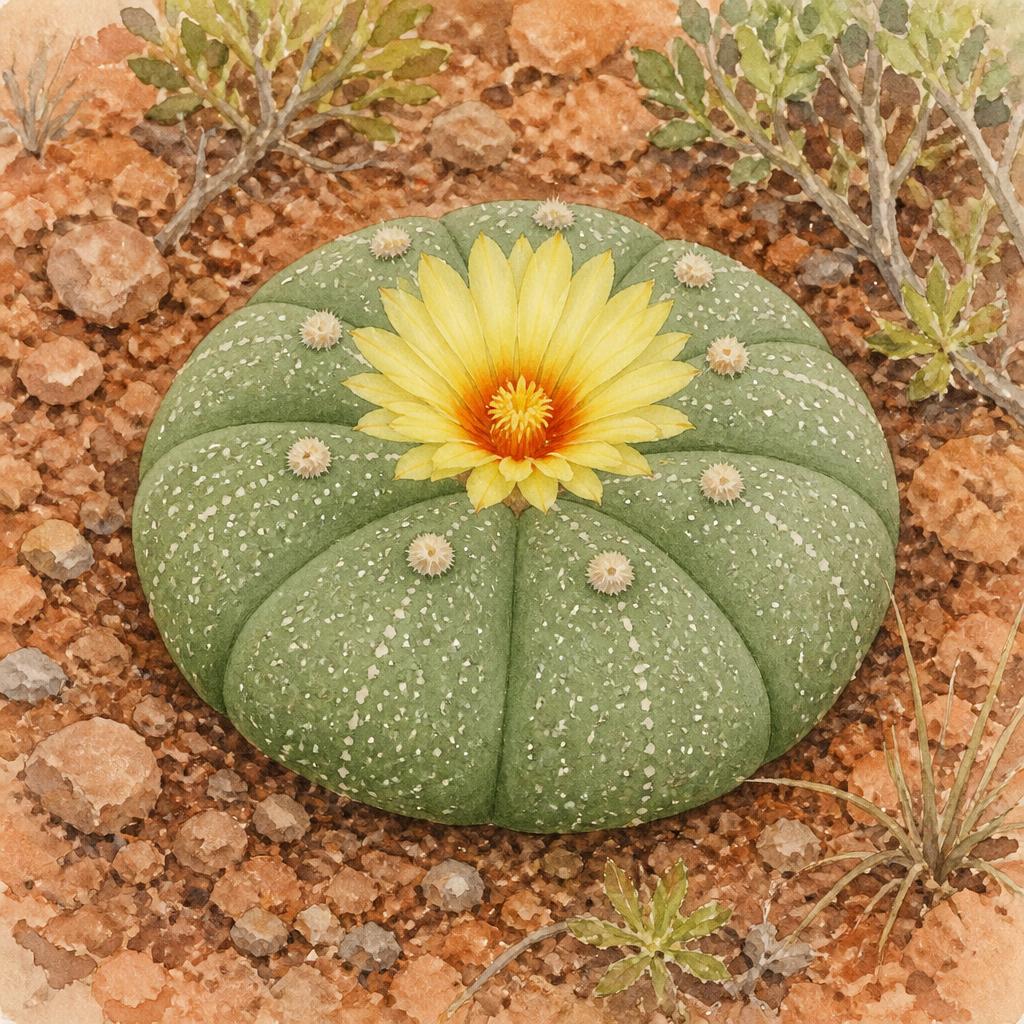
Illustrated Species Ambassador
Asteria — Star Cactus
I'm Asteria, an illustrated ambassador for the star cactus. I am only a couple of inches tall and sit flush with the ground, divided into eight segments.
- One fact worth knowing
- The star cactus is spineless and grows on open gravelly clay flats in south Texas thornscrub. It is now reduced to a few sites and is heavily targeted by illegal collectors.
- What I depend on
- I depend on open, sparsely vegetated gravelly soil, native pollinators, and the absence of collectors — for this species that is a genuine habitat requirement.
- My greatest threat
- My greatest threat is illegal collection, alongside the loss of Tamaulipan thornscrub.
- One way you can help
- Buy cacti only from nurseries that propagate from seed, never dig up a wild plant, and never post precise locations or geotagged photographs of rare plants.
This ambassador is an original illustration created for this project. It is an educational character, not a documentary image, and its statements follow the sourced record on this page. Artwork and rights record
Why this species matters
The star cactus is endangered largely because it is beautiful. Collection for the ornamental cactus trade, not habitat destruction alone, drives its decline — which is why researchers do not publish where it grows.
If it disappears: South Texas thornscrub would lose a globally rare endemic, and one of the clearest cases of a plant driven toward extinction by desirability.
Conservation status
- U.S. Endangered Species Act
- EndangeredListed 1993.Last verified 2026-09-08
- IUCN Red List
- VulnerableLast verified 2026-09-08
- CITES
- Appendix ILast verified 2026-09-08
- Texas
- State endangeredLast verified 2026-09-08
- Mexico
- Protected under NOM-059Last verified 2026-09-08
Population
In the United States the species is known from a small number of sites in Starr and Zapata counties, Texas, with a few thousand plants documented. Additional populations occur in Tamaulipas and Nuevo León, Mexico.
Trend: Decreasing
As reported: USFWS five-year review and IUCN assessment
Source: U.S. Fish and Wildlife Service; IUCN Red List; Texas Parks and Wildlife Department
Uncertainty: Precise site locations are deliberately withheld from public documents because publishing them would invite collection. Population figures should be treated as approximate for the same reason.
Historical: Believed to have been more widespread in south Texas thornscrub before agricultural conversion.
Fragmentation: A very small number of U.S. sites, mostly on private and conservation land.
Range and distribution
Historic range: South Texas and northeastern Mexico thornscrub and Tamaulipan grassland.
Current range: Starr and Zapata counties, Texas, and parts of Tamaulipas and Nuevo León, Mexico.
Range contraction: Lost from areas converted to cropland and development in the Rio Grande Valley.
Regions occupied
- Lower Rio Grande Valley, Texas
- Tamaulipas and Nuevo León, Mexico
Habitat
Primary habitat: Open gravelly clay flats in Tamaulipan thornscrub and native grassland, in sparse vegetation.
Breeding habitat: Produces yellow flowers with orange-red centers, usually after rainfall in spring.
Feeding habitat: Autotrophic, with CAM photosynthesis suited to arid conditions.
Critical habitat: No critical habitat designated.
Habitat dependencies
- Open, sparsely vegetated gravelly soils
- Native pollinators
- Absence of collectors — this is a genuine habitat requirement for this species
Biology and ecology
A component of Tamaulipan thornscrub flora and a nectar source for native insects.
Important adaptations: Spineless and low to the ground, contracting into the soil during drought until it is nearly invisible — camouflage that protects it from herbivores but not from a determined collector who knows what to look for.
- Size
- About 2 to 6 inches across and only 1 to 2 inches tall.
- Lifespan
- Long-lived perennial.
- Diet
- Autotrophic.
- Reproduction
- Insect-pollinated flowers producing seed capsules; seedlings establish in sheltered microsites.
- Offspring
- Modest seed production with low seedling survival.
- Breeding frequency
- Flowers in spring and after rain.
Primary threats
Illegal collection
Collectors dig up wild plants for the ornamental trade; a single visit to a known site can remove a substantial fraction of a population.
Habitat loss
Tamaulipan thornscrub has been extensively cleared for agriculture, ranching, and development in the Rio Grande Valley.
Overgrazing
Heavy grazing and trampling damage plants and their sparse habitat.
Root-plowing and brush clearing
Mechanical brush removal destroys plants and the soil structure they need.
Drought
Extended drought reduces flowering and seedling establishment.
Small population size
Few sites and few plants mean limited genetic diversity.
Border infrastructure
Construction and associated clearing in the Rio Grande Valley affect remaining habitat.
Conservation and recovery
Programs and efforts
- USFWS recovery program with site locations kept confidential
- Nursery propagation to supply the legal trade and reduce demand for wild plants
- Seed banking at botanical institutions
- Land acquisition and conservation easements in the Lower Rio Grande Valley
- CITES Appendix I enforcement against international trade
Protected areas
- Lower Rio Grande Valley National Wildlife Refuge units
- Private conservation properties in Starr and Zapata counties
Legal protections
- Endangered Species Act
- CITES Appendix I
- Texas state endangered listing
- Mexican NOM-059 protection
Measurable progress
- Commercial nursery propagation has made legally grown plants widely available, reducing pressure on wild populations
- Land acquisition has secured some occupied habitat
Continuing challenges
- Enforcement against collection is difficult
- Thornscrub habitat continues to be cleared
- The species is naturally rare and slow to recover
How people can help
What individuals can do
- Buy cacti only from reputable nurseries that propagate from seed, and ask about the source
- Never dig up a wild cactus, and never post precise location data or geotagged photographs of rare plants
- Support Lower Rio Grande Valley habitat conservation
What communities can do
- Support thornscrub restoration and land acquisition in the valley
- Encourage native landscaping using nursery-propagated species
Educational actions
- Use this cactus to teach why conservation scientists sometimes withhold location information
Habitat support
- Support Tamaulipan thornscrub restoration projects
Organizations and programs to learn about
- USFWS Texas Coastal Ecological Services
- Texas Parks and Wildlife Department
- Lower Rio Grande Valley National Wildlife Refuge
Educational notes
- Contracts into the soil during drought until it is nearly invisible.
- One of the species for which researchers deliberately withhold locality data.
- Nursery propagation is a genuine conservation tool when it removes demand for wild plants.