Pollinators
Rusty Patched Bumble Bee
Bombus affinis
The first bumble bee protected under the U.S. Endangered Species Act, gone from about 87 percent of its historic range in roughly two decades.
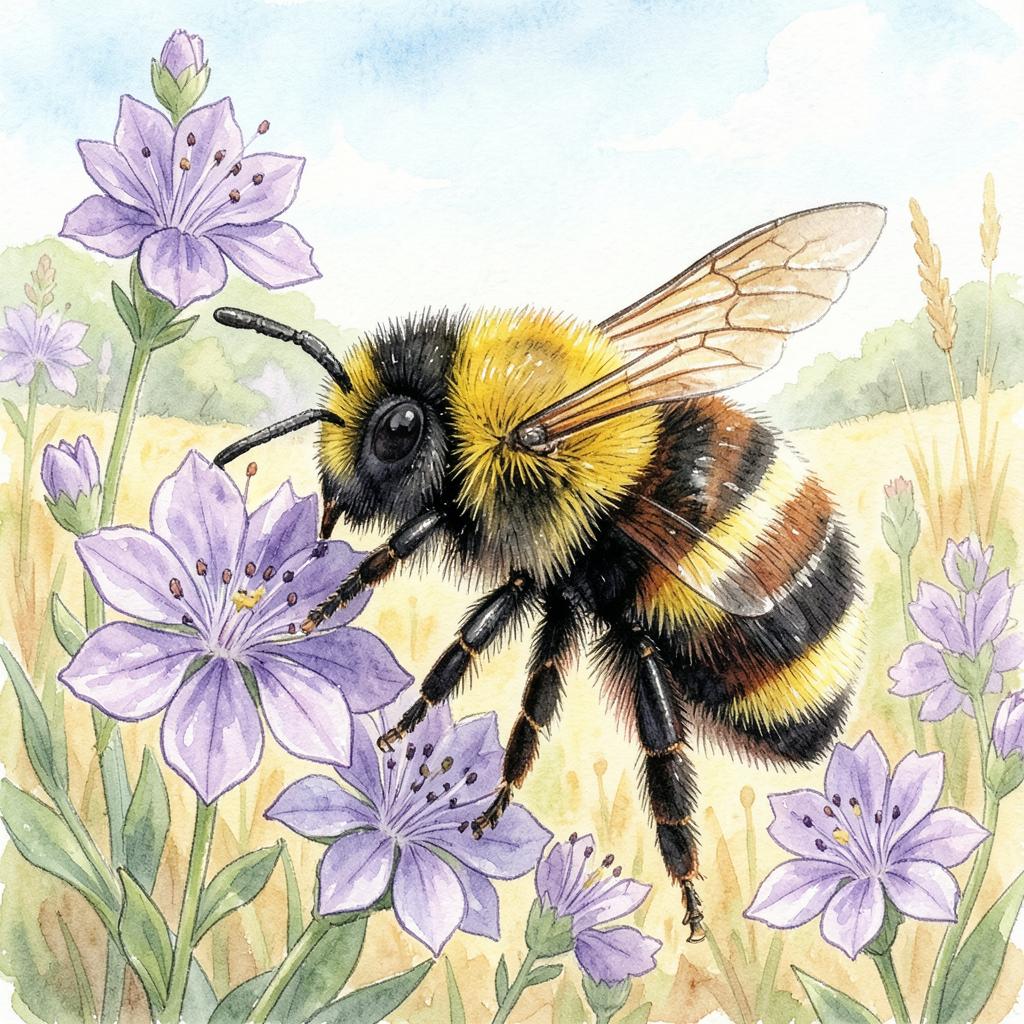
Illustrated Species Ambassador
Rusty — Rusty Patched Bumble Bee
I'm Rusty, an illustrated ambassador for the rusty patched bumble bee. I was common within living memory across the upper Midwest and Northeast.
- One fact worth knowing
- The rusty patched bumble bee was the first bumble bee protected under the U.S. Endangered Species Act, having disappeared from about 87 percent of its historic range in roughly two decades.
- What I depend on
- I depend on flowers blooming continuously from March through October, undisturbed soil and old rodent burrows to nest in, and leaf litter where queens overwinter.
- My greatest threat
- My greatest threats are disease spilling over from commercial bees, and pesticides.
- One way you can help
- Plant for bloom from early spring to late fall rather than midsummer only, leave leaf litter and some bare undisturbed ground, and ask retailers whether nursery plants were treated with neonicotinoids.
This ambassador is an original illustration created for this project. It is an educational character, not a documentary image, and its statements follow the sourced record on this page. Artwork and rights record
Why this species matters
This bee did not decline slowly at the margins; it collapsed from common to nearly absent within about twenty years, across an enormous area, largely unnoticed. It is the clearest warning that abundance today is no guarantee of abundance tomorrow.
If it disappears: Native plants and crops dependent on buzz pollination would lose an efficient pollinator, and one of the earliest-emerging and latest-flying bumble bees in the region would be gone.
Conservation status
- IUCN Red List
- Critically EndangeredLast verified 2026-09-08
- U.S. Endangered Species Act
- EndangeredListed in 2017 — the first bee of the continental United States to receive ESA protection.Last verified 2026-09-08
- Canada (COSEWIC / SARA)
- EndangeredLast verified 2026-09-08
Population
No total count exists. The species has been recorded in a small fraction of its historic range in recent years, with scattered occurrences across a handful of upper Midwest and northeastern states.
Trend: Decreasing
As reported: USFWS species status assessment and ongoing occurrence records
Source: U.S. Fish and Wildlife Service; IUCN Red List
Uncertainty: Bumble bee status is measured by occupied area and detection frequency rather than individual counts. Absence of records is not proof of absence.
Historical: Formerly common and widespread across 28 states and two Canadian provinces; declined sharply beginning in the late 1990s.
Fragmentation: Remaining occurrences are scattered and largely isolated from one another.
Range and distribution
Historic range: Eastern and upper midwestern United States and southern Ontario and Quebec.
Current range: Scattered records concentrated in Minnesota, Wisconsin, Illinois, Iowa, and parts of the Northeast and Appalachians.
Range contraction: Lost from roughly 87 percent of its historic range.
Regions occupied
- Upper Midwest
- Northeastern United States
- Appalachian region
Habitat
Primary habitat: Grasslands, prairies, woodland edges, wetlands, gardens, and urban parks with continuous flowering from spring through fall.
Breeding habitat: Nests underground, often in abandoned rodent burrows.
Feeding habitat: Forages on a wide variety of flowering plants; needs early spring blooms for emerging queens and late fall blooms for new queens.
Seasonal differences: Queens overwinter alone in shallow soil or leaf litter; the colony is annual.
Critical habitat: No critical habitat designated.
Habitat dependencies
- Flowering plants blooming continuously from March through October
- Undisturbed soil and rodent burrows for nesting
- Leaf litter and undisturbed ground for overwintering queens
Biology and ecology
A generalist pollinator of wild plants and crops including cranberry, plum, apple, alfalfa, and tomato.
Important adaptations: Buzz pollination — vibrating flight muscles to shake pollen loose — which honey bees cannot do and which tomatoes, blueberries, and cranberries depend on.
- Size
- Workers about half an inch; queens larger.
- Lifespan
- Workers a few weeks; queens roughly one year.
- Diet
- Nectar and pollen.
- Reproduction
- A single overwintered queen founds an annual colony each spring; new queens and males are produced in late summer.
- Offspring
- Colonies may reach several hundred workers at peak.
- Breeding frequency
- One colony cycle per year.
- Age at maturity
- Weeks from egg to adult worker.
Primary threats
Disease
The pathogen Nosema bombi, thought to have spread from commercially reared bumble bees used in greenhouses, is strongly associated with the timing and pattern of the decline.
Pesticides
Neonicotinoid insecticides impair foraging, navigation, and colony founding at sublethal doses.
Habitat loss
Prairie and grassland conversion removed the continuous season-long bloom colonies require.
Loss of nesting sites
Intensive tillage and manicured landscapes eliminate the rodent burrows and undisturbed soil the bees nest in.
Climate change
Shifts in bloom timing can leave emerging queens without early flowers.
Small population effects
Isolated remnant populations lose genetic diversity, producing sterile males and failed colonies.
Conservation and recovery
Programs and efforts
- USFWS recovery planning and high-potential zone mapping to focus habitat work
- Xerces Society Bumble Bee Atlas community science surveys across multiple states
- Pollinator habitat conservation on farms through USDA conservation programs
- Regulation and screening of commercially reared bumble bees for pathogens
Protected areas
- Upper Midwest prairie preserves and national wildlife refuges within high-potential zones
Legal protections
- Endangered Species Act
- Canadian Species at Risk Act
- Several state endangered listings
Measurable progress
- Community science surveys have located previously unknown populations
- ESA listing has driven habitat protection on public land
Continuing challenges
- The disease pathway is difficult to reverse
- Most habitat is privately owned
- Detection is hard, so declines can go unnoticed
How people can help
What individuals can do
- Plant flowers that bloom from early spring through late fall, not just midsummer
- Leave leaf litter and some bare, undisturbed ground for nesting and overwintering queens
- Stop using neonicotinoid products, including on nursery plants — ask retailers whether stock was treated
- Photograph and report bumble bees to the Bumble Bee Atlas or iNaturalist
What communities can do
- Adopt pesticide-free policies for parks and school grounds
- Establish native pollinator plantings in public spaces
Educational actions
- Join a Bumble Bee Atlas survey — this species was rediscovered in several states through volunteer records
Habitat support
- Restore prairie and grassland with diverse bloom timing
- Reduce mowing frequency on public land
Organizations and programs to learn about
- Xerces Society
- USFWS Midwest Region
- Bumble Bee Watch
Educational notes
- The first bumble bee listed under the U.S. Endangered Species Act.
- Buzz pollination is a real physical technique honey bees cannot perform.
- A species can go from common to nearly extinct in one human generation.
Sources and references
- IUCN Red List — Bombus affinis — IUCN
- U.S. Fish and Wildlife Service — Rusty Patched Bumble Bee — USFWS
- Xerces Society — Bumble Bee Atlas — Xerces Society