Pollinators
Rufous Hummingbird
Selasphorus rufus
A hummingbird weighing about as much as a nickel that migrates from Alaska to Mexico each year, and has lost a large share of its population since the 1970s.
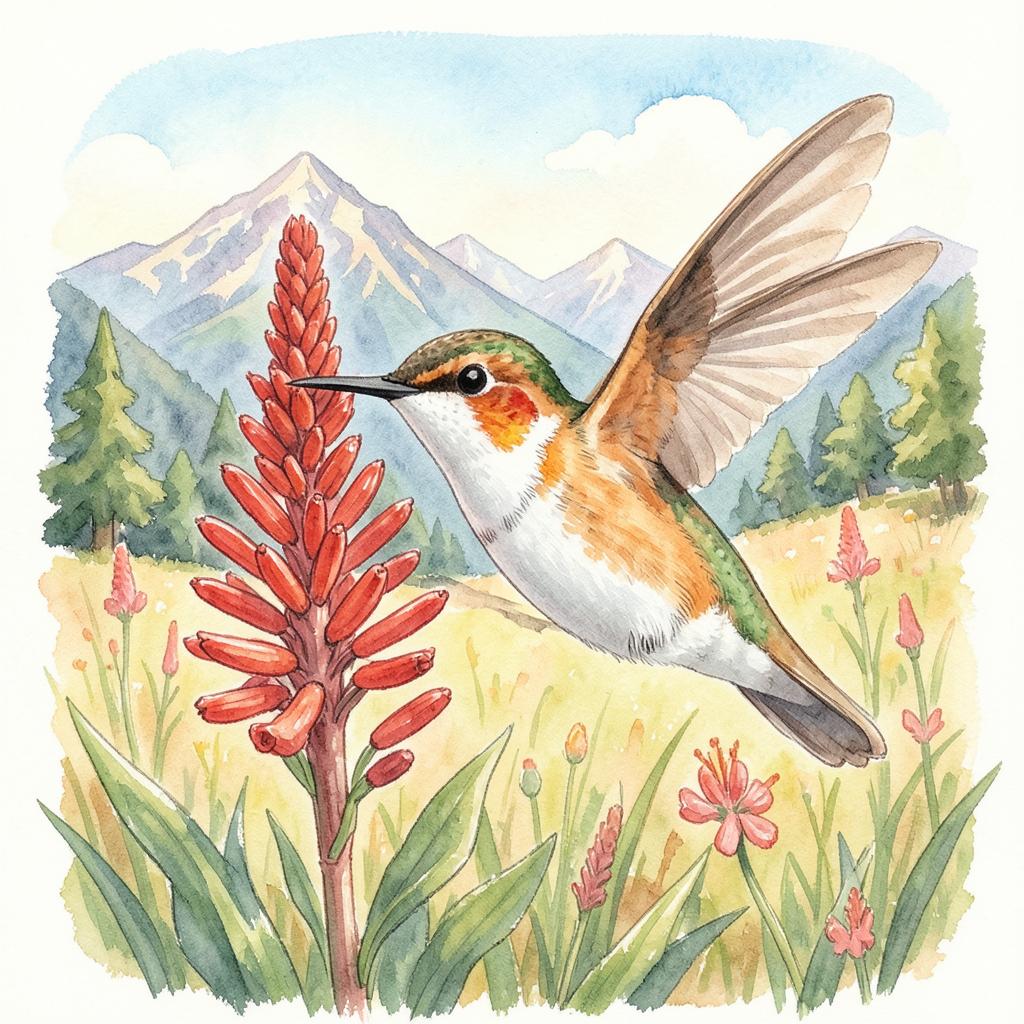
Illustrated Species Ambassador
Ember — Rufous Hummingbird
I'm Ember, an illustrated ambassador for the rufous hummingbird. I weigh about as much as a nickel and I migrate between Alaska and Mexico.
- One fact worth knowing
- The rufous hummingbird migrates roughly 4,000 miles between Alaska and Mexico each year and has lost a large share of its population since the 1970s.
- What I depend on
- I depend on a continuous chain of flowers blooming the length of that route, on mountain meadows flowering in late summer as I head south, and on highland forest in Mexico for winter.
- My greatest threat
- My greatest threat is habitat loss and shifts in bloom timing along the migration route.
- One way you can help
- Plant native tubular flowers rather than relying on feeders alone; if you do keep a feeder, use four parts water to one part sugar with no dye or honey, and clean it every few days in hot weather.
This ambassador is an original illustration created for this project. It is an educational character, not a documentary image, and its statements follow the sourced record on this page. Artwork and rights record
Why this species matters
A bird this small carries no fuel reserve to speak of. Its migration works only because flowers bloom in sequence along a 4,000-mile corridor. Every garden, meadow, and roadside along that route is part of a single connected system.
If it disappears: Plants adapted specifically to hummingbird pollination would lose their principal pollinator across large parts of western North America.
Conservation status
- IUCN Red List
- Near ThreatenedLast verified 2026-09-08
- Partners in Flight
- Included on the Yellow Watch List for steep long-term declineLast verified 2026-09-08
- U.S. Endangered Species Act
- Not listedLast verified 2026-09-08
Population
North American Breeding Bird Survey data indicate a long-term decline of roughly two percent per year since the 1970s, amounting to a loss of a large share of the population over that period.
Trend: Decreasing
As reported: North American Breeding Bird Survey trend analyses, 1970–present
Source: U.S. Geological Survey Breeding Bird Survey; Partners in Flight; IUCN Red List
Uncertainty: Survey coverage of the far northern breeding range is limited, so trend estimates carry more uncertainty than for well-surveyed southern species.
Historical: Historically abundant across western North America.
Range and distribution
Historic range: Breeds from southern Alaska through British Columbia to Oregon and Idaho; winters in Mexico.
Current range: The same range, with increasing winter records along the U.S. Gulf Coast and Southeast.
Migration: One of the longest migrations relative to body size of any bird — up to about 4,000 miles each way, north along the Pacific coast in spring and south through the Rocky Mountains in late summer.
Regions occupied
- Alaska and British Columbia (breeding)
- Pacific Northwest and Rockies (breeding and migration)
- Mexican highlands (wintering)
- Texas and the Gulf Coast (migration and increasing winter records)
Habitat
Primary habitat: Open forest, forest edges, meadows, brushy second growth, and gardens with abundant tubular flowers.
Breeding habitat: Nests in conifers and shrubs in northwestern forest and edge habitat.
Feeding habitat: Nectar from tubular flowers, plus small insects and spiders for protein.
Seasonal differences: Uses montane meadow wildflower blooms during southbound migration and oak-pine highlands in Mexico in winter.
Habitat dependencies
- A continuous chain of blooming flowers along a 4,000-mile route
- Montane meadow bloom timed to the late-summer southbound migration
- Wintering habitat in Mexican highland forest
Biology and ecology
A significant pollinator of tubular red and orange flowers across western North America, many of which are adapted specifically to hummingbird pollination.
Important adaptations: Enters torpor overnight, dropping body temperature and heart rate dramatically to survive cold nights on almost no energy reserve. Extremely aggressive for its size, defending flower patches against much larger birds.
- Size
- About 3 inches long.
- Weight
- Roughly 3 to 4 grams.
- Lifespan
- Typically 3 to 5 years; the record exceeds 8 years.
- Diet
- Flower nectar, tree sap, small insects, and spiders.
- Reproduction
- The female builds the nest, incubates, and raises young alone.
- Offspring
- Usually two eggs.
- Breeding frequency
- One or two broods per year.
- Age at maturity
- One year.
Primary threats
Habitat loss
Logging, development, and conversion reduce breeding, migration, and wintering habitat along the entire route.
Climate change
Warming shifts wildflower bloom earlier, potentially before migrating hummingbirds arrive — a mismatch documented in montane meadows.
Wildfire
Severe wildfire alters western forest and meadow habitat across large areas.
Pesticides
Insecticides reduce the small insects hummingbirds need for protein, especially when feeding young.
Loss of native flowering plants
Ornamental landscaping often provides little usable nectar and no insect prey.
Window collisions
Hummingbirds strike glass, particularly near feeders placed at unsafe distances from windows.
Wintering habitat loss
Highland forest conversion in Mexico reduces winter range.
Conservation and recovery
Programs and efforts
- Western Hummingbird Partnership coordinating habitat work across the flyway
- Hummingbird Monitoring Network banding stations tracking migration
- Partners in Flight population and habitat conservation planning
- Native plant corridor programs in western states
Protected areas
- National forests across the western breeding and migration range
- Protected highland forest in Mexico
Legal protections
- Migratory Bird Treaty Act
- Mexican wildlife protections in the wintering range
Measurable progress
- Community feeder and garden programs have created measurable nectar corridors in some western cities
- Banding networks have clarified migration routes and timing
Continuing challenges
- The species crosses many jurisdictions and habitat types
- Bloom-timing mismatch is difficult to mitigate directly
- Breeding range monitoring is sparse
How people can help
What individuals can do
- Plant native tubular flowers rather than relying only on feeders — native plants also supply the insects hummingbirds need
- If you keep feeders, use only a four-to-one water-to-sugar solution, never red dye or honey, and clean them every few days in hot weather
- Place feeders either within three feet of a window or more than thirty feet away to reduce collisions
- Leave feeders up into late fall — it does not prevent migration and helps late birds
What communities can do
- Establish native nectar corridors in parks and along greenways
- Reduce pesticide use that removes insect prey
Educational actions
- Report banded hummingbirds and participate in Hummingbirds at Home or eBird
Habitat support
- Support montane meadow and western forest habitat protection
Organizations and programs to learn about
- Western Hummingbird Partnership
- Hummingbird Monitoring Network
- Audubon
Educational notes
- Relative to body length, the rufous hummingbird's migration is among the longest of any bird on earth.
- Overnight torpor is a genuine physiological shutdown, not simply sleep.
- Feeders do not keep hummingbirds from migrating; day length drives migration.
Sources and references
- IUCN Red List — Selasphorus rufus — IUCN
- Cornell Lab of Ornithology — Rufous Hummingbird — Cornell Lab of Ornithology
- Partners in Flight Avian Conservation Assessment Database — Partners in Flight