Birds
Rufa Red Knot
Calidris canutus rufa
A shorebird flying up to 9,000 miles between the Arctic and Tierra del Fuego, dependent on horseshoe crab eggs to refuel.
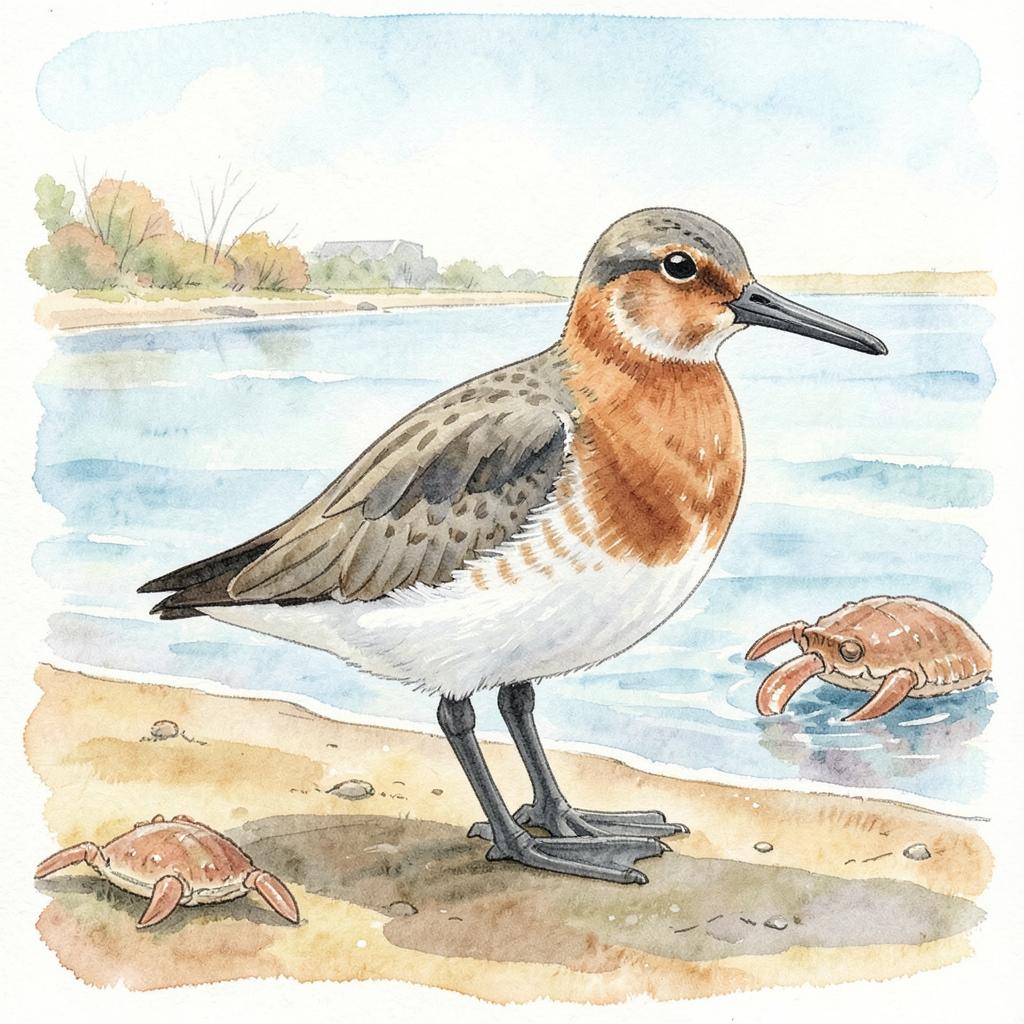
Illustrated Species Ambassador
Bayla — Rufa Red Knot
I'm Bayla, an illustrated ambassador for the rufa red knot. I fly as much as 9,000 miles between the Arctic and Tierra del Fuego, and I cannot do it without refuelling.
- One fact worth knowing
- Rufa red knots time their spring migration to arrive at Delaware Bay when horseshoe crabs spawn, and depend on those eggs to refuel for the rest of the journey.
- What I depend on
- I depend on abundant horseshoe crab spawning at Delaware Bay and on undisturbed tidal flats and beaches all along the flyway.
- My greatest threat
- My greatest threat is the loss of horseshoe crab eggs at migration stopovers.
- One way you can help
- Respect posted beach closures in spring and never flush a resting flock — every take-off burns fuel these birds need for thousands of miles.
This ambassador is an original illustration created for this project. It is an educational character, not a documentary image, and its statements follow the sourced record on this page. Artwork and rights record
Why this species matters
A red knot's survival depends on arriving at Delaware Bay in precisely the weeks horseshoe crabs are spawning. That single point of dependency shows how migration works: not as a journey between two places, but as a chain where every link must hold.
If it disappears: Its loss would break one of the hemisphere's most complete natural connections and signal failure at every stopover along an 9,000-mile chain.
Conservation status
- IUCN Red List
- Near ThreatenedSpecies-level assessment for Calidris canutus.Last verified 2026-09-08
- U.S. Endangered Species Act
- ThreatenedThe rufa subspecies was listed in 2014.Last verified 2026-09-08
- Canada (SARA)
- EndangeredLast verified 2026-09-08
Population
Roughly 40,000–50,000 rufa red knots, down from an estimated 100,000 or more in the 1980s; peak counts at Delaware Bay have fallen sharply from historic highs.
Trend: Decreasing
As reported: USFWS listing documentation and Delaware Bay stopover surveys, 2010s–2020s
Source: U.S. Fish and Wildlife Service; Western Hemisphere Shorebird Reserve Network partners
Uncertainty: Counts vary year to year with stopover timing and weather, so single-year peak counts are not reliable trend indicators.
Historical: Delaware Bay peak counts declined by roughly 75 percent from the early 1980s to the mid-2000s.
Range and distribution
Historic range: Arctic breeding grounds with wintering sites along the Atlantic coast to southern South America.
Current range: Same broad flyway, but with fewer birds and heavy reliance on a small number of stopover sites.
Migration: Up to roughly 9,000 miles each way, one of the longest migrations of any bird.
Range contraction: Wintering flocks in Tierra del Fuego have declined dramatically.
Regions occupied
- Canadian Arctic
- Delaware Bay
- Southeastern U.S. coast
- Texas Gulf Coast
- Brazil
- Argentina
- Tierra del Fuego, Chile
Habitat
Primary habitat: Coastal beaches, tidal flats, and peat banks.
Breeding habitat: Dry tundra ridges in the Canadian Arctic.
Feeding habitat: Horseshoe crab eggs at Delaware Bay in spring; clams, mussels, and small invertebrates elsewhere.
Seasonal differences: Uses Texas and southeastern beaches during migration and winter.
Critical habitat: Critical habitat has been proposed and designated in stages for U.S. wintering and stopover areas.
Habitat dependencies
- Abundant horseshoe crab spawning at Delaware Bay
- Undisturbed tidal flats along the flyway
Biology and ecology
A long-distance migrant that links Arctic, temperate, and South American ecosystems within a single annual cycle.
Important adaptations: Can nearly double body weight before departure and shrink its digestive organs in flight to save weight — an extreme physiological adaptation to long-distance travel.
- Size
- About 9–11 inches long.
- Weight
- Roughly 4–7 ounces, nearly doubling before long flights.
- Lifespan
- Commonly 7 years, with banded birds recorded well past 20.
- Diet
- Horseshoe crab eggs during spring migration; bivalves and marine invertebrates at other times.
- Reproduction
- Ground nest on Arctic tundra.
- Offspring
- Typically 4 eggs.
- Breeding frequency
- One brood a year.
- Age at maturity
- About 2 years.
Primary threats
Overharvest of a food source
Horseshoe crab harvest for bait and biomedical use reduced the egg supply red knots depend on at Delaware Bay.
Climate change
Warming shifts the timing of Arctic insect emergence and crab spawning out of sync with the birds' arrival.
Habitat loss
Coastal development and shoreline armoring remove roosting and feeding flats.
Human disturbance
Beach recreation flushes flocks repeatedly, costing energy they cannot spare.
Sea-level rise
Wintering and stopover flats are being lost to erosion and inundation.
Pollution
Oil spills and contaminants degrade key stopover sites.
Conservation and recovery
Programs and efforts
- USFWS rufa red knot recovery planning
- Delaware Bay horseshoe crab harvest management through the Atlantic States Marine Fisheries Commission
- Western Hemisphere Shorebird Reserve Network site protection
- International banding and resighting program tracking individual birds across continents
Protected areas
- Delaware Bay shoreline reserves
- Cape Romain National Wildlife Refuge
- Bahía Lomas, Chile
- Texas Gulf Coast refuges
Legal protections
- Endangered Species Act (threatened)
- Migratory Bird Treaty Act
- Canada's Species at Risk Act
Measurable progress
- Horseshoe crab harvest restrictions at Delaware Bay
- Coordinated hemispheric monitoring network
Continuing challenges
- Population has not recovered
- Climate-driven timing mismatch is difficult to manage
- Protection required in many countries at once
How people can help
What individuals can do
- Respect posted beach closures during spring migration
- Never disturb resting flocks; flushing birds costs fuel they need for thousands of miles
- Report color-banded knots to research programs
What communities can do
- Support horseshoe crab harvest limits and crab-friendly beach restoration
Educational actions
- Follow individual banded birds — some have documented life histories spanning decades
Habitat support
- Support living shorelines and tidal flat protection
Organizations and programs to learn about
- USFWS
- Western Hemisphere Shorebird Reserve Network
- Atlantic States Marine Fisheries Commission
Educational notes
- A single banded red knot known as B95, or 'Moonbird', flew a documented distance comparable to a trip to the moon and part of the way back.
- Demonstrates how a bird's fate can hinge on the harvest of an unrelated marine invertebrate.