Fish and Aquatic Life
Rio Grande Silvery Minnow
Hybognathus amarus
Once the most abundant fish in the Rio Grande, now restricted to a fraction of the river and dependent on hatchery releases and managed flows.
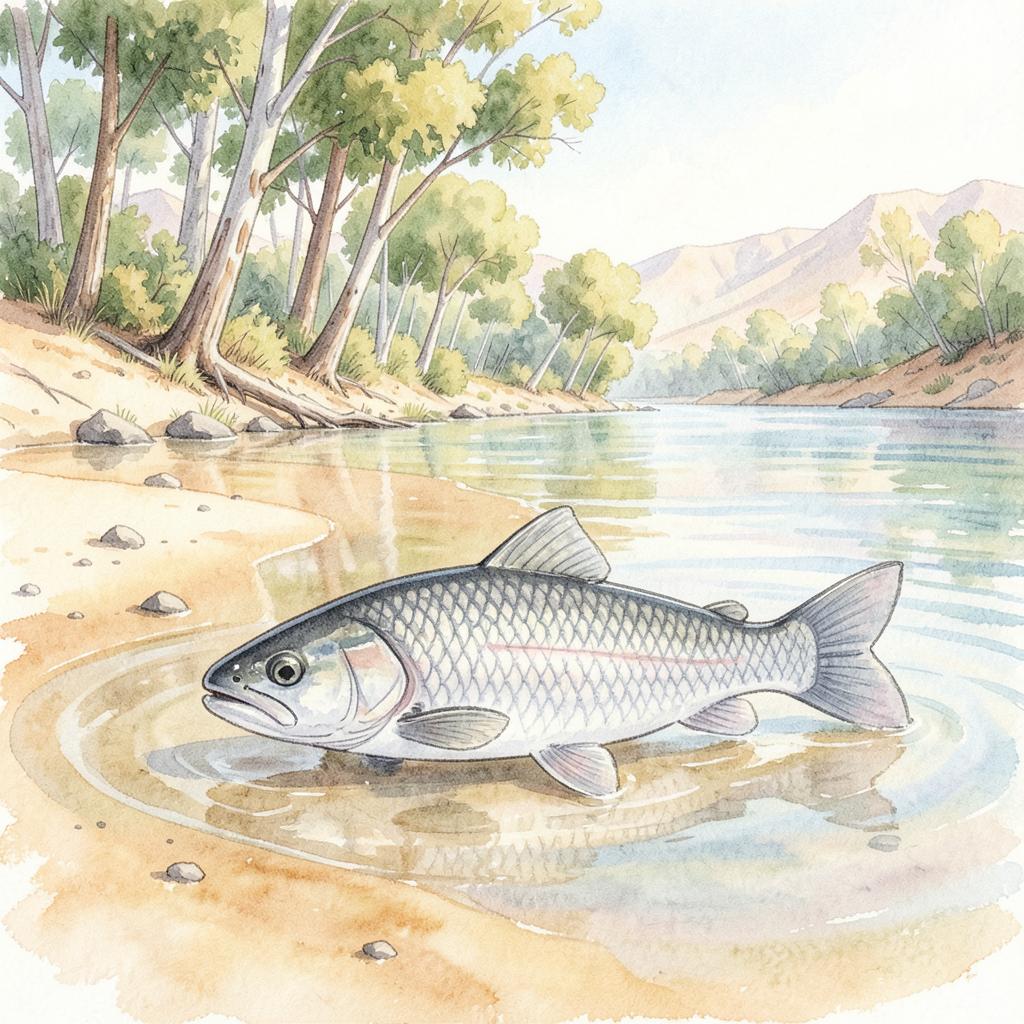
Illustrated Species Ambassador
Amara — Rio Grande Silvery Minnow
I'm Amara, an illustrated ambassador for the Rio Grande silvery minnow. I was once the most abundant fish in this river. Now I hold on in a fraction of it.
- One fact worth knowing
- The Rio Grande silvery minnow is restricted to a fraction of its former river and now depends on hatchery releases and managed flows.
- What I depend on
- I depend on spring runoff pulses to trigger spawning, continuously flowing water so drifting eggs are not stranded, and shallow low-velocity margins to grow up in.
- My greatest threat
- My greatest threat is river drying and the diversion of flow.
- One way you can help
- Conserve water if you live in the Rio Grande basin — the river's flow is literally this species' habitat — and support bosque restoration along the Middle Rio Grande.
This ambassador is an original illustration created for this project. It is an educational character, not a documentary image, and its statements follow the sourced record on this page. Artwork and rights record
Why this species matters
This minnow is small, plain, and easy to overlook, and it is the single best measure of whether the Rio Grande still functions as a river. When the river dries, the minnow disappears first.
If it disappears: Its extinction would signal that the Middle Rio Grande no longer sustains a native aquatic community, with consequences for the birds and larger fish that depend on it.
Conservation status
- IUCN Red List
- Critically EndangeredLast verified 2026-09-08
- U.S. Endangered Species Act
- EndangeredListed 1994, with designated critical habitat.Last verified 2026-09-08
- New Mexico
- State endangeredLast verified 2026-09-08
Population
Highly variable and closely tied to spring runoff. Monitoring catch rates in the Middle Rio Grande have collapsed to near zero in severe drought years and rebounded after wet springs; the population depends heavily on annual hatchery augmentation.
Trend: Decreasing
As reported: USFWS and Middle Rio Grande Endangered Species Collaborative Program monitoring, ongoing
Source: U.S. Fish and Wildlife Service; New Mexico Interstate Stream Commission
Uncertainty: Population is reported as catch-per-unit-effort in monitoring, not as a total count. Year-to-year swings are extreme.
Historical: Formerly one of the most abundant fish across the Rio Grande and Pecos systems in New Mexico, Texas, and Mexico.
Fragmentation: Restricted to roughly 5–7 percent of its historic range, in a stretch of the Middle Rio Grande divided by diversion dams.
Range and distribution
Historic range: Rio Grande from New Mexico through Texas to the Gulf of Mexico, and the Pecos River.
Current range: The Middle Rio Grande in New Mexico between Cochiti Dam and Elephant Butte Reservoir, plus reintroduced populations in Big Bend, Texas.
Range contraction: Lost from more than 90 percent of its historic range.
Regions occupied
- Middle Rio Grande, New Mexico
- Big Bend region, Texas (reintroduced)
Habitat
Primary habitat: Shallow, low-velocity river margins, backwaters, and side channels with silt and sand bottom.
Breeding habitat: Spawns in the water column during spring runoff; eggs drift downstream as they develop.
Feeding habitat: Grazes algae and detritus from the bottom.
Critical habitat: Critical habitat designated along the Middle Rio Grande.
Habitat dependencies
- Spring runoff pulses to trigger spawning
- Continuous flowing water so drifting eggs are not stranded
- Low-velocity nursery margins and overbank flooding
Biology and ecology
A primary consumer converting algae into food for larger river fish and birds.
Important adaptations: Drifting eggs are an adaptation to a naturally long, continuously flowing river — the very thing modern diversions eliminate.
- Size
- About 3.5 inches long.
- Weight
- A fraction of an ounce.
- Lifespan
- Typically 2–3 years, with most fish living only one spawning season.
- Diet
- Algae and organic detritus.
- Reproduction
- Broadcast pelagic spawner; eggs are semi-buoyant and drift with the current.
- Offspring
- Several thousand eggs per female.
- Breeding frequency
- Once a year with spring runoff.
- Age at maturity
- One year.
Primary threats
Altered streamflow
Irrigation diversion and reservoir operations dry long reaches of the river in summer, stranding fish.
Drought
Multi-year drought in the Rio Grande basin has reduced runoff and prolonged drying.
Dams and barriers
Diversion dams fragment the river and prevent fish from recolonizing upstream after drying events.
Channelization
Levees and channel confinement eliminated the low-velocity margins and overbank habitat larvae need.
Water quality
Warm, low-flow conditions reduce oxygen and concentrate contaminants.
Non-native species
Introduced fish compete with and prey on silvery minnows.
Loss of drift distance
Diversion structures capture drifting eggs and larvae before they reach nursery habitat.
Conservation and recovery
Programs and efforts
- Middle Rio Grande Endangered Species Collaborative Program
- Hatchery propagation and annual augmentation releases
- Fish rescue operations during river drying events
- Habitat restoration creating side channels and low-velocity refugia
- Reintroduction to Big Bend reaches in Texas
Protected areas
- Bosque del Apache National Wildlife Refuge reaches
- Rio Grande Nature Center State Park
- Big Bend National Park and Big Bend Ranch State Park
Legal protections
- Endangered Species Act
- Designated critical habitat
- State endangered listing
Measurable progress
- Hatchery propagation has prevented extinction
- Restored side channels have documented spawning and nursery use
Continuing challenges
- The species survives largely on annual augmentation
- Water is fully allocated among agriculture, cities, and interstate compacts
- Drought is intensifying
How people can help
What individuals can do
- Conserve water in Rio Grande basin communities — the river's flow is the species' habitat
- Support xeriscaping and irrigation efficiency
What communities can do
- Back environmental flow allocations and side-channel restoration projects
Educational actions
- Use the silvery minnow to teach that water policy is wildlife policy in the arid southwest
Habitat support
- Support bosque restoration and floodplain reconnection along the Middle Rio Grande
Organizations and programs to learn about
- USFWS New Mexico Ecological Services
- Middle Rio Grande Endangered Species Collaborative Program
- Albuquerque BioPark
Educational notes
- A plain little fish that sits at the center of one of the most contested water disputes in the United States.
- Illustrates why continuous flow, not just water volume, is what a river species needs.