Mammals
Red Wolf
Canis rufus
Declared extinct in the wild in 1980 and rebuilt from fourteen founder animals; the only wild population lives in eastern North Carolina.
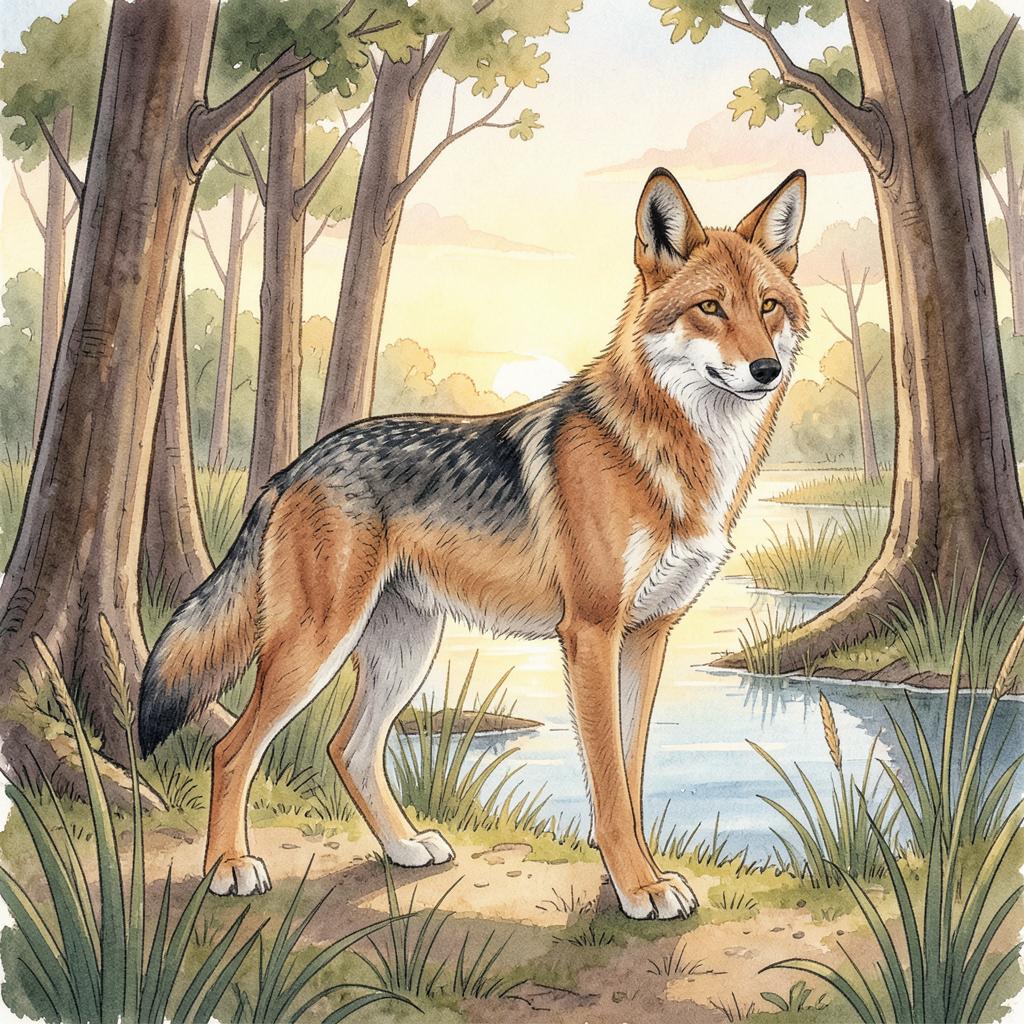
Illustrated Species Ambassador
Ellery — Red Wolf
I'm Ellery, an illustrated ambassador for the red wolf. I am the southeast's own wolf, smaller than a gray wolf and larger than a coyote.
- One fact worth knowing
- The red wolf was declared extinct in the wild in 1980 and rebuilt from fourteen founder animals; the only wild population lives in eastern North Carolina.
- What I depend on
- I depend on large blocks of low-conflict land — bottomland hardwood, pocosin wetland, coastal prairie and farmland mosaic — with enough deer and small mammals, and few coyotes.
- My greatest threat
- My greatest threats are human-caused deaths and hybridization with coyotes.
- One way you can help
- Learn to tell a red wolf from a coyote before hunting in or near the recovery area, drive carefully at night on the Albemarle Peninsula, and report any canid sightings to the Fish and Wildlife Service.
This ambassador is an original illustration created for this project. It is an educational character, not a documentary image, and its statements follow the sourced record on this page. Artwork and rights record
Why this species matters
The red wolf was declared extinct in the wild and brought back from a handful of surviving animals. It is a hard, honest picture of both what people can lose and what people can restore when they decide a species is worth the effort.
If it disappears: Losing the wild population would leave the southeast without its native canid, hand the niche entirely to coyotes, and end the only test of whether an extinct-in-the-wild carnivore can be genuinely restored to an American landscape.
Conservation status
- IUCN Red List
- Critically EndangeredLast verified 2026-09-08
- U.S. Endangered Species Act
- EndangeredListed in 1967; the North Carolina population is managed as a nonessential experimental population.Last verified 2026-09-08
- CITES
- Appendix ILast verified 2026-09-08
Population
Roughly 15–20 known wild individuals in the North Carolina recovery area, plus about 240–270 animals in the managed captive breeding population.
Trend: Decreasing
As reported: USFWS red wolf recovery program reporting, 2023–2024
Source: U.S. Fish and Wildlife Service Red Wolf Recovery Program
Uncertainty: Wild counts distinguish 'known' collared animals from an unknown number of uncollared wolves, so published figures vary between reports.
Historical: Historically distributed across the southeastern United States; declared extinct in the wild in 1980, with the entire species descending from 14 founders captured before that date.
Fragmentation: The single wild population occupies a five-county recovery area, with no second wild population to buffer losses.
Range and distribution
Historic range: Southeastern United States from central Texas and Oklahoma east to the Atlantic and north into the Ohio River valley.
Current range: One reintroduced wild population in the Albemarle Peninsula recovery area of eastern North Carolina.
Range contraction: The species now occupies a fraction of one percent of its historic range.
Regions occupied
- North Carolina (Albemarle Peninsula)
- Historic: southeastern U.S. including east Texas
Habitat
Primary habitat: Bottomland hardwood forest, coastal prairie, pocosin wetland, and agricultural mosaic.
Breeding habitat: Dens in hollow trees, stream banks, sandy knolls, and old canal berms.
Feeding habitat: Open fields and forest edges where white-tailed deer, raccoons, rabbits, and rodents are available.
Critical habitat: No designated critical habitat; the recovery area is managed under a special rule rather than a critical habitat designation.
Habitat dependencies
- Large blocks of low-conflict land
- Adequate deer and small-mammal prey
- Low coyote density
Biology and ecology
The southeast's native mid-sized canid predator, regulating deer, raccoon, and nutria numbers and suppressing coyotes where established.
Key relationships: Family packs of a breeding pair and offspring; competes and interbreeds with coyotes where pack structure breaks down.
Important adaptations: Tolerant of humid bottomland and marsh conditions that larger wolves avoid.
- Size
- About 4 to 5.5 feet long including tail; intermediate in size between a coyote and a gray wolf.
- Weight
- Approximately 45–80 pounds.
- Lifespan
- Roughly 6–8 years in the wild; up to about 15 in captivity.
- Diet
- White-tailed deer, raccoon, rabbit, nutria, and rodents.
- Reproduction
- Monogamous pairs breed once a year, typically February to March.
- Offspring
- Average litter of 3–6 pups.
- Breeding frequency
- One litter per year.
- Age at maturity
- About 22 months.
Primary threats
Human-caused mortality
Gunshot — much of it mistaken identity with coyotes — and vehicle strikes have been the leading recorded causes of death in the recovery area.
Hybridization
Breeding with coyotes introduces coyote genes into the wild population; management depends on sterilized 'placeholder' coyotes to hold territory.
Very small population size
So few wild breeders remain that a single bad year can erase multiple breeding pairs.
Limited genetic diversity
All living red wolves descend from 14 founders, constraining long-term adaptability.
Landowner conflict
Releases depend on private-land cooperation across a working agricultural landscape.
Conservation and recovery
Programs and efforts
- USFWS Red Wolf Recovery Program
- Red Wolf Species Survival Plan captive breeding network across roughly 50 facilities
- Pup fostering of captive-born pups into wild dens
- Sterilized coyote placeholder management
Protected areas
- Alligator River National Wildlife Refuge
- Pocosin Lakes National Wildlife Refuge
Legal protections
- Endangered Species Act listing
- CITES Appendix I
Measurable progress
- Rebuilt from 14 founders to a stable captive population
- Wild population reached roughly 120 animals in the mid-2000s
- Court-ordered resumption of releases restored breeding pairs after a pause in releases
Continuing challenges
- Wild numbers remain far below the mid-2000s peak
- No second wild population exists
- Coyote gene introgression requires continuous management
How people can help
What individuals can do
- Learn to tell red wolves from coyotes before hunting in or near the recovery area
- Drive carefully at night on roads through the Albemarle Peninsula
- Report sightings of collared or uncollared canids to USFWS
What communities can do
- Support landowner agreements that allow wolves safe passage on private land
- Back road-crossing and speed measures in the recovery area
Educational actions
- Visit a Species Survival Plan facility that houses red wolves
- Use the red wolf as a case study in extinction, restoration, and responsibility
Habitat support
- Support bottomland forest and pocosin wetland conservation in eastern North Carolina
Organizations and programs to learn about
- USFWS Red Wolf Recovery Program
- Association of Zoos and Aquariums Red Wolf SAFE program
Educational notes
- A direct discussion starter on stewardship, responsibility, and repair.
- Introduces hybridization as a conservation threat, not just habitat loss.