Urban Wildlife at Risk
Purple Martin
Progne subis
North America's largest swallow, whose eastern population nests almost entirely in housing provided by people.
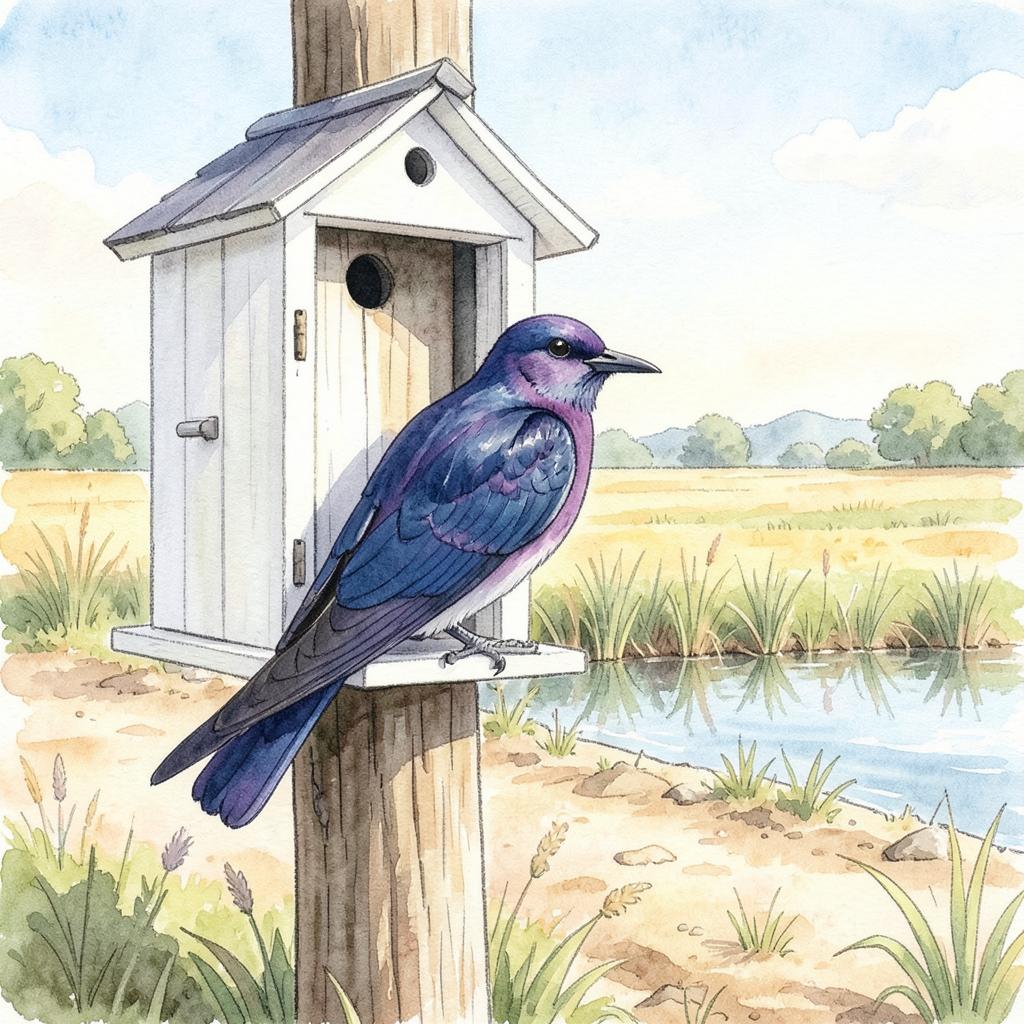
Illustrated Species Ambassador
Gable — Purple Martin
I'm Gable, an illustrated ambassador for the purple martin. In the eastern half of the continent, nearly all of us nest in housing provided by people.
- One fact worth knowing
- North America's largest swallow, the eastern purple martin population nests almost entirely in human-provided housing, which must be actively managed to work.
- What I depend on
- I depend on open flight space well away from tall trees and buildings, insect-rich air near water, and nest housing defended from starlings and house sparrows.
- My greatest threat
- My greatest threat is competition for nest sites from introduced starlings and house sparrows.
- One way you can help
- Put up martin housing only if you will manage it weekly — unmanaged housing helps starlings, not martins — use starling-resistant crescent entrances and pole predator guards, and report your nest data to Project MartinWatch.
This ambassador is an original illustration created for this project. It is an educational character, not a documentary image, and its statements follow the sourced record on this page. Artwork and rights record
Why this species matters
Eastern purple martins are effectively a species in partnership with people. If landlords stop maintaining and defending martin housing, the eastern population declines directly. Few birds make the link between individual action and population outcome so plain.
If it disappears: The eastern population would have no widely available natural nesting alternative, having largely abandoned natural cavities generations ago.
Cultural and regional note: The practice of hanging gourds for martins originated with southeastern Indigenous peoples and remains one of the oldest continuous wildlife-tending traditions in North America.
Conservation status
- IUCN Red List
- Least ConcernLast verified 2026-09-08
- Migratory Bird Treaty Act
- ProtectedLast verified 2026-09-08
- Partners in Flight
- Common Bird in Steep Decline in parts of the rangeLast verified 2026-09-08
Population
Breeding Bird Survey data show a long-term decline across much of North America, with regional variation. The eastern population is almost entirely dependent on human-supplied nest boxes and gourds.
Trend: Decreasing
As reported: North American Breeding Bird Survey trend analyses, 1970–present
Source: U.S. Geological Survey Breeding Bird Survey; Purple Martin Conservation Association
Uncertainty: Because eastern martins nest in monitored colonies, the eastern population is unusually well documented compared with most songbirds.
Historical: Indigenous peoples in the southeastern United States hung hollowed gourds for martins long before European settlement, a practice that shaped the species' nesting behavior over centuries.
Fragmentation: The eastern population is effectively dependent on managed housing; western populations still use natural cavities.
Range and distribution
Historic range: Across much of North America; winters in Brazil and neighboring countries.
Current range: Widespread but patchy, concentrated around managed colonies in the east.
Migration: Long-distance migrant to South America, with enormous premigratory roosts of tens of thousands of birds.
Regions occupied
- Eastern and central North America
- Scattered western populations
- Amazon basin, Brazil (wintering)
Habitat
Primary habitat: Open areas near water — farmland, parks, suburbs, and lakeshores — with unobstructed flight space.
Breeding habitat: Nests colonially in cavities: martin houses, hollowed gourds, and, in the west, natural woodpecker holes and saguaro cavities.
Feeding habitat: Catches flying insects on the wing, often high in the air.
Seasonal differences: Forms massive communal roosts before southbound migration, sometimes visible on weather radar.
Habitat dependencies
- Managed nest housing in the east, actively defended from starlings and house sparrows
- Open flight space with no nearby tall obstructions
- Abundant flying insects, especially during cold snaps
Biology and ecology
An aerial insectivore consuming large numbers of flying insects.
Important adaptations: An extraordinary behavioral shift: over centuries the eastern population moved almost entirely into human-supplied housing, making it one of the most human-dependent wild birds in North America.
- Size
- About 8 inches long.
- Weight
- Roughly 50 grams.
- Lifespan
- Up to about 13 years recorded.
- Diet
- Flying insects — dragonflies, beetles, flies, moths, and wasps.
- Reproduction
- Colonial cavity nester; pairs return to the same colony site in successive years.
- Offspring
- Typically 4 to 6 eggs.
- Breeding frequency
- One brood per year.
- Age at maturity
- One year.
Primary threats
Invasive species
European starlings and house sparrows take over martin cavities, destroy eggs, and kill adults. Unmanaged martin housing is usually taken over within a season or two.
Weather events
Extended cold or rainy spells ground flying insects and can starve entire colonies within days.
Insect decline
Declining flying insect abundance reduces food supply across the range.
Loss of housing landlords
The number of people actively maintaining martin colonies is declining as the tradition fades.
Pesticides
Insecticides reduce prey availability.
Habitat loss on wintering grounds
Amazon basin land conversion affects wintering habitat and roost sites.
Poor housing design
Improperly sized entrances, poor ventilation, and inadequate predator guards cause colony failure.
Conservation and recovery
Programs and efforts
- Purple Martin Conservation Association Project MartinWatch nest monitoring
- Starling-resistant entrance hole design and distribution
- Geolocator and tracking studies mapping migration and roost sites
- Community colony establishment programs at parks and nature centers
Protected areas
- Managed colonies at parks, refuges, and nature centers across the eastern United States
Legal protections
- Migratory Bird Treaty Act — note that starlings and house sparrows are not protected and may be legally controlled
Measurable progress
- Starling-resistant entrance designs have measurably improved colony success
- Volunteer nest monitoring provides a rich long-term dataset
Continuing challenges
- The species depends on continued human effort
- Cold snaps can wipe out colonies regardless of management
- Fewer people are taking up the tradition
How people can help
What individuals can do
- Put up martin housing only if you will actively manage it — unmanaged housing helps invasive starlings, not martins
- Use starling-resistant crescent entrance holes and install predator guards on the pole
- Place housing in open areas at least 40 feet from trees and buildings
- Monitor nests weekly and report data to Project MartinWatch
What communities can do
- Establish and maintain colonies at parks, schools, and nature centers
- Pass on colony management to new volunteers
Educational actions
- Use the gourd tradition to teach the long history of Indigenous wildlife stewardship in North America
Habitat support
- Maintain open, insect-rich landscapes near water
Organizations and programs to learn about
- Purple Martin Conservation Association
- Audubon
- Cornell Lab of Ornithology NestWatch
Educational notes
- Eastern purple martins nest almost exclusively in human-provided housing.
- The tradition of hanging gourds for martins predates European settlement.
- Premigratory roosts are large enough to appear on weather radar.
Sources and references
- IUCN Red List — Progne subis — IUCN
- Purple Martin Conservation Association — PMCA
- Cornell Lab of Ornithology — Purple Martin — Cornell Lab of Ornithology