Birds
Piping Plover
Charadrius melodus
A small sand-colored shorebird that nests on open beaches and river sandbars and winters heavily on the Texas coast.
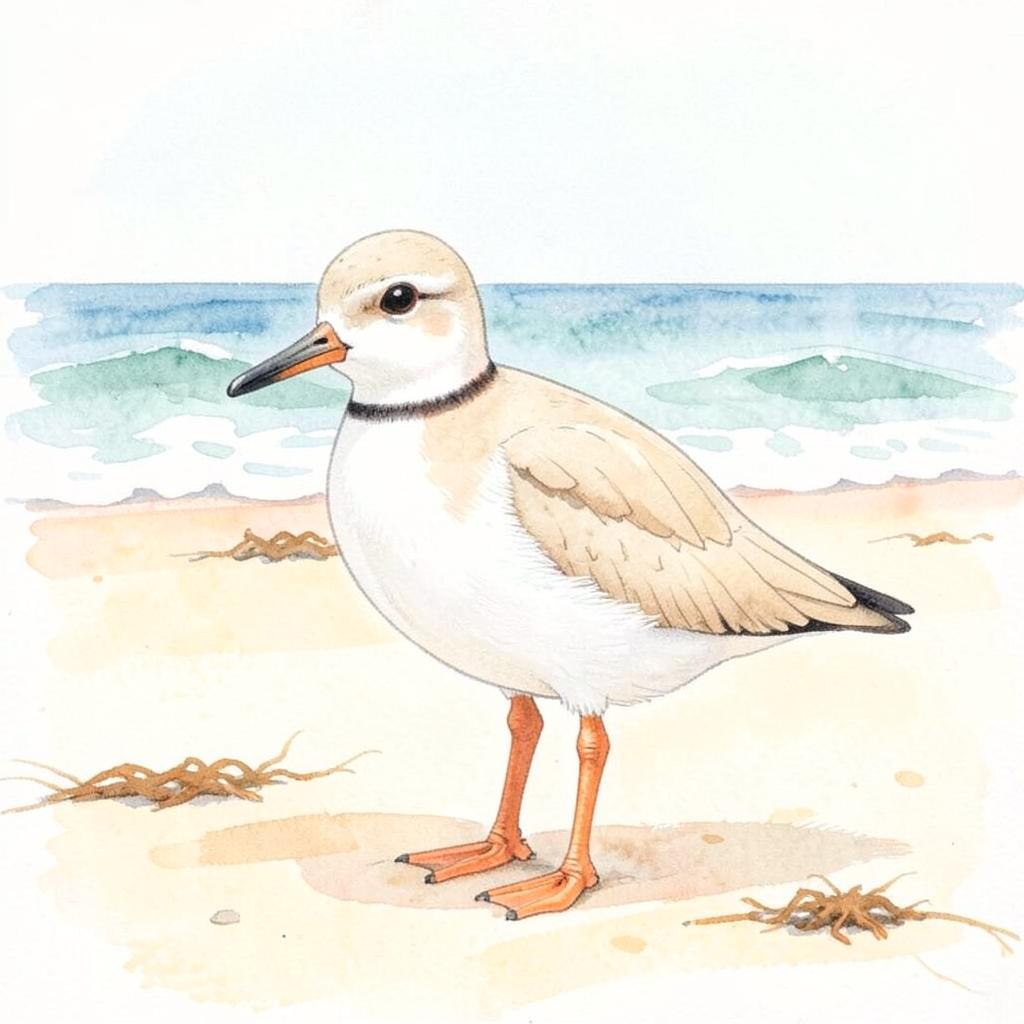
Illustrated Species Ambassador
Pebble — Piping Plover
I'm Pebble, an illustrated ambassador for the piping plover. My eggs sit in a shallow scrape in open sand, and they look almost exactly like the sand.
- One fact worth knowing
- Piping plovers nest on open beaches, river sandbars and alkali flats, and a large share of the population winters on the Texas coast.
- What I depend on
- I depend on open unvegetated sand, undisturbed wrack lines to feed along, and natural river flooding that rebuilds sandbars.
- My greatest threat
- My greatest threat is beach disturbance and the loss of open nesting habitat.
- One way you can help
- Respect roped-off beach areas, keep dogs leashed in spring and summer, and leave the beach wrack where it is — that seaweed line is a plover's feeding ground, not litter.
This ambassador is an original illustration created for this project. It is an educational character, not a documentary image, and its statements follow the sourced record on this page. Artwork and rights record
Why this species matters
The piping plover spends most of its year on the Gulf Coast, which makes Texas beaches critical to a bird that nests thousands of miles away. It also demonstrates how simple measures — rope, signs, and a few weeks of care — can protect a species.
If it disappears: Its decline would signal the loss of naturally functioning beach and sandbar systems, which support many other shorebirds and coastal invertebrates.
Conservation status
- IUCN Red List
- Near ThreatenedLast verified 2026-09-08
- U.S. Endangered Species Act
- Endangered (Great Lakes population); Threatened (Atlantic coast and Northern Great Plains populations)Listed 1985 with different statuses by population segment.Last verified 2026-09-08
- Canada (SARA)
- EndangeredLast verified 2026-09-08
- Texas
- Threatened (state listed)Last verified 2026-09-08
Population
Roughly 8,000–9,000 birds range-wide across all breeding populations, with the Great Lakes population numbering only about 80 breeding pairs.
Trend: Stable
As reported: International Piping Plover Census and USFWS population reporting, 2021–2024
Source: U.S. Fish and Wildlife Service; International Piping Plover Census
Uncertainty: An international census is conducted roughly every five years; between censuses, breeding-pair counts are the more reliable figure.
Fragmentation: Three distinct breeding populations with limited exchange; the Great Lakes population is very small.
Range and distribution
Historic range: Atlantic beaches from Newfoundland to the Carolinas, Great Lakes shorelines, and Great Plains rivers and alkali wetlands.
Current range: Same three regions, but Great Lakes nesting is reduced to a small number of sites.
Migration: Winters on Gulf and Atlantic beaches and tidal flats; Texas hosts a large share of the wintering population.
Range contraction: Great Lakes nesting collapsed to a handful of beaches before recent recovery efforts.
Regions occupied
- Atlantic coast
- Great Lakes
- Northern Great Plains
- Gulf Coast and Texas (wintering)
- Bahamas and Caribbean (wintering)
Habitat
Primary habitat: Open sandy beaches, river sandbars, alkali flats, and dredge-spoil islands.
Breeding habitat: Nests in a simple scrape on open sand or gravel above the tide line.
Feeding habitat: Forages for invertebrates on wet sand, mudflats, and wrack lines.
Seasonal differences: Uses Gulf Coast tidal flats and beaches for roughly two-thirds of the year.
Critical habitat: Extensive critical habitat designated on both breeding and wintering grounds, including Texas coastal units.
Habitat dependencies
- Open, unvegetated sand
- Undisturbed wrack lines for feeding
- Natural river flooding that rebuilds sandbars
Biology and ecology
A beach-nesting shorebird whose success measures whether coastal and riverine sand habitats are functioning naturally.
Important adaptations: Sand-matched plumage and a broken-wing distraction display to lead predators away from nests.
- Size
- About 7 inches long.
- Weight
- Roughly 1.5–2.2 ounces.
- Lifespan
- Around 5 years, with some birds living considerably longer.
- Diet
- Marine worms, insects, crustaceans, and other small invertebrates.
- Reproduction
- Ground scrape lined with pebbles and shell fragments.
- Offspring
- Typically 4 eggs.
- Breeding frequency
- One brood a year, with re-nesting after failure.
- Age at maturity
- One year.
Primary threats
Human disturbance
Beach recreation, vehicles, and unleashed dogs cause nest abandonment and crush eggs and chicks.
Habitat loss
Beach development, shoreline armoring, and vegetation growth eliminate open nesting sand.
Altered streamflow
Dams and river management prevent flooding that creates plains nesting sandbars.
Predation
Gulls, crows, foxes, and raccoons concentrated near development take eggs and chicks.
Storms and sea-level rise
Increasing storm frequency floods nests and erodes wintering flats.
Pollution
Oil spills and beach debris degrade Gulf Coast wintering habitat.
Conservation and recovery
Programs and efforts
- USFWS piping plover recovery programs for all three population segments
- Beach nest exclosures, symbolic fencing, and seasonal beach closures
- International Piping Plover Census
- Great Lakes captive rearing of abandoned eggs
Protected areas
- Designated critical habitat on Atlantic, Great Lakes, and Gulf shorelines
- Padre Island National Seashore
- Sleeping Bear Dunes National Lakeshore
Legal protections
- Endangered Species Act
- Migratory Bird Treaty Act
- Canada's Species at Risk Act
Measurable progress
- Great Lakes population grew from about 13 pairs in the 1980s to roughly 80 pairs
- Atlantic coast numbers have increased substantially under beach management
Continuing challenges
- Beach recreation pressure
- Sea-level rise on wintering habitat
- River management on the Missouri and Platte
How people can help
What individuals can do
- Respect roped-off beach areas and posted nesting closures
- Keep dogs leashed on beaches during spring and summer
- Do not drive on beaches where plovers nest or feed, and remove trash that attracts predators
What communities can do
- Support seasonal beach management and volunteer nest monitoring programs
Educational actions
- Join a beach steward program during nesting season
Habitat support
- Leave beach wrack in place — it is the plover's feeding ground, not litter
Organizations and programs to learn about
- USFWS coastal refuges
- Audubon coastal bird stewardship programs
- Texas Parks and Wildlife Department
Educational notes
- Beach wrack that looks like debris is actually essential shorebird feeding habitat.
- Illustrates how a bird can be protected differently in different parts of one country.