Reptiles and Amphibians
Panamanian Golden Frog
Atelopus zeteki
Panama's national symbol, possibly extinct in the wild since the late 2000s and surviving in a network of captive assurance colonies.
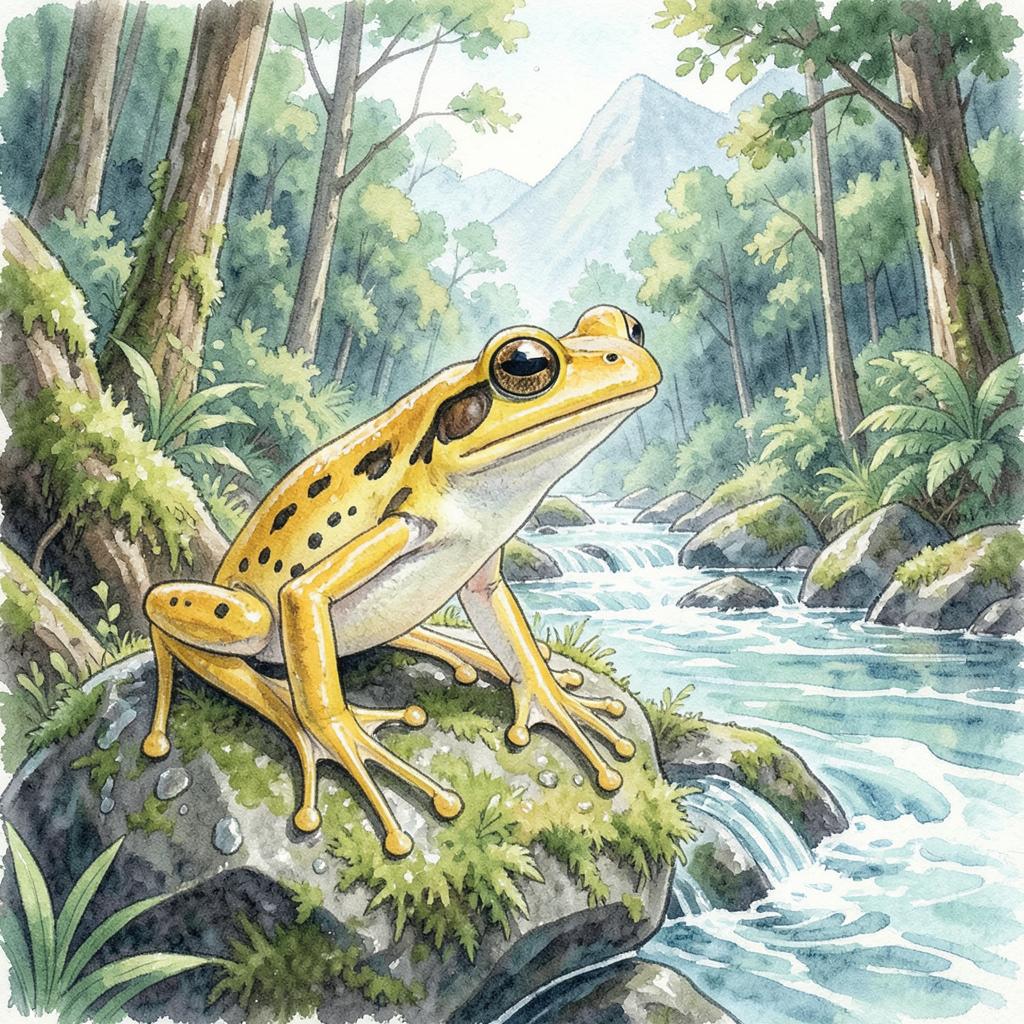
Illustrated Species Ambassador
Zeta — Panamanian Golden Frog
I'm Zeta, an illustrated ambassador for the Panamanian golden frog. I am Panama's national symbol, and I may no longer exist in the wild at all.
- One fact worth knowing
- The Panamanian golden frog is possibly extinct in the wild since the late 2000s and survives in a network of captive assurance colonies.
- What I depend on
- I depend on clean, cool, fast-flowing montane cloud forest streams — and on the absence of the amphibian chytrid fungus.
- My greatest threat
- My greatest threat is chytrid fungus disease.
- One way you can help
- Never buy wild-caught amphibians — the pet trade helped spread chytrid worldwide — and clean and disinfect boots and gear between streams and countries.
This ambassador is an original illustration created for this project. It is an educational character, not a documentary image, and its statements follow the sourced record on this page. Artwork and rights record
Why this species matters
This frog is the clearest example of what an emerging wildlife disease can do. It vanished from healthy, protected, undisturbed forest — habitat protection alone could not save it.
If it disappears: Complete extinction would remove a national symbol, an important stream predator, and the strongest existing test case for whether captive assurance colonies can eventually return a species to the wild.
Cultural and regional note: The golden frog appears in Panamanian folklore and on lottery tickets, and Panama observes a National Golden Frog Day on August 14.
Conservation status
- IUCN Red List
- Critically Endangered (Possibly Extinct in the Wild)Last verified 2026-09-08
- CITES
- Appendix ILast verified 2026-09-08
- Panama
- Nationally protected; declared a national symbolLast verified 2026-09-08
Population
No confirmed wild population. The last widely accepted wild sightings date to around 2007–2009. Roughly 1,500 frogs are maintained across a managed captive network in Panama and the United States.
Trend: Unknown
As reported: IUCN Red List assessment; Panama Amphibian Rescue and Conservation Project reporting, 2020s
Source: IUCN Red List; Panama Amphibian Rescue and Conservation Project; Smithsonian
Uncertainty: Occasional unverified reports of surviving wild frogs circulate. Until confirmed by researchers, the wild status remains 'possibly extinct in the wild'.
Historical: Formerly abundant along streams in the Panamanian highlands, easily observed by visitors.
Range and distribution
Historic range: Cloud forest and streamside habitat in the Cordillera Central of west-central Panama.
Current range: No confirmed wild sites; the species exists in captive assurance colonies.
Range contraction: A complete collapse across the entire known range within roughly a decade.
Regions occupied
- Coclé and Panamá Oeste provinces, Panama
Habitat
Primary habitat: Fast-flowing streams in montane cloud forest and adjacent rainforest.
Breeding habitat: Eggs laid in strings in shallow stream margins; tadpoles cling to rocks in current.
Feeding habitat: Small invertebrates taken from the forest floor and stream edges.
Habitat dependencies
- Clean, cool montane streams
- Absence of the amphibian chytrid fungus
Biology and ecology
Stream-edge insect predator and prey; part of the amphibian assemblage that transfers energy between water and forest.
Important adaptations: Communicates by semaphore — waving a front foot — because its calls are inaudible over rushing stream noise. Its bright yellow skin advertises potent toxins.
- Size
- About 1.5–2.5 inches; females are noticeably larger than males.
- Weight
- A fraction of an ounce.
- Lifespan
- Up to about 12 years in captivity.
- Diet
- Small insects and other invertebrates.
- Reproduction
- Males call and hold females in amplexus for extended periods before egg laying in streams.
- Offspring
- Strings of several hundred eggs.
- Breeding frequency
- Seasonal, tied to rainfall.
- Age at maturity
- About 1–2 years.
Primary threats
Disease
Chytridiomycosis, caused by the fungus Batrachochytrium dendrobatidis, swept through Panama's highlands in the 2000s and eliminated this and many other amphibian species.
Habitat loss
Deforestation and stream degradation reduced habitat before the disease arrived.
Illegal collection
Collection for the pet trade removed frogs from accessible streams.
Climate change
Shifting temperature and moisture patterns in cloud forest can favor chytrid transmission.
Water pollution
Agricultural runoff degrades the montane streams needed for reintroduction.
Conservation and recovery
Programs and efforts
- Panama Amphibian Rescue and Conservation Project captive assurance colonies
- Smithsonian Tropical Research Institute and Smithsonian's National Zoo breeding programs
- Research into probiotic skin bacteria and other chytrid mitigation strategies
- Project Golden Frog binational conservation and education partnership
Protected areas
- El Valle de Antón region protected forest
- Panamanian national parks in the Cordillera Central
Legal protections
- CITES Appendix I
- Panamanian national protection
Measurable progress
- Captive breeding is reliable, and the assurance population is genetically managed
- Substantial research progress on chytrid mitigation
Continuing challenges
- Chytrid fungus remains present in the wild habitat, so reintroduction is not yet safe
- Captive populations require indefinite funding and biosecurity
How people can help
What individuals can do
- Never buy wild-caught amphibians; the pet trade helped spread chytrid globally
- Clean and disinfect boots and gear between visits to different streams and countries
What communities can do
- Support amphibian biosecurity protocols in field research and the pet trade
Educational actions
- Observe National Golden Frog Day and use it to teach about wildlife disease
Habitat support
- Support Panamanian cloud forest and stream protection so reintroduction habitat remains available
Organizations and programs to learn about
- Panama Amphibian Rescue and Conservation Project
- Smithsonian Tropical Research Institute
- Amphibian Ark
Educational notes
- Waves its hand to communicate over the noise of rushing streams — an unusual and memorable behavior.
- The definitive case study for disease as a primary extinction driver.
Sources and references
- IUCN Red List — Atelopus zeteki — IUCN
- Panama Amphibian Rescue and Conservation Project — Smithsonian Tropical Research Institute and partners
- CITES Appendices — CITES