Mammals
Ocelot
Leopardus pardalis
Secure across Latin America but nearly gone from the United States, where a few dozen cats survive in south Texas thornscrub.
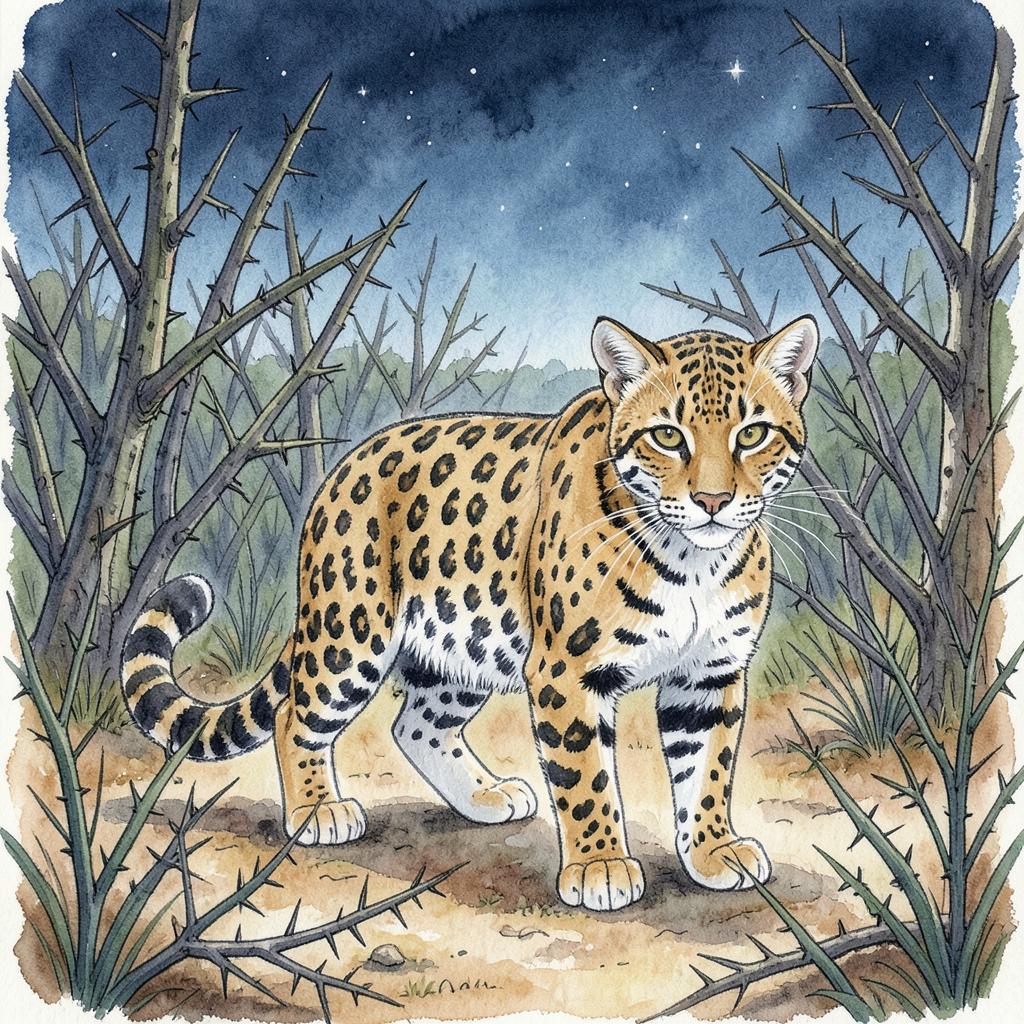
Illustrated Species Ambassador
Sombra — Ocelot
I'm Sombra, an illustrated ambassador for the ocelot. I hunt at night through dense thornscrub, and I will not cross open ground if I can avoid it.
- One fact worth knowing
- Ocelots remain widespread across Latin America, but in the United States only a few dozen survive, in the dense thornscrub of south Texas.
- What I depend on
- I depend on brush with canopy cover above roughly 75 percent, and on connected corridors between the brush patches that are left.
- My greatest threat
- My greatest threats are thornscrub loss and being killed on roads.
- One way you can help
- Drive slowly on south Texas highways at dawn, dusk and night, leave native brush standing on rural property, and report ocelot sightings and roadkill to Texas Parks and Wildlife.
This ambassador is an original illustration created for this project. It is an educational character, not a documentary image, and its statements follow the sourced record on this page. Artwork and rights record
Why this species matters
The ocelot is a reminder that a species can be secure across its wider range and still be nearly gone from a particular place. Keeping it in Texas means keeping brushland connected — the same connected cover that carries countless smaller species with it.
If it disappears: Losing the Texas ocelot would remove the last U.S. population of a native wild cat and confirm that the Lower Rio Grande Valley's remaining thornscrub is too fragmented to hold a wide-ranging predator.
Conservation status
- IUCN Red List
- Least ConcernRange-wide assessment; the U.S. population is a small, isolated fragment at the northern edge.Last verified 2026-09-08
- U.S. Endangered Species Act
- EndangeredListed 1982.Last verified 2026-09-08
- Texas
- Endangered (state listed)Last verified 2026-09-08
- CITES
- Appendix ILast verified 2026-09-08
Population
Fewer than 100 ocelots are believed to remain in the United States, distributed between two small breeding groups in Willacy and Cameron counties, Texas. Range-wide numbers across Latin America are large but not precisely counted.
Trend: Decreasing
As reported: USFWS and Texas ocelot conservation reporting, 2021–2024
Source: U.S. Fish and Wildlife Service; Texas Parks and Wildlife Department
Uncertainty: U.S. estimates are commonly given as 50–80 animals; different sources round differently and none claim a precise census.
Fragmentation: The two U.S. groups are separated by roads and cleared farmland and have limited genetic exchange with Mexican populations.
Range and distribution
Historic range: From Arkansas, Louisiana, and Arizona through Texas, Mexico, Central America, and South America to northern Argentina.
Current range: Widespread in Latin America; in the United States restricted to remnant thornscrub in far south Texas.
Range contraction: The U.S. range has contracted to a handful of brush patches from a historic range spanning several states.
Regions occupied
- South Texas
- Mexico
- Central America
- South America to northern Argentina
Habitat
Primary habitat: Dense thornscrub and closed-canopy brushland with heavy understory cover.
Breeding habitat: Dens in the densest available brush thickets and thorn tangles.
Feeding habitat: Hunts small mammals, birds, and reptiles under continuous canopy cover.
Critical habitat: No critical habitat designated in the United States.
Habitat dependencies
- Brush canopy cover above roughly 75 percent
- Connected corridors between brush patches
Biology and ecology
Mid-sized nocturnal predator regulating rodent and small-mammal populations in dense brush.
Important adaptations: Excellent night vision and a coat pattern suited to broken light under thick canopy.
- Size
- About 26–39 inches head and body, plus a 10–18 inch tail.
- Weight
- Approximately 15–35 pounds.
- Lifespan
- Around 7–10 years in the wild.
- Diet
- Rodents, rabbits, birds, lizards, snakes, and occasional fish.
- Reproduction
- Breeds year-round in the tropics; south Texas births cluster in fall and winter.
- Offspring
- Usually one kitten, occasionally two.
- Breeding frequency
- Roughly every one to two years.
- Age at maturity
- About 18–24 months.
Primary threats
Habitat loss
More than 90 percent of the Lower Rio Grande Valley's native thornscrub has been cleared for agriculture and development.
Road mortality
Vehicle strikes are the single largest documented cause of ocelot death in Texas.
Fragmentation
Cleared land between brush patches isolates the two remaining breeding groups.
Reduced genetic diversity
Isolation from Mexican populations limits gene flow into the U.S. cats.
Human-wildlife conflict
Free-roaming dogs and incidental trapping add losses a tiny population cannot absorb.
Conservation and recovery
Programs and efforts
- USFWS Ocelot Recovery Plan
- Texas Parks and Wildlife Department ocelot conservation and landowner incentive work
- Caesar Kleberg Wildlife Research Institute ocelot research and genetic rescue planning
- Wildlife crossing construction on state highways in Cameron County
Protected areas
- Laguna Atascosa National Wildlife Refuge
- Lower Rio Grande Valley National Wildlife Refuge
- Private ranchland under conservation easement in Willacy County
Legal protections
- Endangered Species Act listing
- Texas state endangered listing
- CITES Appendix I
Measurable progress
- Multiple wildlife underpasses built and documented in use by ocelots
- Substantial private ranch acreage placed under thornscrub conservation agreements
Continuing challenges
- Continued valley development
- Slow regrowth of thornscrub
- Need for genetic exchange with Mexico
How people can help
What individuals can do
- Drive slowly at dawn, dusk, and night on south Texas highways
- Leave native brush intact on rural property rather than clearing it
- Report ocelot sightings and roadkill to TPWD
What communities can do
- Back wildlife crossings and underpasses on roads through occupied habitat
- Support conservation easements that keep ranchland in brush
Educational actions
- Use the ocelot to teach the difference between global status and local status
Habitat support
- Volunteer for thornscrub replanting at Lower Rio Grande Valley refuges
Organizations and programs to learn about
- USFWS South Texas Refuge Complex
- Texas Parks and Wildlife Department
Educational notes
- Illustrates the difference between global status and local status for the same animal.
- A clear introduction to habitat corridors and why connection matters as much as acreage.