Plants
Navasota Ladies'-tresses
Spiranthes parksii
A small terrestrial orchid known only from a handful of east-central Texas counties, easy to overlook and easy to lose.
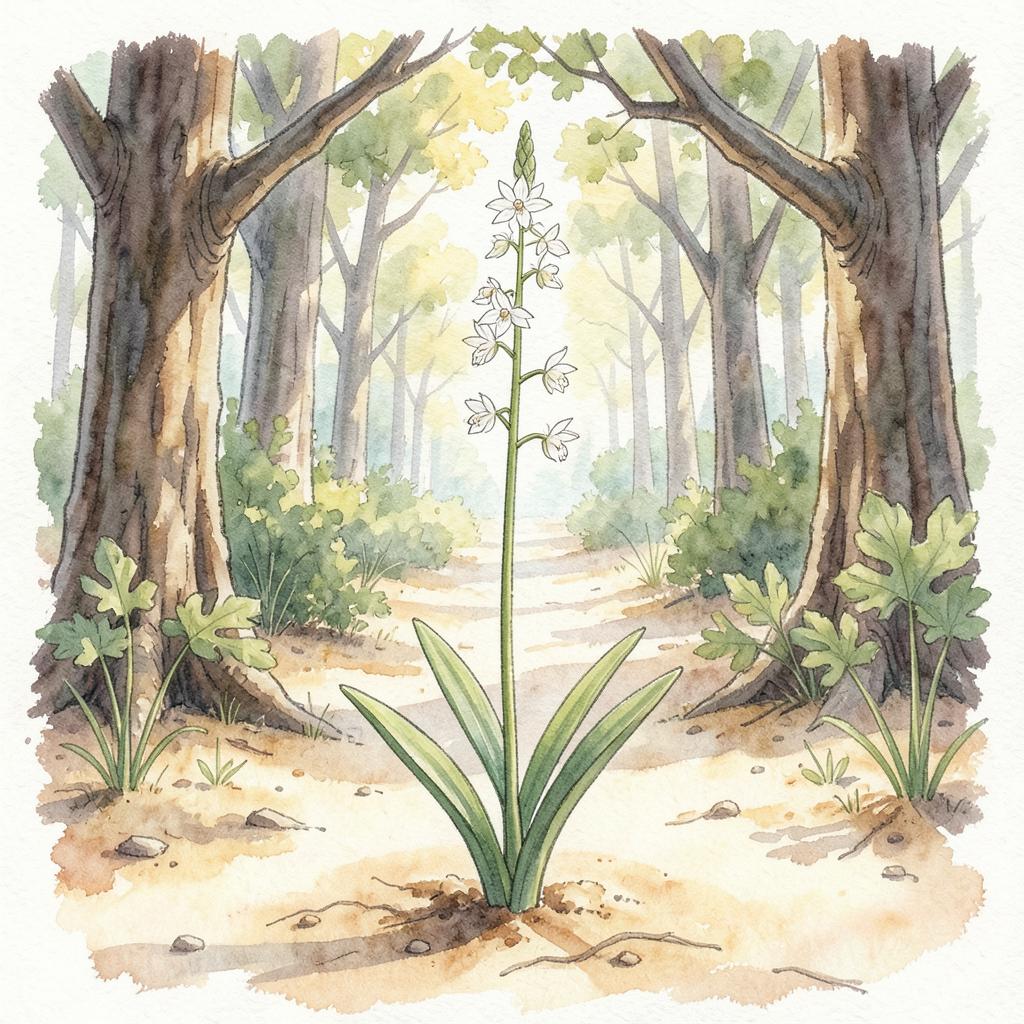
Illustrated Species Ambassador
Twist — Navasota Ladies'-tresses
I'm Twist, an illustrated ambassador for the Navasota ladies'-tresses. I am a wild orchid, no taller than your hand span, known from only a few Texas counties.
- One fact worth knowing
- This orchid cannot germinate without particular soil fungi, so it depends on undisturbed soil communities as much as on the woodland above them.
- What I depend on
- I depend on open post oak woodland on sandy soil along seasonally moist drainages, an uncrowded understory, and the mycorrhizal fungi my seeds need.
- My greatest threat
- My greatest threats are habitat conversion, reservoir flooding and altered water flow.
- One way you can help
- Never collect wild orchids — transplanted ones almost always die and the seed source is lost — and support prescribed fire and brush management that keeps post oak savanna open.
This ambassador is an original illustration created for this project. It is an educational character, not a documentary image, and its statements follow the sourced record on this page. Artwork and rights record
Why this species matters
Orchid seeds carry almost no food reserve and cannot germinate without the right soil fungus. That makes this orchid a measure of soil health as much as of habitat, and it makes transplanting or relocating the species nearly impossible.
If it disappears: The Post Oak Savannah would lose a globally rare endemic and one of the few plants signaling that its soil fungal community remains intact.
Conservation status
- U.S. Endangered Species Act
- EndangeredListed 1982.Last verified 2026-09-08
- Texas
- State endangeredLast verified 2026-09-08
- NatureServe
- ImperiledLast verified 2026-09-08
- CITES
- Appendix II (all orchids)Last verified 2026-09-08
Population
Known from a limited number of sites across several east-central Texas counties. Counts vary enormously between years because individual plants may remain dormant underground for one or more growing seasons without flowering.
Trend: Unknown
As reported: USFWS five-year review and Texas Parks and Wildlife survey data
Source: U.S. Fish and Wildlife Service; Texas Parks and Wildlife Department
Uncertainty: Orchid dormancy makes year-to-year counts genuinely unreliable. A low count does not necessarily indicate a decline, and a high count does not confirm recovery.
Historical: First described in 1947 and not rediscovered until the late 1970s; the historic baseline is poorly known.
Fragmentation: Sites are scattered across a fragmented landscape of ranchland, developing suburbs, and reservoir margins.
Range and distribution
Historic range: Post Oak Savannah of east-central Texas.
Current range: Brazos, Grimes, Robertson, Leon, Madison, Burleson, Freestone, Fayette, and adjacent counties.
Range contraction: Sites lost to reservoir construction, lignite mining, and suburban development.
Regions occupied
- Post Oak Savannah ecoregion, east-central Texas
Habitat
Primary habitat: Open post oak woodland and savanna on sandy soils, typically along seasonally moist drainages and creek margins.
Breeding habitat: Flowers in autumn, producing a spiral of small white flowers on a slender stem.
Feeding habitat: Depends on a symbiotic soil fungus, particularly for seed germination and seedling establishment.
Critical habitat: No critical habitat designated.
Habitat dependencies
- Symbiotic mycorrhizal fungi in the soil — orchid seeds cannot germinate without them
- Open, uncrowded woodland understory maintained by fire or light grazing
- Seasonal soil moisture along drainages
Biology and ecology
A component of intact post oak savanna groundcover and an indicator of undisturbed soil fungal communities.
Important adaptations: Can remain dormant underground for a season or more, waiting out drought — which also means a site can appear empty while the plants are still alive.
- Size
- Flowering stem typically 6 to 14 inches tall.
- Lifespan
- Perennial, potentially long-lived, with dormant years.
- Diet
- Autotrophic, but reliant on soil fungi for germination and nutrient exchange.
- Reproduction
- Insect-pollinated; produces enormous numbers of dust-like seeds with almost no stored food reserve.
- Offspring
- Thousands of tiny seeds per plant, with extremely low germination success.
- Breeding frequency
- Flowers in autumn when conditions are suitable; may skip years entirely.
Primary threats
Habitat conversion
Post oak savanna has been extensively cleared for pasture, development, and lignite mining.
Reservoir flooding
Reservoir construction has inundated known sites in the region.
Altered hydrology
Drainage modification and pond construction change the seasonal soil moisture the orchid depends on.
Woody encroachment
Without fire, yaupon and other shrubs close the understory and shade out the orchid.
Overgrazing
Heavy grazing and soil compaction damage plants and the fungal community they depend on.
Herbicide use
Brush control herbicides applied broadly kill non-target native groundcover.
Illegal collection
Orchids attract collectors, and removal from the wild is almost always fatal to the plant.
Conservation and recovery
Programs and efforts
- USFWS recovery program and five-year status reviews
- Texas A&M University research on habitat requirements and propagation
- Conservation agreements with private landowners and utilities
- Seed banking and symbiotic propagation research
- Survey requirements before development in occupied counties
Protected areas
- Protected sites on public land and utility corridors in the Post Oak Savannah
- Private conservation easements
Legal protections
- Endangered Species Act
- Texas state endangered listing
- CITES Appendix II
Measurable progress
- Survey requirements have identified previously unknown populations
- Research has clarified habitat requirements and dormancy behavior
Continuing challenges
- Most habitat is privately owned
- Dormancy makes monitoring difficult and can hide declines
- Propagation requires the correct fungal partner and remains technically difficult
How people can help
What individuals can do
- Never collect wild orchids — they almost always die and the seed source is lost
- If you own land in the Post Oak Savannah, ask about survey and conservation agreement options
- Avoid broadcast herbicide on native groundcover
What communities can do
- Support post oak savanna conservation and prescribed fire programs
- Encourage survey before development in occupied counties
Educational actions
- Use orchid-fungus symbiosis to teach that soil is a living community, not just dirt
Habitat support
- Support prescribed fire and brush management that maintains open savanna understory
Organizations and programs to learn about
- USFWS Texas Coastal Ecological Services
- Texas Parks and Wildlife Department
- Native Plant Society of Texas
Educational notes
- Orchid seeds are nearly microscopic and cannot germinate without a fungal partner.
- The plant may stay dormant underground for a year or more, which makes counting it genuinely hard.
- Described in 1947, then not seen again for roughly thirty years.