Global Endangered Species
Mountain Gorilla
Gorilla beringei beringei
One of the few great apes whose numbers are increasing, recovering from near-extinction through decades of protection built around tourism and community partnership.
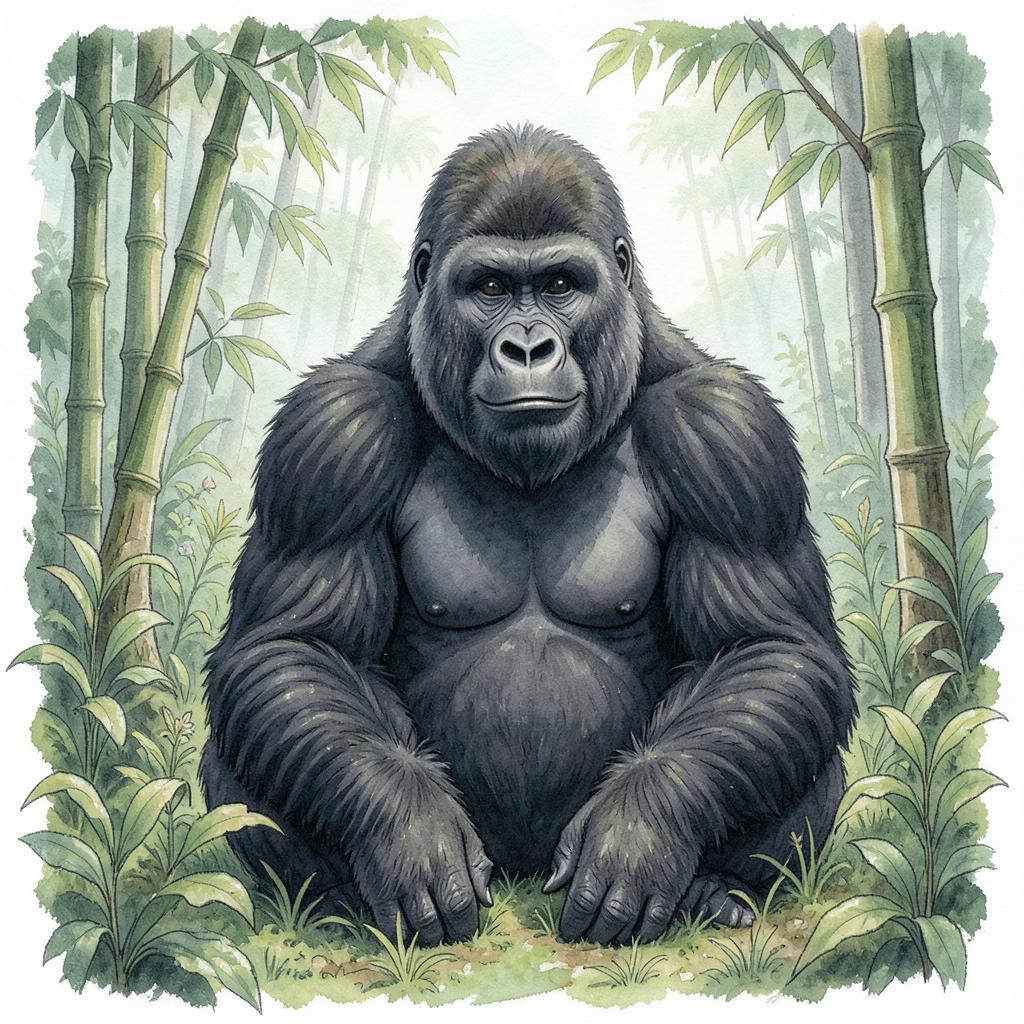
Illustrated Species Ambassador
Kigo — Mountain Gorilla
I'm Kigo, an illustrated ambassador for the mountain gorilla. My family lives high in the misty forest, and our story is one of the more hopeful ones.
- One fact worth knowing
- Mountain gorilla numbers are increasing, recovering from near-extinction through decades of protection built around tourism revenue and community partnership.
- What I depend on
- I depend on intact montane and bamboo forest with abundant leafy vegetation, on protection from human diseases, and on rangers being able to keep working.
- My greatest threat
- My greatest threats are disease passed from people, pressure on the forest, and regional instability.
- One way you can help
- If you ever visit, follow every rule exactly — distance, masks, and turning back if you are unwell are disease control, not formalities — and never visit gorillas with even a mild cold.
This ambassador is an original illustration created for this project. It is an educational character, not a documentary image, and its statements follow the sourced record on this page. Artwork and rights record
Why this species matters
Mountain gorillas were expected to be extinct by the year 2000. They are not. Their recovery came from continuous ranger protection, veterinary care, revenue sharing with neighboring communities, and tightly regulated tourism — sustained through war and instability. It is the strongest evidence in conservation that decline is not inevitable.
If it disappears: Beyond the loss of a great ape, it would remove the strongest working proof that intensive, community-linked conservation can reverse a great ape decline.
Cultural and regional note: Gorilla tourism is now a major source of national revenue in Rwanda and Uganda, and revenue-sharing arrangements return a portion directly to communities bordering the parks — a central reason local support has held.
Conservation status
- IUCN Red List
- EndangeredReclassified from Critically Endangered to Endangered in 2018 following documented population growth — one of very few great ape downlistings.Last verified 2026-09-08
- CITES
- Appendix ILast verified 2026-09-08
- National
- Fully protected in Rwanda, Uganda, and the Democratic Republic of the CongoLast verified 2026-09-08
Population
Slightly over 1,000 individuals across both populations, based on coordinated sweep censuses of the Virunga Massif and Bwindi Impenetrable National Park.
Trend: Increasing
As reported: Most recent coordinated Virunga Massif and Bwindi censuses
Source: IUCN SSC Primate Specialist Group; Greater Virunga Transboundary Collaboration; Uganda Wildlife Authority
Uncertainty: Mountain gorillas are among the very few wild ape populations counted essentially individual by individual, using coordinated multi-country sweeps and genetic analysis of dung samples. The figure is unusually reliable.
Historical: Fell to roughly 250 to 300 individuals in the 1970s and 1980s, when extinction within decades was widely predicted.
Fragmentation: Two separate populations — the Virunga Massif spanning Rwanda, Uganda, and the DRC, and Bwindi Impenetrable National Park in Uganda — with no exchange between them.
Range and distribution
Historic range: Montane forest across the Albertine Rift.
Current range: The Virunga Massif and Bwindi Impenetrable National Park.
Range contraction: Confined to two forest islands surrounded by some of the most densely populated rural land in Africa.
Regions occupied
- Volcanoes National Park, Rwanda
- Virunga National Park, Democratic Republic of the Congo
- Mgahinga Gorilla National Park, Uganda
- Bwindi Impenetrable National Park, Uganda
Habitat
Primary habitat: Montane and bamboo forest between roughly 5,000 and 13,000 feet elevation.
Breeding habitat: Groups build fresh nests nightly; infants are born and raised within a cohesive family group.
Feeding habitat: Feeds heavily on leaves, stems, shoots, bamboo, and some fruit and invertebrates.
Seasonal differences: Moves to bamboo zones during shoot season.
Habitat dependencies
- Intact montane forest with abundant herbaceous vegetation
- Protection from human disease exposure
- Continuity of ranger presence, which depends on regional stability
Biology and ecology
A large herbivore shaping montane forest vegetation and dispersing seeds.
Key relationships: Lives in stable family groups led by a silverback male, with strong social bonds and extended maternal care.
Important adaptations: Thicker, longer fur than other gorillas, suited to cold high-elevation forest.
- Size
- Males up to about 6 feet standing.
- Weight
- Males roughly 350 to 430 pounds; females about half that.
- Lifespan
- Around 35 to 40 years in the wild.
- Diet
- Primarily leaves, stems, and shoots; a heavily folivorous diet.
- Reproduction
- A single infant after roughly 8.5 months of gestation.
- Offspring
- One, rarely twins.
- Breeding frequency
- About every four years, since infants nurse and remain dependent for years.
- Age at maturity
- Females around 10 years; males around 12 to 15.
Primary threats
Disease
Gorillas are highly susceptible to human respiratory illness. A common cold can kill. This is why tourist distance rules, mask requirements, and health screening exist.
Habitat pressure
The parks are surrounded by dense agricultural settlement, leaving no room for range expansion.
Snares
Snares set for antelope and other bushmeat frequently injure or kill gorillas that are not the intended target.
Regional instability
Armed conflict in the eastern DRC repeatedly disrupts patrols and has cost the lives of many rangers.
Small population size
Just over a thousand animals in two isolated groups is genetically precarious.
Climate change
Shifting montane vegetation zones may alter food availability at elevation.
Tourism pressure
Tourism funds protection but increases disease exposure and behavioral disturbance if not tightly regulated.
Conservation and recovery
Programs and efforts
- Continuous ranger patrols and snare removal across all four parks
- Gorilla Doctors veterinary intervention for injured or ill individuals
- Greater Virunga Transboundary Collaboration coordinating Rwanda, Uganda, and the DRC
- Strictly regulated tourism with limited daily permits, distance rules, and mask requirements
- Revenue-sharing programs returning tourism income to bordering communities
- Long-term research at the Karisoke Research Center and Bwindi
Protected areas
- Volcanoes National Park, Rwanda
- Virunga National Park, DRC
- Mgahinga Gorilla National Park, Uganda
- Bwindi Impenetrable National Park, Uganda, a UNESCO World Heritage Site
Legal protections
- CITES Appendix I
- National park protection in all three countries
- Strict tourism regulation and permit limits
Measurable progress
- Population growth from roughly 250 to over 1,000 individuals
- IUCN downlisting from Critically Endangered to Endangered in 2018
- Sustained protection maintained through periods of armed conflict
Continuing challenges
- Habitat cannot expand into surrounding farmland
- Tourism revenue proved fragile during global travel disruption
- Ranger safety in the eastern DRC remains a serious concern
How people can help
What individuals can do
- If you visit, follow every rule exactly — distance, masks, and turning back if you are ill are not formalities but disease control
- Never visit gorillas while sick, even with a mild cold
- Choose operators that contribute to park fees and community revenue sharing
What communities can do
- Support community revenue sharing and alternative livelihood programs around the parks
Educational actions
- Use mountain gorillas as the leading example of a documented conservation recovery
Habitat support
- Support reforestation and buffer zone programs adjacent to the parks
Organizations and programs to learn about
- Dian Fossey Gorilla Fund
- Gorilla Doctors
- International Gorilla Conservation Programme
- Uganda Wildlife Authority and Rwanda Development Board
Educational notes
- One of the very few great ape populations that is growing.
- Counted by coordinated multi-country sweeps and genetic analysis, making the population figure unusually trustworthy.
- Mask rules for visitors exist because gorillas can die from human respiratory infections.
Sources and references
- IUCN Red List — Gorilla beringei beringei — IUCN
- Dian Fossey Gorilla Fund — Dian Fossey Gorilla Fund
- Gorilla Doctors — Gorilla Doctors
- CITES Appendices — CITES