Urban Wildlife at Risk
Little Brown Bat
Myotis lucifugus
Once among the most common bats in North America, reduced by more than 90 percent in the northeast within roughly a decade by a fungal disease.
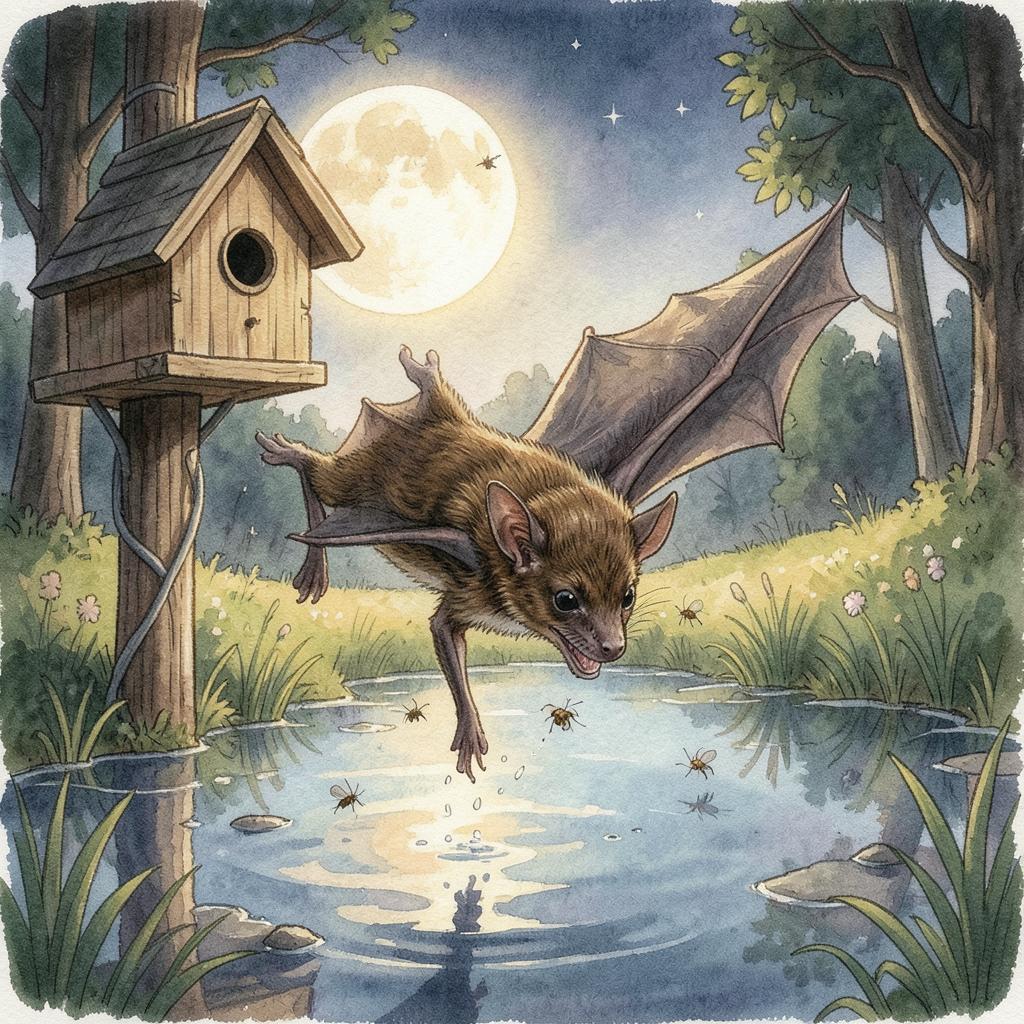
Illustrated Species Ambassador
Myo — Little Brown Bat
I'm Myo, an illustrated ambassador for the little brown bat. I used to be one of the commonest bats on this continent. In much of it, I am not any more.
- One fact worth knowing
- White-nose syndrome, a cold-loving fungal disease of hibernating bats, has caused catastrophic declines in little brown bat populations across eastern North America.
- What I depend on
- I depend on undisturbed caves and mines for winter hibernation, warm attics, barns and bat houses for summer maternity roosts, and insect-rich water nearby.
- My greatest threat
- My greatest threat is white-nose syndrome.
- One way you can help
- Stay out of closed caves and decontaminate gear between any caves you do enter, put up a bat house, and leave existing roosts undisturbed from spring through late summer.
This ambassador is an original illustration created for this project. It is an educational character, not a documentary image, and its statements follow the sourced record on this page. Artwork and rights record
Why this species matters
White-nose syndrome killed millions of little brown bats in about a decade — one of the fastest declines of any North American mammal ever recorded. With one pup per year, this species cannot rebuild quickly even where the disease has passed through.
If it disappears: Agriculture and forestry would lose enormous natural insect control, and nighttime insect populations would shift in ways only beginning to be measured.
Conservation status
- IUCN Red List
- EndangeredLast verified 2026-09-08
- U.S. Endangered Species Act
- Proposed for listing as EndangeredUSFWS published a proposed rule; verify the current status before publication.Last verified 2026-09-08
- Canada (SARA)
- EndangeredLast verified 2026-09-08
- State
- Endangered or threatened in numerous northeastern and midwestern statesLast verified 2026-09-08
Population
Hibernaculum counts in the northeastern United States have declined by more than 90 percent since white-nose syndrome appeared in 2006. Some western populations remain comparatively intact, but the disease continues to spread westward.
Trend: Decreasing
As reported: USFWS white-nose syndrome response reporting and state hibernaculum surveys
Source: U.S. Fish and Wildlife Service; White-Nose Syndrome Response Team; IUCN Red List
Uncertainty: Counts are of hibernating bats at known caves and mines, which is a strong method for this species but misses bats hibernating in unknown sites.
Historical: Among the most abundant mammals in North America before 2006, with individual hibernacula holding hundreds of thousands of bats.
Fragmentation: Severe regional variation — collapsed in the east, less affected in parts of the west so far.
Range and distribution
Historic range: Across most of North America from Alaska and Canada south through much of the United States.
Current range: The same range, drastically reduced in the east and midwest.
Migration: Moves seasonally between summer roosts and winter hibernacula, sometimes hundreds of miles.
Regions occupied
- Northeastern United States and eastern Canada (severely affected)
- Midwest (affected)
- Western United States and Canada (disease spreading)
- Alaska
Habitat
Primary habitat: Forests, wetlands, and settled areas near water; roosts in buildings, attics, bat houses, and trees in summer.
Breeding habitat: Females form maternity colonies in warm attics, barns, and bat houses, often numbering in the hundreds.
Feeding habitat: Catches flying insects over water and forest edges using echolocation.
Seasonal differences: Hibernates from autumn to spring in caves and mines with stable temperature and high humidity.
Habitat dependencies
- Cold, humid hibernacula that remain undisturbed all winter
- Warm, safe maternity roost sites in summer
- Abundant flying insects near water
Biology and ecology
A major consumer of night-flying insects, providing pest control valued in the billions of dollars annually to North American agriculture.
Important adaptations: Delayed fertilization allows mating before hibernation and birth timed to spring insect abundance. Echolocation permits precise hunting in complete darkness.
- Size
- About 3 to 4 inches long with a 9 to 11 inch wingspan.
- Weight
- Roughly 7 to 14 grams.
- Lifespan
- Exceptionally long for such a small mammal — commonly over 10 years and recorded beyond 30.
- Diet
- Flying insects, including mosquitoes, midges, moths, and beetles; can eat a large number of insects in a single night.
- Reproduction
- Mates in autumn; females store sperm through hibernation and fertilization occurs in spring.
- Offspring
- Usually a single pup per year.
- Breeding frequency
- Once yearly.
- Age at maturity
- Females often in their first year.
Primary threats
Disease
White-nose syndrome, caused by the introduced fungus Pseudogymnoascus destructans, grows on hibernating bats, rousing them repeatedly through winter until they exhaust their fat reserves and starve.
Human disturbance
Entering hibernacula wakes bats and burns the fat they need to survive winter; people can also carry fungal spores between caves.
Wind turbines
Turbine collisions and barotrauma kill bats, particularly during migration.
Pesticides
Insecticide use reduces prey and accumulates in bat tissue.
Roost loss
Exclusion from buildings and removal of dead trees eliminates summer maternity roosts.
Slow reproduction
One pup per year makes recovery from a mass mortality event extremely slow.
Climate change
Warming affects hibernaculum temperatures and insect emergence timing.
Conservation and recovery
Programs and efforts
- National White-Nose Syndrome Response Team coordinating research and management
- Cave closures and decontamination protocols for cavers and researchers
- Experimental treatments including probiotic bacteria and antifungal applications
- Artificial hibernacula construction and roost modification
- Research into naturally surviving bats that appear resistant to the fungus
Protected areas
- Protected cave and mine hibernacula, many gated to allow bats but exclude people
- National park and forest cave systems
Legal protections
- Proposed ESA listing
- Canadian Species at Risk Act
- Numerous state endangered listings
- Cave closure orders on federal land
Measurable progress
- Some remnant colonies in affected areas appear to be persisting and may be developing resistance
- Decontamination protocols have slowed human-assisted spread
- Treatment trials have shown promise at specific sites
Continuing challenges
- The fungus cannot be eradicated from caves
- The disease continues spreading west
- Recovery is limited by one pup per year
How people can help
What individuals can do
- Never enter a cave or mine that is closed for bat protection, and decontaminate gear between caves
- If bats roost in your building, exclude them only outside the maternity season — sealing them in during summer traps flightless pups
- Install a bat house before excluding bats, so they have somewhere to go
- Reduce outdoor insecticide use
What communities can do
- Support cave gating and hibernaculum protection
- Educate residents that bats are protected and beneficial rather than pests
Educational actions
- Use white-nose syndrome to teach how an introduced pathogen can devastate a species with no evolved defense
Habitat support
- Leave standing dead trees where safe, and protect wetlands where bats forage
Organizations and programs to learn about
- Bat Conservation International
- USFWS White-Nose Syndrome Response Team
- state wildlife agencies
Educational notes
- One of the longest-lived small mammals on earth relative to body size.
- White-nose syndrome does not kill directly; it starves bats by repeatedly waking them.
- Bats provide agricultural pest control estimated in the billions of dollars per year.
Sources and references
- IUCN Red List — Myotis lucifugus — IUCN
- U.S. Fish and Wildlife Service — Little Brown Bat — USFWS
- White-Nose Syndrome Response Team — USFWS and partners