Global Endangered Species
Javan Rhinoceros
Rhinoceros sondaicus
The rarest large mammal on earth, surviving as a single population in one Indonesian national park.
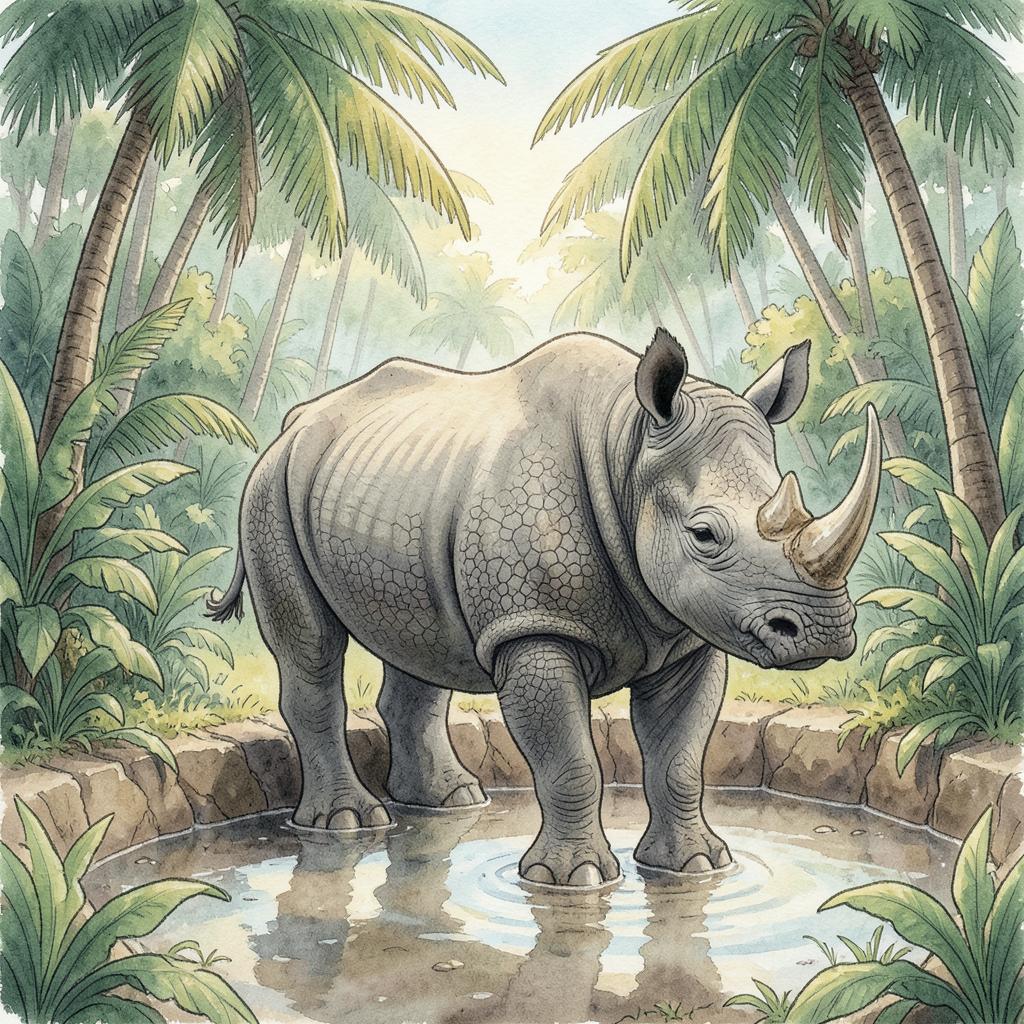
Illustrated Species Ambassador
Ujung — Javan Rhinoceros
I'm Ujung, an illustrated ambassador for the Javan rhinoceros. Every one of us alive lives in a single national park on the island of Java.
- One fact worth knowing
- The Javan rhinoceros survives in only one place on earth, Ujung Kulon National Park in Indonesia, which makes the whole species vulnerable to a single disaster.
- What I depend on
- I depend on dense lowland rainforest with mud wallows, and on the forest not being crowded out by the invasive arenga palm.
- My greatest threat
- My greatest threat is having only one population, exposed at once to disease, tsunami, volcanic activity and poaching.
- One way you can help
- Support the work to establish a second protected population and to remove invasive palm from the park — one site is not enough for a whole species.
This ambassador is an original illustration created for this project. It is an educational character, not a documentary image, and its statements follow the sourced record on this page. Artwork and rights record
Why this species matters
Every Javan rhinoceros alive lives in one park, on one island, in one country. A single disease outbreak, a tsunami, or an eruption of the nearby Anak Krakatau volcano could end the species in a day. It is the clearest possible argument for establishing a second population before it is too late.
If it disappears: It would be the extinction of a large mammal that survived humanity for millennia, and the loss of a major seed disperser and forest architect in Javan lowland rainforest.
Conservation status
- IUCN Red List
- Critically EndangeredLast verified 2026-09-08
- CITES
- Appendix ILast verified 2026-09-08
- Indonesia
- Fully protected national speciesLast verified 2026-09-08
Population
Fewer than 100 individuals, all in Ujung Kulon National Park. Recent official counts have been in the range of roughly 75 to 80 animals, though independent reviews have raised concerns that camera-trap-based figures may be overstated following a poaching investigation.
Trend: Unknown
As reported: Indonesian Ministry of Environment and Forestry annual monitoring and IUCN Red List assessment
Source: Indonesian Ministry of Environment and Forestry; IUCN SSC Asian Rhino Specialist Group
Uncertainty: Official counts and independent assessments have diverged in recent years. A poaching network operating inside the park was uncovered, which raised questions about the accuracy of published totals. Report both the official figure and the uncertainty.
Historical: Once ranged across Southeast Asia from India and Bangladesh through Myanmar, Thailand, Laos, Cambodia, Vietnam, Malaysia, Sumatra, and Java. The last Vietnamese individual was killed by a poacher in 2010.
Fragmentation: A single population in a single park — there is no second population anywhere in the world.
Range and distribution
Historic range: Northeast India, Bangladesh, Myanmar, Thailand, Laos, Cambodia, Vietnam, peninsular Malaysia, Sumatra, and Java.
Current range: Ujung Kulon National Park, at the western tip of Java, Indonesia.
Range contraction: Reduced from a range spanning most of Southeast Asia to roughly 500 square kilometers.
Regions occupied
- Ujung Kulon National Park, Banten Province, Indonesia
Habitat
Primary habitat: Dense lowland tropical rainforest, mud wallows, and secondary growth near water.
Breeding habitat: Calves are born in dense forest cover; details are limited because the species is so rarely observed.
Feeding habitat: Browses on saplings, shoots, twigs, and fallen fruit.
Critical habitat: The entire park functions as protected habitat.
Habitat dependencies
- Dense lowland forest with abundant browse
- Mud wallows for thermoregulation and parasite control
- Absence of arenga palm, an invasive palm that crowds out food plants
Biology and ecology
A large browser that shapes forest structure and disperses seeds through its dung.
Important adaptations: Only the male carries a short horn; females often have little or none. Loose folded skin gives an armored appearance.
- Size
- Around 10 feet long and 5.5 feet at the shoulder.
- Weight
- Roughly 1,900 to 5,000 pounds.
- Lifespan
- Estimated 30 to 45 years.
- Diet
- Browse — shoots, twigs, young foliage, and fallen fruit.
- Reproduction
- A single calf after a gestation of roughly 15 to 16 months.
- Offspring
- One.
- Breeding frequency
- Roughly every three to five years.
- Age at maturity
- Females around five to seven years; males later.
Primary threats
Single-site risk
The entire species occupies one coastal park near an active volcano and in a tsunami-exposed area. No second population exists as insurance.
Poaching
A poaching network operating inside Ujung Kulon was uncovered and prosecuted in recent years, demonstrating that even the last population is not secure.
Disease
Cattle-borne disease from surrounding villages could move through a population with no genetic or spatial separation.
Invasive species
Arenga palm spreads aggressively through the park and displaces the plants the rhinos eat.
Low genetic diversity
A population this small carries substantial inbreeding risk.
Natural disaster
Anak Krakatau's 2018 collapse generated a tsunami that struck the coast near the park.
Habitat limitation
The park may be near its carrying capacity for the species without active habitat management.
Conservation and recovery
Programs and efforts
- Ujung Kulon National Park rhino monitoring using an extensive camera trap network
- Rhino Protection Units conducting continuous patrols
- Arenga palm removal and habitat expansion to increase available browse
- Javan Rhino Study and Conservation Area within the park
- Planning for a second population site elsewhere in Indonesia
- Prosecution of the poaching network discovered inside the park
Protected areas
- Ujung Kulon National Park, a UNESCO World Heritage Site
Legal protections
- CITES Appendix I
- Indonesian national protected species status
- UNESCO World Heritage designation
Measurable progress
- The population increased from a very low point in the 1960s under sustained protection
- Habitat management has expanded browse availability
- Camera trap monitoring documents individual animals and births
Continuing challenges
- Establishing a second population requires a suitable, secure site and is technically and politically difficult
- Recent poaching showed protection gaps
- Population figures are contested
How people can help
What individuals can do
- Never buy rhino horn or any product claiming to contain it — horn is keratin with no medicinal effect
- Support reputable Indonesian conservation organizations working in Ujung Kulon
What communities can do
- Support demand-reduction efforts in rhino horn consumer markets
Educational actions
- Use this species to teach why conservation biologists insist on establishing a second population
Habitat support
- Support arenga palm removal and habitat expansion funding
Organizations and programs to learn about
- International Rhino Foundation
- IUCN SSC Asian Rhino Specialist Group
- Indonesian Ministry of Environment and Forestry
Educational notes
- The last Javan rhinoceros in Vietnam was killed in 2010, ending the species on the mainland.
- Almost never seen directly by researchers; nearly all knowledge comes from camera traps and dung.
Sources and references
- IUCN Red List — Rhinoceros sondaicus — IUCN
- International Rhino Foundation — Javan Rhino — International Rhino Foundation
- CITES Appendices — CITES