Reptiles and Amphibians
Houston Toad
Anaxyrus houstonensis
One of the first animals ever protected under U.S. endangered species law, now found in only a few central Texas counties.
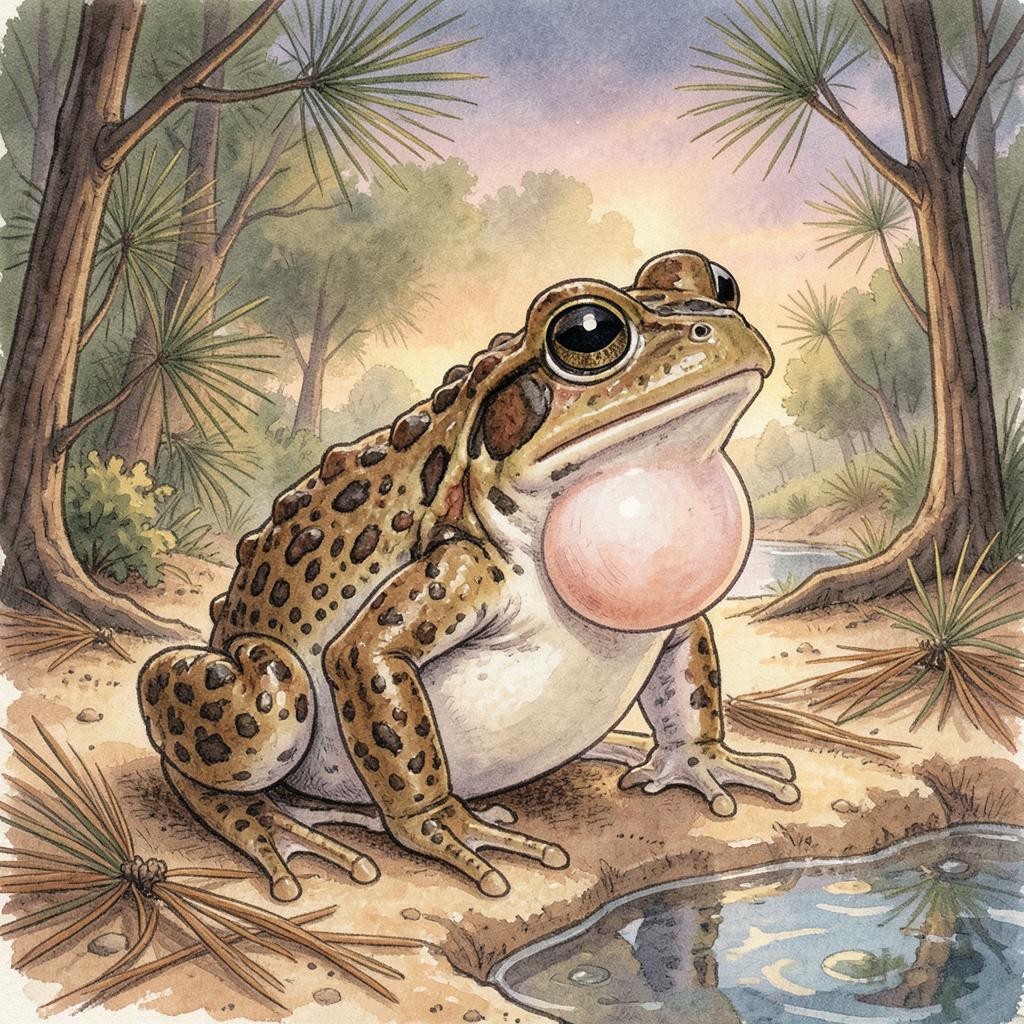
Illustrated Species Ambassador
Bastrop — Houston Toad
I'm Bastrop, an illustrated ambassador for the Houston toad. I spend most of the year underground in deep sand, waiting for the right rain.
- One fact worth knowing
- The Houston toad was among the very first animals protected under United States endangered species law, and is now found in only a few central Texas counties.
- What I depend on
- I depend on deep loose sand to burrow in, seasonal fish-free pools to breed in, and pine and oak canopy that keeps the soil moist.
- My greatest threat
- My greatest threat is the loss of deep-sand woodland and the breeding pools within it.
- One way you can help
- Leave seasonal ponds and rain pools intact rather than filling them or stocking them with fish, and avoid pesticide and herbicide use anywhere near them.
This ambassador is an original illustration created for this project. It is an educational character, not a documentary image, and its statements follow the sourced record on this page. Artwork and rights record
Why this species matters
Amphibians breathe and drink through their skin, which makes them among the first species to register changes in soil and water. The Houston toad exists in only a few Texas counties, so its survival is decided almost entirely by local land and water choices.
If it disappears: It would be the extinction of a species found nowhere else on earth, and a failure of the very first generation of American endangered species protection.
Conservation status
- IUCN Red List
- EndangeredLast verified 2026-09-08
- U.S. Endangered Species Act
- EndangeredListed in 1970, among the first species protected under federal endangered species law.Last verified 2026-09-08
- Texas
- Endangered (state listed)Last verified 2026-09-08
Population
Very small. Bastrop County has historically held the largest population, and post-wildfire call surveys have detected only tens of calling males in some years; several other counties may hold no more than remnant individuals.
Trend: Decreasing
As reported: USFWS and Texas State University call-survey reporting following the 2011 Bastrop County Complex Fire
Source: U.S. Fish and Wildlife Service; Texas State University Houston toad research program
Uncertainty: Counts are of calling males detected during spring surveys, not total animals, and vary strongly with rainfall.
Historical: Formerly recorded from roughly a dozen Texas counties, including the Houston area, where it is now considered extirpated.
Fragmentation: Surviving groups are isolated on separate sand deposits with no connection between them.
Range and distribution
Historic range: Deep sandy soils across roughly 12 counties in southeast-central Texas, including Harris County.
Current range: Bastrop County stronghold plus a small number of remnant sites in nearby counties.
Range contraction: Extirpated from the Houston area for which it is named.
Regions occupied
- Bastrop County, Texas
- Adjacent southeast-central Texas counties
Habitat
Primary habitat: Deep sandy soils under loblolly pine and post oak woodland.
Breeding habitat: Shallow, fish-free ponds, rain pools, and flooded depressions.
Feeding habitat: Insects and other small invertebrates on the woodland floor.
Seasonal differences: Burrows into sandy soil during hot, dry, and cold periods.
Critical habitat: Critical habitat designated in Bastrop and Burleson counties.
Habitat dependencies
- Deep, friable sand for burrowing
- Seasonal fish-free breeding pools
- Canopy that retains soil moisture
Biology and ecology
Insect predator and prey species; a sensitive indicator of soil moisture and water quality.
Important adaptations: Burrows into loose sand to survive drought and cold — an adaptation that ties it to one soil type.
- Size
- About 2–3.5 inches long.
- Weight
- A few tenths of an ounce.
- Lifespan
- Typically 2–3 years, which leaves little margin for consecutive failed breeding seasons.
- Diet
- Ants, beetles, and other small invertebrates.
- Reproduction
- Males call from pond edges after winter and spring rains; eggs are laid in long strings.
- Offspring
- Several thousand eggs per string.
- Breeding frequency
- One breeding season a year, contingent on adequate rainfall.
- Age at maturity
- About 1 year.
Primary threats
Habitat loss
Development and clearing of deep-sand pine and oak woodland removes both burrowing soil and canopy.
Drought
Without sufficient winter and spring rain, breeding pools never form and no reproduction occurs that year.
Wildfire
The 2011 Bastrop County Complex Fire burned much of the core habitat and sharply reduced detections.
Invasive species
Red imported fire ants prey on toadlets and reduce the invertebrates the toads eat.
Pesticides
Runoff into breeding pools harms eggs and tadpoles, which absorb contaminants directly.
Road mortality
Toads crossing roads to reach breeding pools are killed in numbers a small population cannot absorb.
Predation by stocked fish
Ponds stocked with fish eliminate tadpole survival entirely.
Conservation and recovery
Programs and efforts
- Houston Zoo captive breeding and headstarting, releasing egg strands and toadlets into the wild
- USFWS Safe Harbor agreements with Bastrop County landowners
- Loblolly pine replanting after the 2011 fire
- Volunteer spring call surveys coordinated with Texas State University
Protected areas
- Bastrop State Park
- Griffith League Ranch
- Private lands under Safe Harbor agreements
Legal protections
- Endangered Species Act
- Texas state endangered listing
- Designated critical habitat
Measurable progress
- Captive-bred egg strands have produced documented wild metamorphs
- Substantial private acreage enrolled in Safe Harbor agreements
Continuing challenges
- Extremely small wild population
- Habitat still recovering from the 2011 fire
- Multi-year droughts prevent breeding entirely
How people can help
What individuals can do
- Protect and replant native pine and oak woodland on sandy soils
- Keep seasonal ponds and rain pools intact rather than filling or stocking them with fish
- Avoid pesticide and herbicide use near wetlands and pools
What communities can do
- Support Safe Harbor agreements and post-fire reforestation in Bastrop County
Educational actions
- Volunteer for spring call surveys — an approachable citizen-science activity
Habitat support
- Leave leaf litter and deep sand undisturbed on rural property in the range
Organizations and programs to learn about
- Houston Zoo
- USFWS Austin Ecological Services Field Office
- Texas State University
Educational notes
- Breeding call surveys are an accessible citizen-science activity for students.
- Good example of how fire, drought, and soil type interact within one small range.