Birds
Golden-cheeked Warbler
Setophaga chrysoparia
The only bird species that nests exclusively in Texas, building its nest from the bark of mature Ashe juniper.
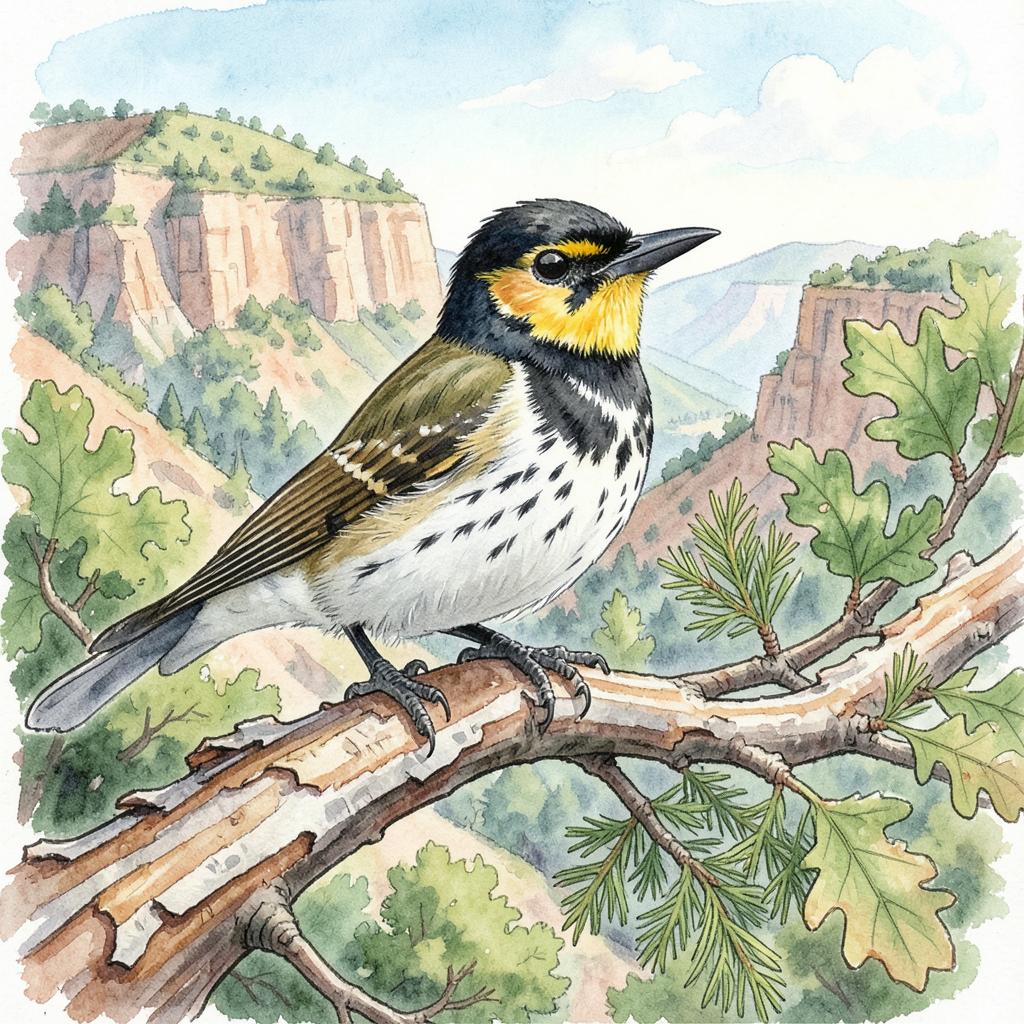
Illustrated Species Ambassador
Juniper — Golden-cheeked Warbler
I'm Juniper, an illustrated ambassador for the golden-cheeked warbler. I am the only bird species that nests nowhere but Texas.
- One fact worth knowing
- The golden-cheeked warbler builds its nest from the stringy bark of mature Ashe juniper, so it cannot nest where those old junipers have been cleared.
- What I depend on
- I depend on mature Ashe juniper mixed with oak on canyon slopes, in patches large enough that predators cannot work the edges.
- My greatest threat
- My greatest threat is the clearing and fragmentation of juniper-oak woodland.
- One way you can help
- Protect mature juniper and oak stands rather than clearing them wholesale, and keep cats indoors through the March to July nesting season.
This ambassador is an original illustration created for this project. It is an educational character, not a documentary image, and its statements follow the sourced record on this page. Artwork and rights record
Why this species matters
This warbler nests nowhere else on earth but central Texas. A species with a home that small is a direct local responsibility: what happens on a few hundred acres of hill country woodland decides whether it continues at all.
If it disappears: Its loss would be the first extinction of a bird that bred only in Texas, and would signal that the Edwards Plateau's mature woodland has been fragmented past function.
Conservation status
- IUCN Red List
- EndangeredLast verified 2026-09-08
- U.S. Endangered Species Act
- EndangeredEmergency listed in 1990.Last verified 2026-09-08
- Texas
- Endangered (state listed)Last verified 2026-09-08
Population
Published estimates vary widely, from roughly 27,000 to over 250,000 birds depending on survey method and habitat model used.
Trend: Decreasing
As reported: USFWS species status assessment and peer-reviewed Texas A&M habitat modeling, 2010s–2020s
Source: U.S. Fish and Wildlife Service; Texas A&M Institute of Renewable Natural Resources
Uncertainty: Authorities disagree substantially. Earlier direct-count estimates were far lower than later habitat-model estimates, and the difference reflects method rather than a documented increase. Both figures are reported here rather than selecting one.
Fragmentation: Breeding habitat is scattered in canyon and slope woodland across the Edwards Plateau, much of it on private land.
Range and distribution
Historic range: Juniper-oak woodland across the Edwards Plateau, Lampasas Cut Plain, and Cross Timbers of central Texas.
Current range: Roughly 33 central Texas counties, with declining and increasingly fragmented occupancy near expanding cities.
Migration: Arrives in Texas in March, departs by July for pine-oak forests of southern Mexico and Central America.
Range contraction: Substantial loss around the Austin-San Antonio corridor.
Regions occupied
- Edwards Plateau, Texas
- Southern Mexico
- Guatemala
- Honduras
- Nicaragua
Habitat
Primary habitat: Mature Ashe juniper mixed with oak on canyon slopes and ravines.
Breeding habitat: Requires bark from junipers roughly 40 years or older for nest construction.
Feeding habitat: Gleans caterpillars and insects from oak and juniper foliage.
Seasonal differences: Winters in pine-oak forest at middle elevations in Mexico and Central America.
Critical habitat: No critical habitat designated.
Habitat dependencies
- Mature Ashe juniper for nest bark
- Mixed oak canopy for insect prey
- Patches large enough to reduce edge predation
Biology and ecology
Insectivore controlling caterpillar populations in hill country woodland; an indicator of mature juniper-oak habitat.
Important adaptations: Nest construction depends entirely on a single tree species' shredding bark.
- Size
- About 4.5–5 inches long.
- Weight
- Roughly 0.3–0.4 ounces.
- Lifespan
- Commonly 3–5 years.
- Diet
- Caterpillars, spiders, beetles, and other insects.
- Reproduction
- Nests woven from stripped juniper bark bound with spider silk.
- Offspring
- Usually 3–4 eggs.
- Breeding frequency
- One brood a year, with re-nesting after failure.
- Age at maturity
- One year.
Primary threats
Habitat loss
Clearing of mature juniper-oak woodland for subdivisions, roads, and range improvement.
Habitat fragmentation
Remaining patches are often too small; edge-dwelling predators and cowbirds concentrate at boundaries.
Nest parasitism
Brown-headed cowbirds lay eggs in warbler nests, and cowbird chicks outcompete the young warblers.
Wintering habitat loss
Pine-oak forest loss in Mexico and Central America reduces winter survival.
Wildfire and drought
Severe fire removes mature juniper that takes decades to replace.
Conservation and recovery
Programs and efforts
- Balcones Canyonlands Conservation Plan in Travis County
- USFWS Safe Harbor and conservation banking agreements with private landowners
- Texas Military Department habitat management at Fort Cavazos and Camp Bullis
- Cowbird trapping in occupied habitat
Protected areas
- Balcones Canyonlands National Wildlife Refuge
- Balcones Canyonlands Preserve
- Government Canyon State Natural Area
Legal protections
- Endangered Species Act
- Migratory Bird Treaty Act
- Texas state endangered listing
Measurable progress
- Large regional habitat conservation plans have permanently protected tens of thousands of acres near Austin
Continuing challenges
- Rapid central Texas growth
- Most habitat is privately owned
- Population estimates remain disputed
How people can help
What individuals can do
- Protect mature Ashe juniper and oak stands rather than clearing them wholesale
- Keep cats indoors during the March to July nesting season
- Avoid clearing brush and trees during the breeding season
What communities can do
- Support conservation easements and land trusts on the Edwards Plateau
- Back regional habitat conservation plans
Educational actions
- Join spring bird surveys that track breeding territories
Habitat support
- Leave mature juniper-oak canopy intact on hill country property
Organizations and programs to learn about
- Balcones Canyonlands National Wildlife Refuge
- Travis Audubon
- Texas Parks and Wildlife Department
Educational notes
- An accessible example of endemism — a species tied to one region and no other.
- Shows why habitat quality, not just habitat size, decides whether nesting succeeds.
- A live example of scientific disagreement: population estimates differ by an order of magnitude depending on method.