Fish and Aquatic Life
Fountain Darter
Etheostoma fonticola
A thumb-sized fish living only in the Comal and San Marcos spring systems of central Texas, dependent on constant spring flow.
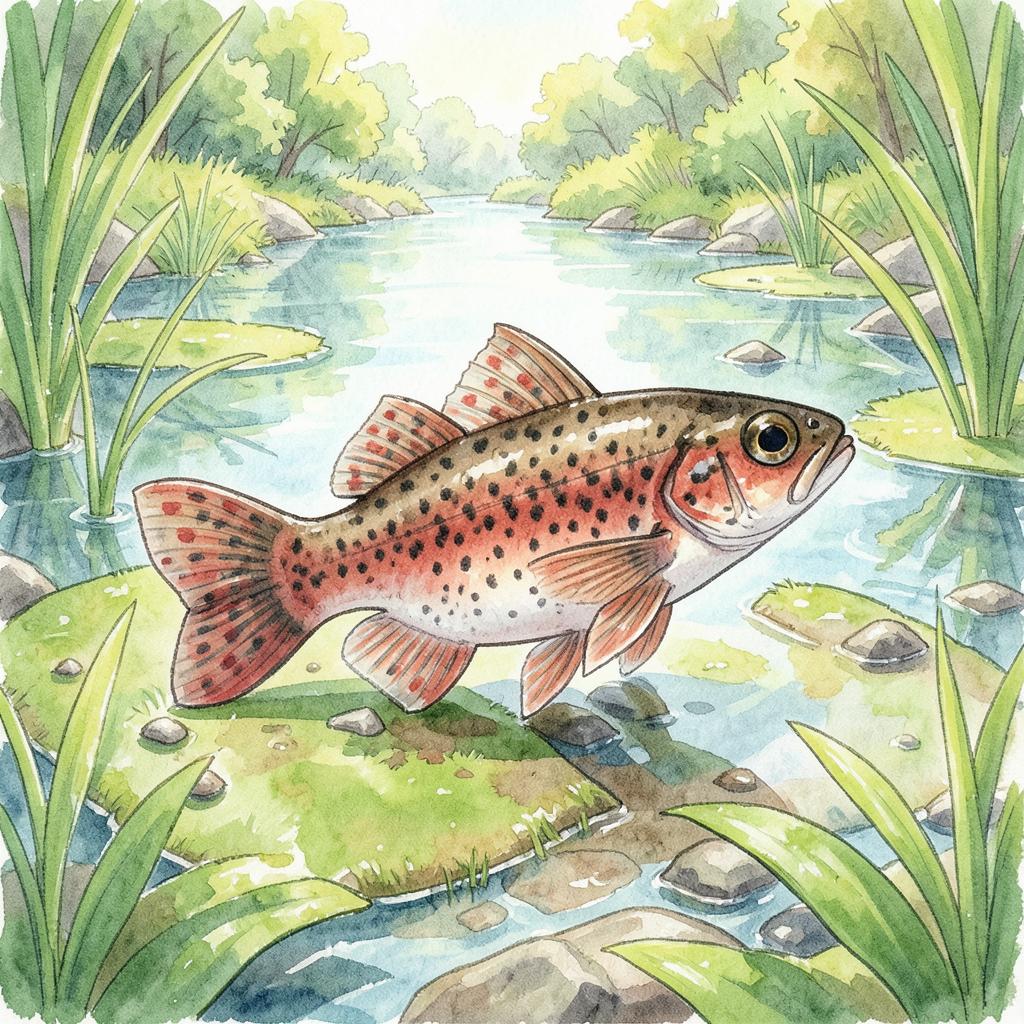
Illustrated Species Ambassador
Dart — Fountain Darter
I'm Dart, an illustrated ambassador for the fountain darter. I am about the length of your thumb and I live in two Texas spring systems, nowhere else.
- One fact worth knowing
- The fountain darter is one of the smallest darters, living only in the Comal and San Marcos spring systems of central Texas.
- What I depend on
- I depend on continuous flow from the Edwards Aquifer that holds the water near 70 to 75 degrees all year, and on native plant beds to hide and spawn in.
- My greatest threat
- My greatest threat is the loss of spring flow from aquifer pumping and drought.
- One way you can help
- When tubing or swimming the San Marcos and Comal, stay on the marked paths and out of the vegetation beds, and never release aquarium plants or animals into spring water.
This ambassador is an original illustration created for this project. It is an educational character, not a documentary image, and its statements follow the sourced record on this page. Artwork and rights record
Why this species matters
The fountain darter is one of several species that exist only because the Edwards Aquifer keeps flowing. Its fate is bound to how much water central Texas pumps, which makes it an unusually direct link between household water use and extinction risk.
If it disappears: Losing it would signal the failure of the Edwards Aquifer spring systems, which also support Texas wild rice, the San Marcos salamander, and the Comal Springs riffle beetle.
Conservation status
- IUCN Red List
- VulnerableLast verified 2026-09-08
- U.S. Endangered Species Act
- EndangeredListed 1970, with designated critical habitat.Last verified 2026-09-08
- Texas
- Endangered (state listed)Last verified 2026-09-08
Population
Locally abundant within suitable vegetation in both spring systems, with population density monitored by regular dive surveys rather than a total count.
Trend: Stable
As reported: Edwards Aquifer Habitat Conservation Plan biological monitoring, ongoing
Source: Edwards Aquifer Authority; U.S. Fish and Wildlife Service
Uncertainty: Local abundance can be high while extinction risk stays severe, because the whole species depends on two spring systems continuing to flow.
Historical: The Comal population was extirpated during the drought of the 1950s when the springs stopped flowing, and was later re-established from San Marcos stock.
Fragmentation: Two spring systems, roughly 20 miles apart, with no natural connection.
Range and distribution
Historic range: Comal Springs in New Braunfels and San Marcos Springs, Texas.
Current range: The same two systems, plus a refugia population held at the San Marcos Aquatic Resources Center.
Range contraction: The natural Comal population was lost once already and had to be re-established.
Regions occupied
- Comal County, Texas
- Hays County, Texas
Habitat
Primary habitat: Clear, constant-temperature spring runs with dense mats of aquatic vegetation and algae.
Breeding habitat: Eggs are deposited among filamentous algae and aquatic plants.
Feeding habitat: Feeds on tiny aquatic invertebrates within the vegetation.
Critical habitat: Critical habitat designated in the Comal and San Marcos systems.
Habitat dependencies
- Continuous flow from the Edwards Aquifer
- Water temperature held near 70–75°F year-round by spring discharge
- Native aquatic vegetation such as Texas wild rice and fountain plants for cover and spawning
Biology and ecology
A small predator within a spring ecosystem containing several species found nowhere else.
Important adaptations: Year-round breeding is possible because spring water temperature never varies seasonally.
- Size
- About 1 to 1.5 inches — one of the smallest darters.
- Weight
- Negligible.
- Lifespan
- Roughly 1–2 years.
- Diet
- Tiny aquatic invertebrates, especially copepods and midge larvae.
- Reproduction
- Spawns year-round in constant-temperature spring water.
- Offspring
- Small numbers of eggs laid repeatedly rather than in a single clutch.
- Breeding frequency
- Continuous.
- Age at maturity
- A few months.
Primary threats
Groundwater pumping
Aquifer withdrawal for municipal and agricultural use reduces spring discharge; if flow stops, the habitat ceases to exist.
Drought
The Comal Springs stopped flowing entirely during the drought of record in the 1950s, extirpating the local population.
Invasive species
Introduced aquatic plants, snails, and a non-native gill parasite affect darter habitat and health.
Recreation impacts
Heavy tubing and swimming use damages the aquatic vegetation the fish depend on.
Water quality
Urban runoff into the spring systems degrades habitat.
Sedimentation
Silt smothers the vegetation mats used for spawning and cover.
Conservation and recovery
Programs and efforts
- Edwards Aquifer Habitat Conservation Plan, a regional agreement guaranteeing minimum spring flows
- Refugia populations maintained at the San Marcos Aquatic Resources Center
- Native aquatic vegetation restoration in the spring runs
- Invasive species control and recreation management
Protected areas
- Landa Park spring run, New Braunfels
- Spring Lake and the San Marcos River headwaters
- Designated critical habitat
Legal protections
- Endangered Species Act
- Designated critical habitat
- Edwards Aquifer Authority pumping limits
Measurable progress
- The Comal population was successfully re-established after extirpation
- The Edwards Aquifer Habitat Conservation Plan is a working model of regional water sharing for endangered species
Continuing challenges
- Regional water demand keeps growing
- Drought of record conditions would again threaten the Comal system
- Recreation pressure on the spring runs is intense
How people can help
What individuals can do
- Conserve water — Edwards Aquifer pumping directly determines spring flow
- Stay on designated paths and out of vegetation beds when tubing or swimming in the San Marcos and Comal rivers
- Never release aquarium plants or animals into spring-fed waters
What communities can do
- Support Edwards Aquifer Habitat Conservation Plan implementation and drought-stage water restrictions
Educational actions
- Visit the Meadows Center at Spring Lake to see the spring ecosystem directly
Habitat support
- Volunteer for native aquatic vegetation planting and invasive removal in the spring runs
Organizations and programs to learn about
- Edwards Aquifer Authority
- USFWS San Marcos Aquatic Resources Center
- The Meadows Center for Water and the Environment
Educational notes
- A species whose survival is decided by municipal water policy, not by hunting or habitat clearing.
- Illustrates that local abundance and extinction risk are not the same thing.
Sources and references
- IUCN Red List — Etheostoma fonticola — IUCN
- U.S. Fish and Wildlife Service — Fountain Darter — USFWS
- Edwards Aquifer Habitat Conservation Plan — Edwards Aquifer Authority