Mammals
Florida Panther
Puma concolor coryi
The last breeding puma population in the eastern United States, recovered from near-collapse by a 1995 genetic rescue using Texas cougars.
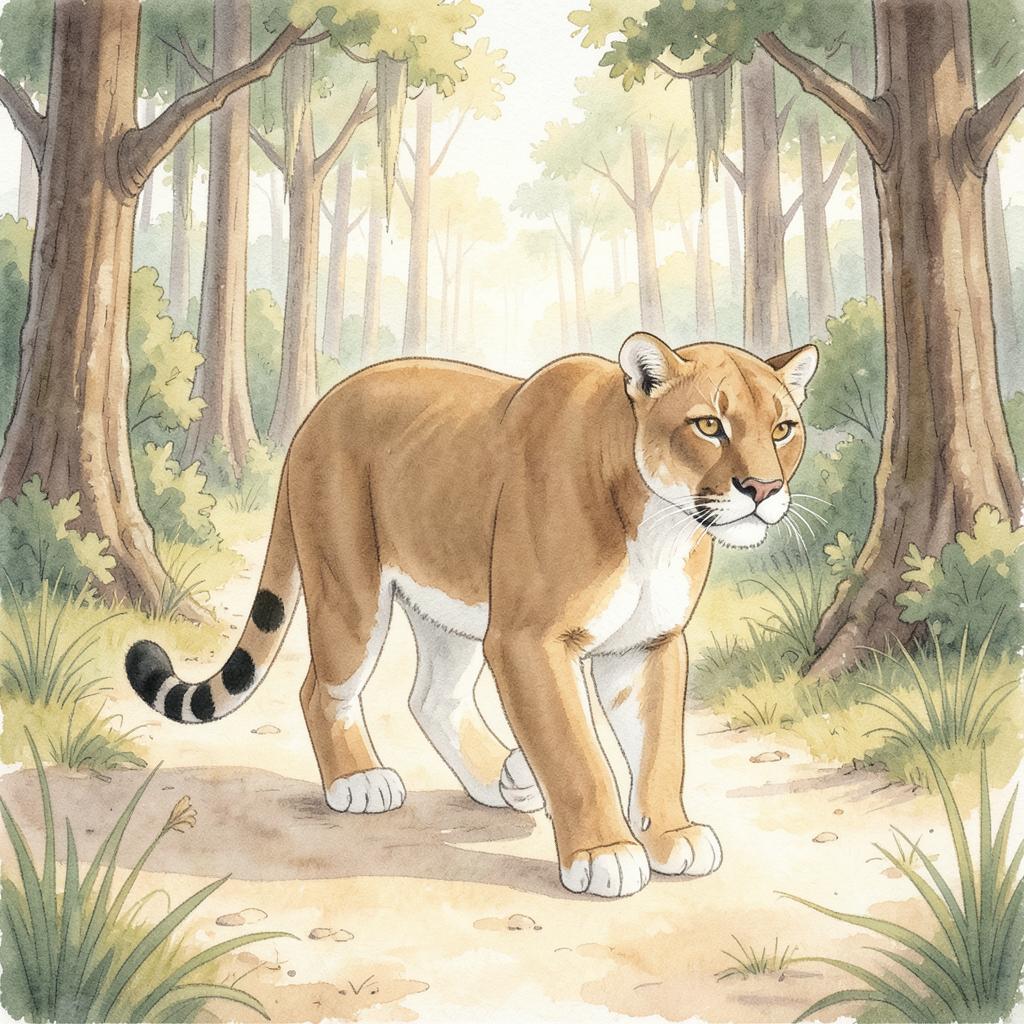
Illustrated Species Ambassador
Cypress — Florida Panther
I'm Cypress, an illustrated ambassador for the Florida panther. I am the last breeding puma population in the eastern United States, and I walk a long way every night.
- One fact worth knowing
- The Florida panther came back from near-collapse after a 1995 genetic rescue that brought Texas cougars into the population.
- What I depend on
- I depend on large connected blocks of cypress swamp, hammock and pine flatwoods, enough deer, and safe north-south corridors to move through.
- My greatest threat
- My greatest threats are vehicle collisions and the loss of that connected habitat.
- One way you can help
- Obey the reduced night speed limits in panther zones, and secure livestock and pets after dark in panther country.
This ambassador is an original illustration created for this project. It is an educational character, not a documentary image, and its statements follow the sourced record on this page. Artwork and rights record
Why this species matters
The Florida panther is proof that a genetic dead end can sometimes be reversed. The 1995 introduction of eight Texas cougars reversed inbreeding defects and roughly tripled the population — a documented, measurable rescue.
If it disappears: Extinction would remove the last eastern puma population and eliminate top-down control of deer and invasive hogs across south Florida's remaining wild lands.
Conservation status
- U.S. Endangered Species Act
- EndangeredListed 1967.Last verified 2026-09-08
- IUCN Red List
- Puma concolor is Least Concern range-wide; this subspecies is not separately assessedLast verified 2026-09-08
- Florida
- Endangered (state listed)Last verified 2026-09-08
Population
An estimated 120–230 adults and subadults in south Florida, excluding kittens still dependent on their mothers.
Trend: Stable
As reported: Florida Fish and Wildlife Conservation Commission estimate, most recently reaffirmed in the 2020s
Source: Florida Fish and Wildlife Conservation Commission; USFWS
Uncertainty: FWC publishes a range rather than a point estimate because panthers are counted by track, camera, and radio-collar data rather than direct census.
Historical: Reduced to an estimated 20–30 animals by the early 1990s with severe inbreeding effects.
Fragmentation: Breeding is still largely confined to south of the Caloosahatchee River.
Range and distribution
Historic range: Throughout the southeastern United States from Arkansas and Louisiana east to South Carolina and Florida.
Current range: Southwest Florida south of the Caloosahatchee River, with occasional male dispersal further north.
Range contraction: Now occupies roughly five percent of its historic range.
Regions occupied
- Southwest Florida
- Big Cypress and Everglades region
Habitat
Primary habitat: Cypress swamp, hardwood hammock, pine flatwoods, and mixed swamp forest.
Breeding habitat: Dens in dense palmetto thickets.
Feeding habitat: Hunts white-tailed deer and wild hogs across forest and prairie mosaic.
Critical habitat: No critical habitat has been designated for the Florida panther.
Habitat dependencies
- Large contiguous forest blocks
- Sufficient deer populations
- Safe north-south movement corridors
Biology and ecology
The region's apex terrestrial predator, controlling deer and hog numbers.
Important adaptations: Tolerates flooded and swampy terrain unusual for pumas; males require home ranges exceeding 200 square miles.
- Size
- About 6–7 feet long including tail.
- Weight
- Males roughly 100–160 pounds; females roughly 70–100 pounds.
- Lifespan
- Around 10–12 years in the wild.
- Diet
- White-tailed deer and wild hog primarily, with raccoon, armadillo, and alligator taken opportunistically.
- Reproduction
- Breeds year-round; gestation about 92–96 days.
- Offspring
- Typically 1–3 kittens.
- Breeding frequency
- Roughly every two years.
- Age at maturity
- About 2–3 years.
Primary threats
Vehicle collisions
Roadkill is the leading documented cause of panther death, with dozens of animals lost in some years.
Habitat loss
South Florida development continues to consume the forest and prairie the panther needs.
Habitat fragmentation
The Caloosahatchee River and Interstate 75 limit expansion northward.
Intraspecific conflict
Territorial fighting among males rises as habitat is compressed.
Disease
Feline leukemia and a still-unexplained neurological disorder have been documented in the population.
Conservation and recovery
Programs and efforts
- USFWS Florida Panther Recovery Program
- FWC panther monitoring, necropsy, and telemetry program
- 1995 genetic restoration using eight female Texas cougars
- Florida Wildlife Corridor land protection
Protected areas
- Florida Panther National Wildlife Refuge
- Big Cypress National Preserve
- Everglades National Park
- Picayune Strand State Forest
Legal protections
- Endangered Species Act listing
- Florida state endangered listing
Measurable progress
- Population grew from roughly 20–30 animals to well over 100 following genetic restoration
- Documented female panther reproduction north of the Caloosahatchee River in 2016, the first in decades
- Dozens of wildlife underpasses built along I-75 and other highways
Continuing challenges
- Roadkill losses
- Development pressure
- Need for a second breeding population outside south Florida
How people can help
What individuals can do
- Obey reduced night speed limits in panther zones and watch for crossing signs
- Secure livestock and pets at night in panther range
- Report panther sightings and roadkill to FWC
What communities can do
- Support the Florida Wildlife Corridor and wildlife underpass funding
Educational actions
- Use the 1995 genetic restoration as a case study in inbreeding and recovery
Habitat support
- Back conservation easements on ranchland between south and central Florida
Organizations and programs to learn about
- USFWS Florida Panther National Wildlife Refuge
- Florida Fish and Wildlife Conservation Commission
Educational notes
- One of the best-documented genetic rescues in wildlife management.
- Shows how a single interstate highway can define a species' range.