Reptiles and Amphibians
Eastern Hellbender
Cryptobranchus alleganiensis alleganiensis
North America's largest salamander, breathing through its skin in fast, clean streams and disappearing as those streams fill with silt.
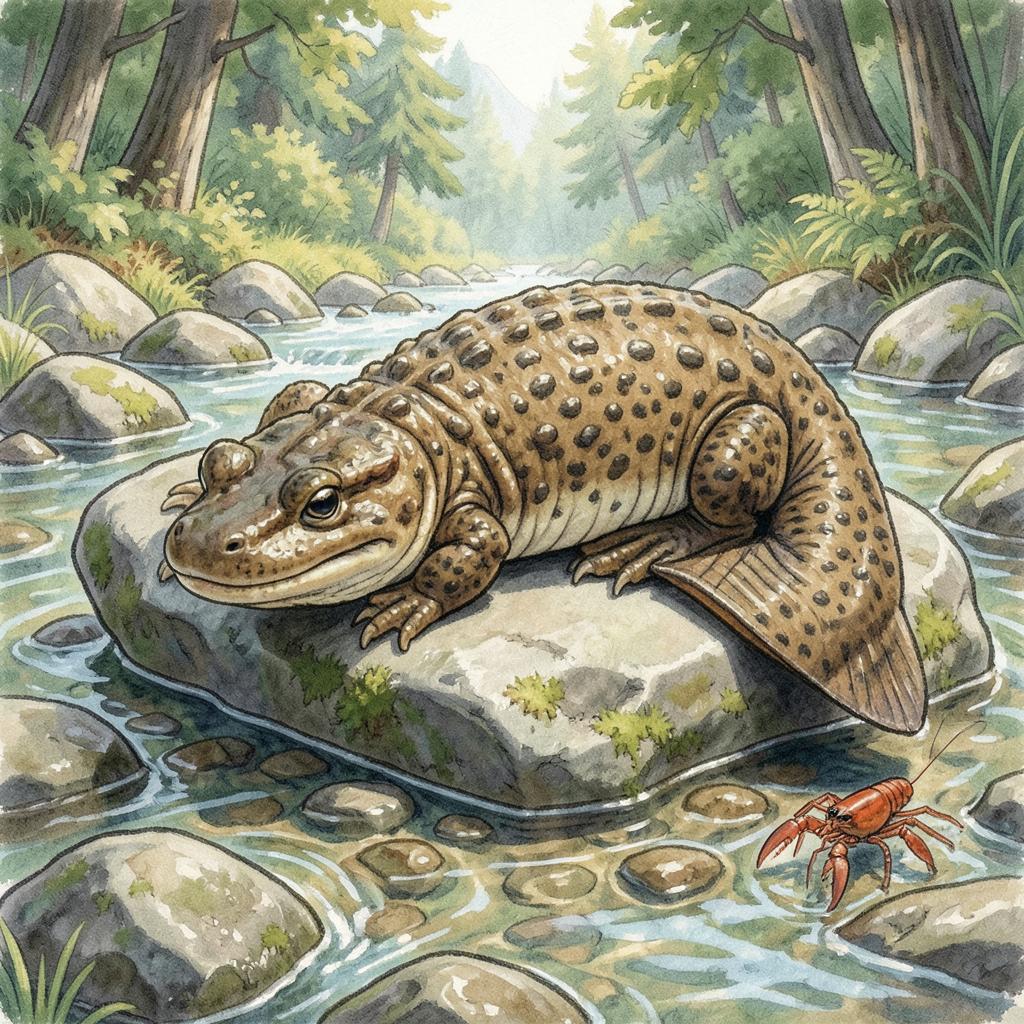
Illustrated Species Ambassador
Cobble — Eastern Hellbender
I'm Cobble, an illustrated ambassador for the eastern hellbender. I breathe through my skin, I hide under a flat rock, and I have never harmed anyone.
- One fact worth knowing
- The eastern hellbender is North America's largest salamander, reaching about 29 inches, and it breathes through its skin — which is why it needs cold, clean, fast water.
- What I depend on
- I depend on large flat rocks that have not been buried in silt, high oxygen and cool water, plenty of crayfish, and forested banks holding the soil in place.
- My greatest threat
- My greatest threat is sedimentation filling in the spaces between the stones of my stream.
- One way you can help
- Never move or flip large flat stream rocks — that destroys shelter and nest sites — and if you hook one while fishing, cut the line and let it go.
This ambassador is an original illustration created for this project. It is an educational character, not a documentary image, and its statements follow the sourced record on this page. Artwork and rights record
Why this species matters
A hellbender cannot live in a degraded stream. Where they persist, the water is genuinely clean and cool — which makes them one of the most honest biological measures of stream health in eastern North America.
If it disappears: Their disappearance would confirm widespread degradation of Appalachian headwater streams that supply drinking water to millions of people.
Conservation status
- IUCN Red List
- VulnerableSpecies-level assessment for Cryptobranchus alleganiensis.Last verified 2026-09-08
- U.S. Endangered Species Act
- The Ozark hellbender subspecies is listed as endangered; USFWS proposed listing the eastern hellbender as endangered in 2024Confirm whether the eastern hellbender proposal has been finalized before describing it as listed.Last verified 2026-09-08
- Multiple states
- State endangered, threatened, or of special concern across much of the rangeLast verified 2026-09-08
Population
Declining across most of the range. Long-term monitoring in several states documents population losses exceeding 70 percent at historic sites, with many streams now holding only aging adults and no juveniles.
Trend: Decreasing
As reported: USFWS species status assessment supporting the 2024 listing proposal
Source: U.S. Fish and Wildlife Service; state wildlife agency stream surveys
Uncertainty: The absence of juveniles at many sites indicates reproductive failure rather than simple adult mortality — a serious signal.
Fragmentation: Dams and degraded reaches isolate remaining stream populations from each other.
Range and distribution
Historic range: Cool, fast, rocky streams from New York and Pennsylvania south through the Appalachians to Georgia and west to Missouri and Arkansas.
Current range: Same broad range with many local extirpations and few reproducing populations.
Range contraction: Lost from a large share of historic stream reaches.
Regions occupied
- Appalachian states from New York to Georgia
- Ohio River basin
- Ozarks of Missouri and Arkansas
Habitat
Primary habitat: Cool, fast-flowing, well-oxygenated rocky streams and rivers.
Breeding habitat: Males guard nests beneath large flat rocks.
Feeding habitat: Hunts crayfish at night among stream cobble.
Habitat dependencies
- Large flat rocks that are not buried in silt
- High dissolved oxygen and cool water temperature
- Abundant crayfish
- Forested streamside buffers
Biology and ecology
A top stream invertebrate predator and a direct indicator of stream water quality.
Important adaptations: Absorbs nearly all its oxygen through loose folds of skin, which requires cold, fast, highly oxygenated water and makes it acutely sensitive to pollution and siltation.
- Size
- Up to about 29 inches — the largest salamander in North America.
- Weight
- Up to roughly 5 pounds.
- Lifespan
- 25–30 years or more in the wild.
- Diet
- Primarily crayfish, with fish and aquatic invertebrates.
- Reproduction
- Fertilization is external; males guard nests of eggs under rocks through incubation.
- Offspring
- Several hundred eggs per nest.
- Breeding frequency
- Once a year in late summer or fall.
- Age at maturity
- About 5–8 years.
Primary threats
Sedimentation
Silt from erosion, logging, and construction fills the spaces under rocks where hellbenders shelter and nest.
Pollution
Agricultural runoff, mine drainage, and chemical contaminants damage skin-breathing amphibians directly.
Habitat fragmentation
Dams block movement and warm the water above them.
Disease
Chytrid fungus and ranavirus have been detected in hellbender populations.
Persecution
Anglers historically killed hellbenders in the false belief that they harm game fish.
Illegal collection
Collection for the pet trade removes long-lived adults that take years to replace.
Climate change
Warmer, flashier streams reduce dissolved oxygen and scour nest sites.
Conservation and recovery
Programs and efforts
- USFWS listing process and species status assessment
- Head-starting programs at the Saint Louis Zoo, Nashville Zoo, Buffalo Zoo, and partners, raising larvae for release
- Artificial nest box installation in degraded streams
- Riparian buffer planting and streambank stabilization programs
Protected areas
- Appalachian national forests
- State scenic rivers and protected stream reaches
Legal protections
- Endangered Species Act (Ozark subspecies)
- State-level protections across much of the range
- CITES Appendix III listing for the genus
Measurable progress
- Head-started hellbenders have been successfully released and recaptured years later
- Artificial nest boxes have documented successful reproduction
Continuing challenges
- Sedimentation is diffuse and hard to regulate
- Reproductive failure at many sites is not fully explained
- Long maturation slows recovery
How people can help
What individuals can do
- Never move or flip large flat stream rocks — that destroys nest and shelter sites
- If you catch a hellbender while fishing, cut the line and release it; it is harmless and does not eat game fish
- Do not collect hellbenders; adults take years to replace
What communities can do
- Support streamside forest buffers and erosion control at construction sites
- Report sediment discharge into streams
Educational actions
- Use the hellbender as the classroom definition of an indicator species
Habitat support
- Plant and protect trees along creek banks to keep water cool and hold soil in place
Organizations and programs to learn about
- USFWS
- Saint Louis Zoo Ron Goellner Center for Hellbender Conservation
- state wildlife agencies
Educational notes
- Breathes almost entirely through its skin — the reason it cannot tolerate poor water quality.
- Regional nicknames like 'snot otter' and 'devil dog' make it memorable for younger audiences.