Urban Wildlife at Risk
Common Nighthawk
Chordeiles minor
A bird that nests on bare gravel rooftops in cities and is disappearing as flat roofs are resurfaced with smooth membrane.
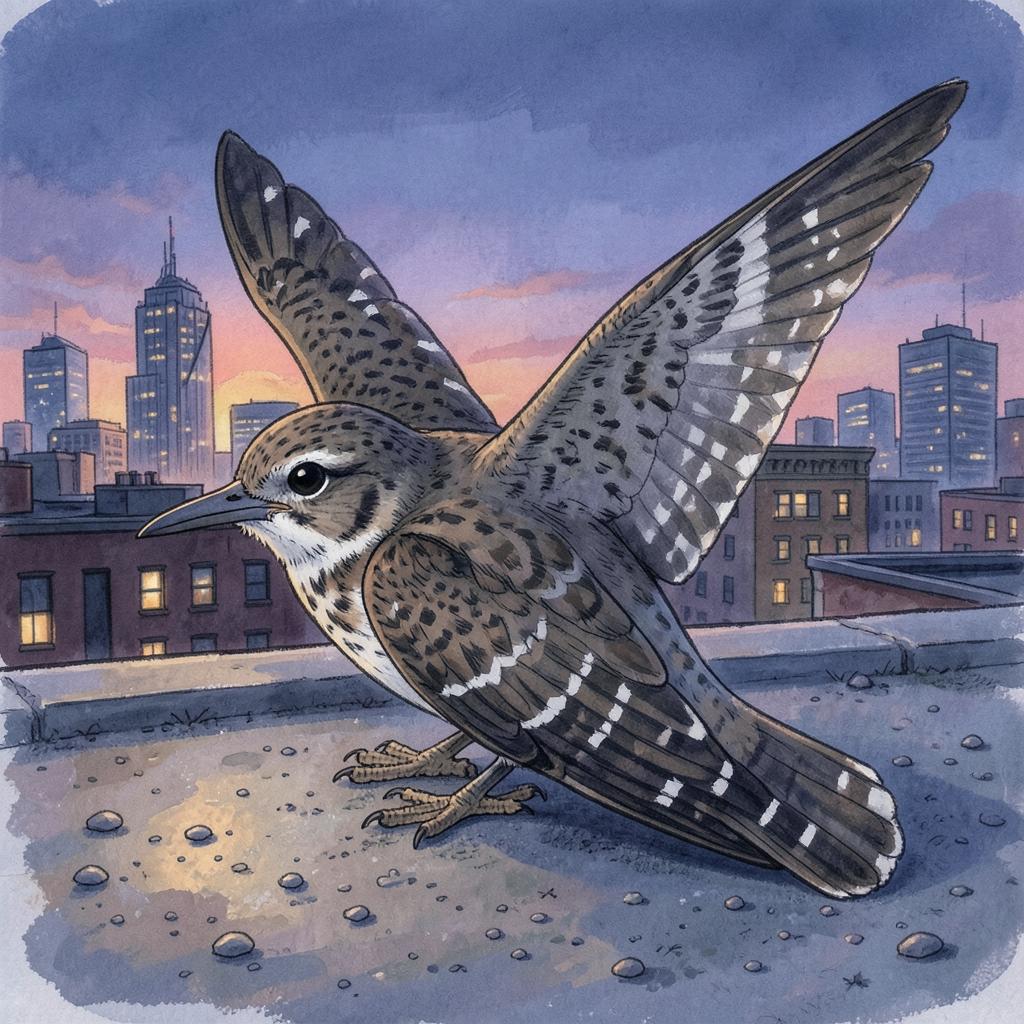
Illustrated Species Ambassador
Dusk — Common Nighthawk
I'm Dusk, an illustrated ambassador for the common nighthawk. Watch the sky above your street just after sunset in early summer and you may hear me boom.
- One fact worth knowing
- Common nighthawks nest on bare gravel, including flat gravel rooftops in cities, and are declining as those roofs are resurfaced with smooth membrane.
- What I depend on
- I depend on bare open substrate to nest on — gravel, sand, rock or a gravel roof — plenty of flying moths and beetles, and open sky to feed in.
- My greatest threat
- My greatest threat is the loss of gravel rooftops together with the decline of flying insects.
- One way you can help
- If you own or manage a flat-roofed building, add gravel pads in the corners; it is small and inexpensive and it makes nest sites.
This ambassador is an original illustration created for this project. It is an educational character, not a documentary image, and its statements follow the sourced record on this page. Artwork and rights record
Why this species matters
Nighthawks nested on city rooftops for generations. Replacing gravel roofs with smooth membrane — a routine, sensible building decision — removed that habitat almost invisibly. It shows how construction standards quietly determine which wildlife a city can hold.
If it disappears: Cities and open country would lose one of the few birds hunting insects at dusk, a niche largely shared only with bats.
Conservation status
- IUCN Red List
- Least ConcernThe global range is very large, which keeps the IUCN category low despite steep regional declines. Do not read Least Concern as 'not declining'.Last verified 2026-09-08
- Canada (SARA)
- Special ConcernLast verified 2026-09-08
- Migratory Bird Treaty Act
- ProtectedLast verified 2026-09-08
- Partners in Flight
- Common Bird in Steep DeclineLast verified 2026-09-08
Population
Breeding Bird Survey data indicate a long-term decline of roughly one to two percent per year across North America, amounting to the loss of a large share of the population since 1970.
Trend: Decreasing
As reported: North American Breeding Bird Survey trend analyses, 1970–present
Source: U.S. Geological Survey Breeding Bird Survey; Partners in Flight
Uncertainty: Nighthawks are crepuscular and hard to survey with standard morning counts, so trends carry more uncertainty than for daytime songbirds.
Historical: Historically abundant, with rooftop nesting common in cities through the mid-twentieth century.
Range and distribution
Historic range: Across most of North America from central Canada to Central America; winters in South America.
Current range: Same broad range, with sharp declines in urban nesting.
Migration: One of the longest migrations of any North American bird, reaching southern South America.
Regions occupied
- Most of the United States and southern Canada (breeding)
- Central America (migration)
- South America (wintering)
Habitat
Primary habitat: Open habitat with bare ground — prairie, burned areas, sandy openings, gravel bars, and flat gravel rooftops.
Breeding habitat: Lays eggs directly on bare gravel or soil with no nest structure at all.
Feeding habitat: Catches flying insects on the wing at dusk and dawn, often around streetlights.
Habitat dependencies
- Bare, open substrate for nesting — gravel, sand, rock, or gravel roof
- Abundant flying insects, especially moths and beetles
- Open sky for aerial foraging
Biology and ecology
A major aerial insectivore active at dusk, when few other birds are feeding.
Important adaptations: An enormous gaping mouth for catching insects in flight, and cryptic plumage so effective that a nesting bird is almost invisible on gravel. The male's diving display produces a booming sound from air rushing through the wing feathers.
- Size
- About 9 inches long with a wingspan near 2 feet.
- Weight
- Roughly 65 to 100 grams.
- Lifespan
- Up to about 9 years recorded.
- Diet
- Flying insects — moths, beetles, flying ants, and mosquitoes.
- Reproduction
- Two eggs laid directly on bare substrate; the female relies on camouflage rather than concealment.
- Offspring
- Usually two eggs.
- Breeding frequency
- One or two broods per year.
- Age at maturity
- One year.
Primary threats
Loss of nesting substrate
Gravel roofs have been widely replaced with smooth rubber or membrane surfaces that offer no nest site.
Insect decline
Aerial insectivores as a group are declining faster than almost any other bird guild, tracking flying insect losses.
Pesticides
Insecticide use reduces prey and may expose birds through their diet.
Habitat loss
Loss of open ground habitat — burned areas, prairie, and sandy openings — reduces natural nesting sites.
Fire suppression
Suppression of natural fire eliminates the open burned ground the species nests on.
Predation
Rooftop nests are vulnerable to crows, gulls, and cats where access exists.
Collisions
Low dusk flight over roads leads to frequent vehicle collisions.
Conservation and recovery
Programs and efforts
- Gravel pad installation on membrane roofs to restore nesting sites
- Nightjar Survey Network community science monitoring
- Partners in Flight aerial insectivore conservation planning
- Canadian recovery planning under Special Concern status
Protected areas
- Prairie and grassland preserves providing natural open-ground nesting habitat
Legal protections
- Migratory Bird Treaty Act
- Canadian Species at Risk Act
Measurable progress
- Gravel pads placed on flat roofs have been successfully used for nesting in several cities
- Volunteer nightjar surveys have improved trend data for a hard-to-survey species
Continuing challenges
- Roofing standards are driven by cost and durability, not wildlife
- Insect decline is broad and poorly understood
- Standard bird surveys undercount crepuscular species
How people can help
What individuals can do
- If you own or manage a flat-roofed building, add gravel pads in the corners — a small, inexpensive change that creates nest sites
- Reduce outdoor insecticide use
- Watch and listen for the male's booming dive display at dusk in early summer, and report sightings to eBird
What communities can do
- Encourage gravel pad installation on municipal and school buildings
- Support dark-sky and reduced-pesticide policies
Educational actions
- Join the Nightjar Survey Network — dusk surveys are one of the few ways to monitor this species
Habitat support
- Support prescribed fire and open-ground habitat management on natural lands
Organizations and programs to learn about
- Center for Conservation Biology Nightjar Survey Network
- Audubon
- Cornell Lab of Ornithology
Educational notes
- Not a hawk, and not strictly nocturnal — it feeds mainly at dusk and dawn.
- Builds no nest at all; eggs are laid directly on bare gravel.
- A Least Concern global status can coexist with a steep regional decline.
Sources and references
- IUCN Red List — Chordeiles minor — IUCN
- Cornell Lab of Ornithology — Common Nighthawk — Cornell Lab of Ornithology
- Partners in Flight Avian Conservation Assessment Database — Partners in Flight