Freshwater Species
Comal Springs Riffle Beetle
Heterelmis comalensis
A beetle the size of a grain of rice that lives only where Edwards Aquifer water emerges at two Texas spring systems.
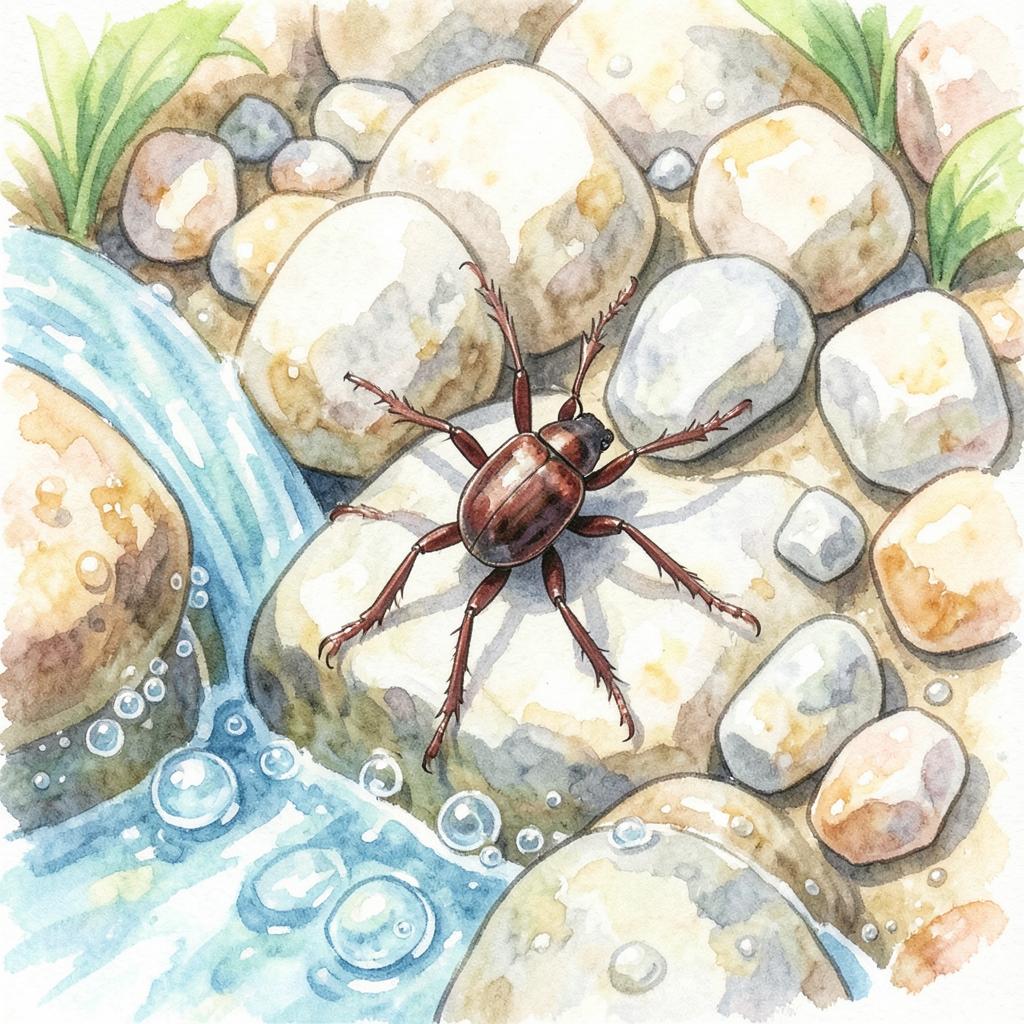
Illustrated Species Ambassador
Grit — Comal Springs Riffle Beetle
I'm Grit, an illustrated ambassador for the Comal Springs riffle beetle. I am about the size of a grain of rice, and I live where the water comes out of the ground.
- One fact worth knowing
- This beetle lives only at two Texas spring systems, in the gravel right at the spring openings where Edwards Aquifer water emerges.
- What I depend on
- I depend on continuous spring discharge, the constant temperature and chemistry the aquifer gives it, and clean gravel with spaces between the stones.
- My greatest threat
- My greatest threat is the loss of spring discharge from aquifer pumping and drought.
- One way you can help
- Conserve water — Edwards Aquifer pumping decides whether these springs keep flowing at all — and never tip anything onto the ground in karst recharge country.
This ambassador is an original illustration created for this project. It is an educational character, not a documentary image, and its statements follow the sourced record on this page. Artwork and rights record
Why this species matters
A beetle two millimeters long, living only where water leaves the ground at two Texas springs, is a precise measure of the Edwards Aquifer. If the springs slow, it is among the first species to be affected, and its condition tells the region something about its water long before people notice.
If it disappears: Its loss would indicate failing spring discharge, threatening the fountain darter, Texas wild rice, the San Marcos salamander, and the whole endemic spring community with it.
Conservation status
- U.S. Endangered Species Act
- EndangeredListed 1997, with designated critical habitat.Last verified 2026-09-08
- IUCN Red List
- Not assessedLast verified 2026-09-08
- NatureServe
- Critically ImperiledLast verified 2026-09-08
Population
Monitored by cotton lure sampling at spring outlets, with abundance reported as catch per sampling effort. Numbers vary with spring discharge and no total population estimate exists.
Trend: Unknown
As reported: Edwards Aquifer Habitat Conservation Plan biological monitoring, ongoing
Source: Edwards Aquifer Authority; U.S. Fish and Wildlife Service
Uncertainty: Sampling detects presence and relative abundance only. Absence in a sample does not indicate absence at a spring.
Historical: Described only in 1988; long-term historic baseline data do not exist.
Fragmentation: Confined to two spring systems roughly 20 miles apart with no connection between them.
Range and distribution
Historic range: Comal Springs in New Braunfels and San Marcos Springs, Texas, as far as records show.
Current range: The same two spring systems, plus refugia populations held in captivity.
Range contraction: Unknown, given the short record; the Comal Springs stopped flowing entirely during the 1950s drought.
Regions occupied
- Comal County, Texas
- Hays County, Texas
Habitat
Primary habitat: Gravel and cobble immediately at spring orifices where aquifer water emerges.
Breeding habitat: Larvae develop in the same gravel interstices at spring outlets.
Feeding habitat: Grazes on biofilm and decaying plant material in spring gravel.
Critical habitat: Critical habitat designated at Comal and San Marcos springs.
Habitat dependencies
- Continuous spring discharge — the beetle lives only where water emerges
- Constant water temperature and chemistry from the aquifer
- Clean gravel with interstitial spaces and organic material
Biology and ecology
A decomposer and grazer in one of the most restricted aquatic ecosystems in North America.
Important adaptations: Adults do not fly and cannot swim well. They breathe using a plastron — a layer of air trapped by fine hairs — which requires the highly oxygenated water only a flowing spring supplies.
- Size
- About 2 millimeters long.
- Lifespan
- Not well established.
- Diet
- Biofilm, algae, and decaying plant material.
- Reproduction
- Eggs are laid in spring gravel; details are incompletely known.
- Offspring
- Not established.
- Breeding frequency
- Not established.
- Age at maturity
- Not established.
Primary threats
Groundwater pumping
Edwards Aquifer withdrawal reduces spring discharge; without flow at the orifice the habitat ceases to exist.
Drought
Comal Springs ceased flowing entirely during the drought of record in the 1950s.
Water quality
Urban runoff and contaminant spills reach the springs through the karst aquifer quickly and with little filtration.
Sedimentation
Silt fills the gravel spaces the beetle lives in.
Recreation impacts
Heavy human use of the spring runs disturbs gravel habitat at the outlets.
Extremely restricted range
Two spring systems constitute the entire known global range.
Invasive species
Introduced aquatic species alter conditions at the spring outlets.
Conservation and recovery
Programs and efforts
- Edwards Aquifer Habitat Conservation Plan, which guarantees minimum spring flows for listed species
- Refugia populations maintained at the USFWS San Marcos Aquatic Resources Center
- Long-term cotton lure monitoring at both spring systems
- Spring run habitat restoration and sediment management
Protected areas
- Landa Park spring run, New Braunfels
- Spring Lake and the San Marcos River headwaters
- Designated critical habitat
Legal protections
- Endangered Species Act
- Designated critical habitat
- Edwards Aquifer Authority pumping limits and drought-stage restrictions
Measurable progress
- Captive refugia populations have been successfully maintained, providing insurance against a drying event
- The Edwards Aquifer Habitat Conservation Plan established enforceable minimum flow targets
Continuing challenges
- Regional water demand continues to grow
- Basic life history remains poorly documented
- A drought of record would threaten the entire species
How people can help
What individuals can do
- Conserve water — Edwards Aquifer pumping directly determines whether these springs keep flowing
- Never dump anything on the ground in karst recharge areas; it reaches the springs quickly
- Stay out of spring outlet areas when swimming or tubing
What communities can do
- Support Edwards Aquifer Habitat Conservation Plan implementation and drought-stage restrictions
- Back recharge zone protection ordinances
Educational actions
- Use this beetle to teach that some species measure a resource more accurately than any gauge
Habitat support
- Support spring run restoration and sediment control at Comal and San Marcos
Organizations and programs to learn about
- Edwards Aquifer Authority
- USFWS San Marcos Aquatic Resources Center
- The Meadows Center for Water and the Environment
Educational notes
- Not described by science until 1988 — a reminder that species can be discovered and endangered almost simultaneously.
- The plastron breathing structure requires flowing, highly oxygenated water and cannot work in still water.
Sources and references
- U.S. Fish and Wildlife Service — Comal Springs Riffle Beetle — USFWS
- Edwards Aquifer Habitat Conservation Plan — Edwards Aquifer Authority
- NatureServe Explorer — NatureServe