Global Endangered Species
Chinese Pangolin
Manis pentadactyla
A scaled, ant-eating mammal from southern Asia, trafficked in such volume that it has been functionally lost across much of its historic range.
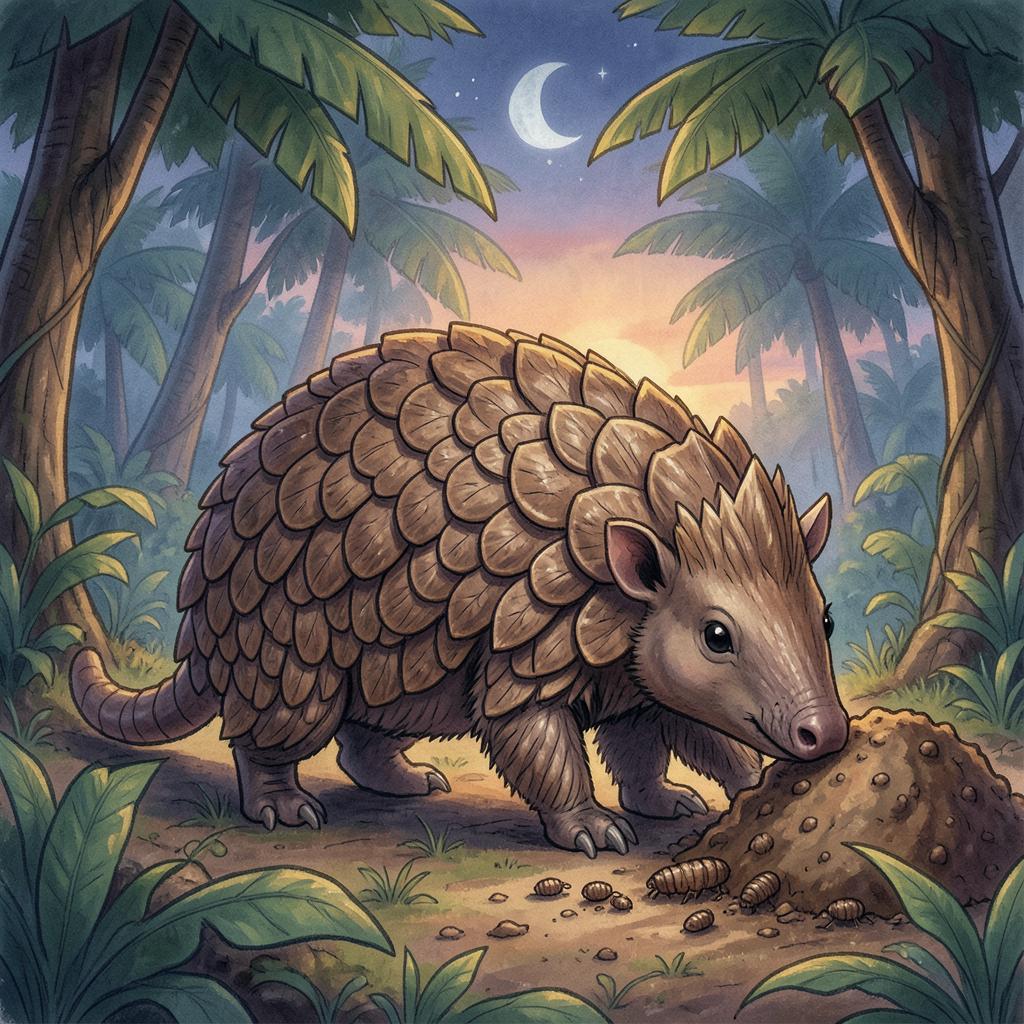
Illustrated Species Ambassador
Shan — Chinese Pangolin
I'm Shan, an illustrated ambassador for the Chinese pangolin. I dig at night, I eat ants, and when I am afraid I roll into a ball.
- One fact worth knowing
- Pangolin scales are keratin — the same material as your fingernails. Trafficking has been heavy enough that the Chinese pangolin has been lost across much of its historic range.
- What I depend on
- I depend on abundant ant and termite colonies, soil I can burrow into, and low hunting pressure. Habitat alone is not enough for me if the hunting continues.
- My greatest threat
- My greatest threat is poaching and international wildlife trafficking.
- One way you can help
- Never buy pangolin products of any kind, and tell people the plain fact that the scales are only keratin.
This ambassador is an original illustration created for this project. It is an educational character, not a documentary image, and its statements follow the sourced record on this page. Artwork and rights record
Why this species matters
The pangolin's defense is perfect against a leopard and useless against a person with a sack. It is the clearest illustration in conservation that an adaptation is only ever suited to the threats a species evolved with, and it is widely reported as the most trafficked wild mammal on earth.
If it disappears: Forests would lose a major natural regulator of ants and termites, and the world would lose one of only eight species in an ancient and entirely distinct mammalian order.
Cultural and regional note: Demand is driven by meat consumed as a luxury and by scales used in some traditional medicine. Pangolin scales are made of keratin — the same material as human fingernails — and there is no established medicinal basis for their use.
Conservation status
- IUCN Red List
- Critically EndangeredLast verified 2026-09-08
- CITES
- Appendix IAll eight pangolin species were moved to Appendix I in 2016, prohibiting commercial international trade.Last verified 2026-09-08
- U.S. Endangered Species Act
- EndangeredLast verified 2026-09-08
- China
- Class I State Protected AnimalUpgraded to the highest national protection level in 2020.Last verified 2026-09-08
Population
No reliable global population estimate exists. IUCN documents declines exceeding 80 percent over roughly three generations, with the species functionally extirpated across much of mainland China.
Trend: Decreasing
As reported: IUCN Red List assessment and national survey reporting
Source: IUCN Red List; IUCN SSC Pangolin Specialist Group
Uncertainty: Pangolins are nocturnal, solitary, and burrow-dwelling, which makes counting them extremely difficult. Trade seizure volumes are often the best available indicator of scale, not a population census.
Historical: Historically widespread and locally common across southern China and northern Southeast Asia.
Fragmentation: Remaining populations are small, scattered, and heavily hunted; Taiwan holds one of the better-studied populations.
Range and distribution
Historic range: Southern China, Taiwan, Hong Kong, northeastern India, Nepal, Bhutan, Bangladesh, Myanmar, Thailand, Laos, and Vietnam.
Current range: Severely reduced across the range; Taiwan and parts of Nepal and northeast India retain the most studied remaining populations.
Range contraction: Functionally lost from most of mainland China and much of Vietnam and Laos.
Regions occupied
- Southern China
- Taiwan
- Northeast India and Nepal
- Northern Myanmar, Laos, and Vietnam
Habitat
Primary habitat: Subtropical and broadleaf forest, bamboo, grassland, and agricultural mosaic with termite and ant colonies.
Breeding habitat: Gives birth in a burrow, which the female digs herself.
Feeding habitat: Excavates ant and termite nests using powerful claws.
Seasonal differences: Digs deeper winter burrows in the northern part of its range.
Habitat dependencies
- Abundant ant and termite colonies
- Soil suitable for burrowing
- Low hunting pressure — habitat alone is not sufficient
Biology and ecology
Controls ant and termite populations — a single pangolin may consume many millions of insects a year — and its burrows shelter other species.
Important adaptations: The only mammals covered in keratin scales. They roll into an armored ball when threatened, which defeats natural predators completely and makes them trivially easy for a human to pick up.
- Size
- Head and body roughly 20 inches, plus tail.
- Weight
- Typically 4 to 15 pounds.
- Lifespan
- Around 20 years in captivity; wild lifespan poorly documented.
- Diet
- Ants and termites almost exclusively.
- Reproduction
- Usually a single offspring after a gestation of several months.
- Offspring
- One per birth, occasionally two.
- Breeding frequency
- About once per year.
- Age at maturity
- Around one to two years.
Primary threats
Wildlife trafficking
Pangolins are trafficked in enormous volumes for scales and meat; individual seizures have involved many tons of scales at a time.
Poaching
Hunting is easy and low-risk because the animal's defensive response is to curl up rather than flee.
Habitat loss
Forest clearing for agriculture and development reduces the remaining range.
Loss of prey
Pesticide use and land conversion reduce ant and termite availability.
Slow reproduction
A single offspring per year means populations cannot absorb heavy offtake or rebound quickly.
Enforcement gaps
Trafficking networks cross many jurisdictions with uneven enforcement capacity.
Captive breeding difficulty
Pangolins do poorly in captivity, so captive breeding is not currently a viable safety net.
Conservation and recovery
Programs and efforts
- CITES Appendix I listing prohibiting commercial international trade in all pangolin species
- IUCN SSC Pangolin Specialist Group range-wide conservation strategy
- China's 2020 elevation of pangolins to Class I protection and removal of pangolin scales from the official pharmacopoeia listing
- Anti-trafficking enforcement, detection dog programs, and port screening
- Community-based conservation and former-hunter engagement in Nepal and Taiwan
- Rescue and rehabilitation centers for confiscated animals
Protected areas
- Protected forest reserves across Nepal, India, Taiwan, and southern China
Legal protections
- CITES Appendix I
- China Class I State Protected Animal
- National protection laws across most range states
- U.S. Endangered Species Act listing
Measurable progress
- Chinese national protection was substantially strengthened in 2020
- Major trafficking seizures and prosecutions have increased
- Taiwan's pangolin population is among the better-documented and comparatively better protected
Continuing challenges
- Demand persists
- Captive breeding remains largely unsuccessful
- The species is hard to survey, so declines are detected late
How people can help
What individuals can do
- Never purchase pangolin products of any kind, including scales in traditional remedies or leather goods
- Report suspected wildlife products to authorities when travelling
- Learn and share that pangolin scales are keratin, identical in material to fingernails
What communities can do
- Support demand-reduction education campaigns in consumer markets
- Back customs and port detection programs
Educational actions
- Teach pangolins as a trafficking case study rather than only a habitat-loss case study
Habitat support
- Support forest protection and community conservation programs in range states
Organizations and programs to learn about
- IUCN SSC Pangolin Specialist Group
- TRAFFIC
- Save Pangolins
- national wildlife authorities in range states
Educational notes
- Pangolins are the only mammals with true keratin scales.
- Widely described as the most trafficked wild mammal in the world.
- They belong to their own order, Pholidota — not closely related to armadillos or anteaters despite the resemblance.
Related educational project
Pango's Secret Armor: The Little Creature Who Needed Big Friends
A children's educational story from Crowned Compass Publishing that introduces young readers to pangolins and why they need protection. The story is a work of fiction; the scientific record above is kept entirely separate from it.
Learn about this project →Sources and references
- IUCN Red List — Manis pentadactyla — IUCN
- CITES Appendices — CITES
- IUCN SSC Pangolin Specialist Group — IUCN SSC
- U.S. Fish and Wildlife Service — Pangolins — USFWS