Mammals
Black-footed Ferret
Mustela nigripes
North America's only native ferret, twice believed extinct, entirely dependent on prairie dog colonies for food and shelter.
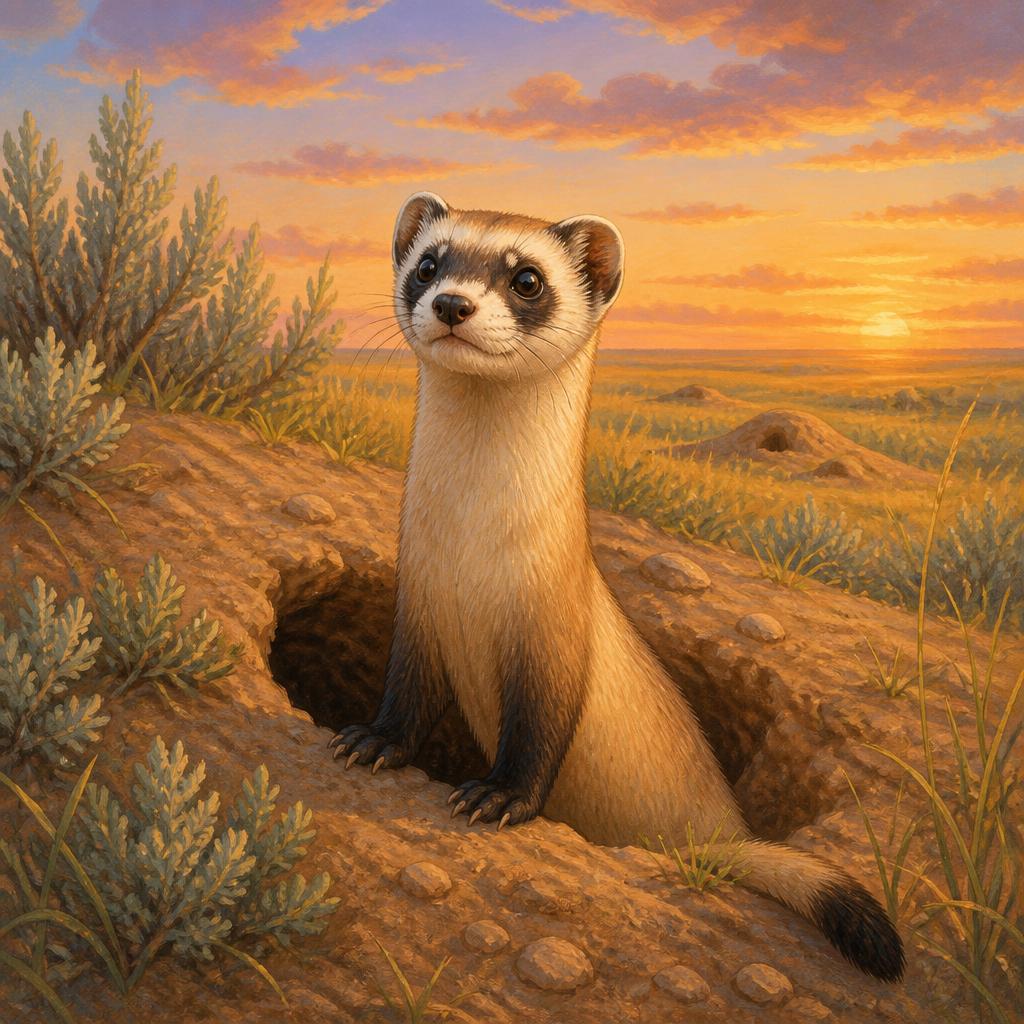
Illustrated Species Ambassador
Pip — Black-footed Ferret
Welcome. I'm Pip, an illustrated ambassador for the black-footed ferret. I do my living underground and my hunting at night, so most people have never met one of us.
- One fact worth knowing
- The black-footed ferret was once believed extinct. A small surviving population discovered in Wyoming in 1981 became the foundation of a remarkable captive-breeding and reintroduction program. More recently, cloning from preserved cells has begun restoring genetic diversity that was absent from the original breeding population.
- What I depend on
- I depend almost entirely on prairie dogs — for food and for the burrows I shelter and raise young in. Where prairie dog colonies disappear, so do we.
- My greatest threat
- My greatest threat is the loss of prairie dog colonies, through habitat conversion and sylvatic plague, which kills both prairie dogs and ferrets.
- One way you can help
- Support conservation of intact prairie dog colonies on public and private grassland — protecting the colony protects the ferret.
This ambassador is an original illustration created for this project. It is an educational character, not a documentary image, and its statements follow the sourced record on this page. Artwork and rights record
Why this species matters
The ferret cannot be saved by itself. Recovering it requires recovering prairie dog colonies, which means recovering functioning prairie — a habitat that has been reduced further than almost any other in North America.
If it disappears: Extinction would remove the last native ferret in the Americas and confirm the collapse of the prairie dog ecosystem that supports burrowing owls, swift foxes, ferruginous hawks, and many others.
Conservation status
- IUCN Red List
- EndangeredLast verified 2026-09-08
- U.S. Endangered Species Act
- EndangeredListed 1967.Last verified 2026-09-08
- CITES
- Appendix ILast verified 2026-09-08
Population
Roughly 300–400 ferrets in the wild across reintroduction sites, supported by about 300 animals in captive breeding facilities.
Trend: Unknown
As reported: USFWS Black-footed Ferret Recovery Program reporting, 2023–2024
Source: U.S. Fish and Wildlife Service; IUCN Red List
Uncertainty: Wild numbers swing sharply with plague outbreaks in prairie dog colonies, so single-year figures are not a reliable trend.
Historical: Believed extinct in 1979; a small population was discovered near Meeteetse, Wyoming in 1981, and all living ferrets descend from seven of those founders.
Fragmentation: Wild ferrets occupy roughly 30 scattered reintroduction sites with little natural exchange between them.
Range and distribution
Historic range: Shortgrass and mixed-grass prairie from southern Canada through the Great Plains into northern Mexico, including the Texas panhandle.
Current range: Reintroduction sites in Wyoming, South Dakota, Montana, Colorado, Arizona, Kansas, New Mexico, Utah, Canada, and Mexico.
Range contraction: Prairie dog colonies, and with them ferret habitat, have been reduced by roughly 95 percent or more from historic extent.
Regions occupied
- Great Plains states
- Saskatchewan, Canada
- Chihuahua, Mexico
Habitat
Primary habitat: Active prairie dog colonies in shortgrass and mixed-grass prairie.
Breeding habitat: Raises kits inside prairie dog burrows.
Feeding habitat: Hunts prairie dogs underground at night.
Habitat dependencies
- Large, plague-free prairie dog colonies
- Continuous burrow systems
Biology and ecology
Specialist predator of prairie dogs and an indicator of intact prairie dog ecosystems.
Key relationships: Obligate dependence on a single prey genus makes it uniquely vulnerable to that prey's decline.
Important adaptations: Long, narrow body built for hunting inside burrows; almost entirely nocturnal.
- Size
- About 18–24 inches long including tail.
- Weight
- Approximately 1.4–2.5 pounds.
- Lifespan
- Around 3–4 years in the wild.
- Diet
- Prairie dogs make up roughly 90 percent of the diet.
- Reproduction
- Breeds in March and April; young emerge above ground in July.
- Offspring
- Average litter of 3–4 kits.
- Breeding frequency
- One litter per year.
- Age at maturity
- About 1 year.
Primary threats
Habitat loss
Conversion of prairie to cropland and long-running prairie dog eradication removed the ferret's only food supply.
Disease
Sylvatic plague, an introduced bacterial disease, kills both prairie dogs and ferrets and can eliminate a colony within a season.
Disease (canine distemper)
Distemper is lethal to ferrets and drove the collapse of the last known wild population in the 1980s.
Small population size
Descent from seven founders leaves very low genetic diversity.
Poisoning
Rodenticides used against prairie dogs remove ferret prey and can poison ferrets directly.
Conservation and recovery
Programs and efforts
- USFWS National Black-footed Ferret Conservation Center captive breeding
- Plague management through insecticide dusting and oral sylvatic plague vaccine baits
- Reintroduction to more than two dozen sites across the historic range
- Cloning of a historic founder genome to add genetic diversity, first achieved in 2020
Protected areas
- Conata Basin, South Dakota
- Rocky Mountain Arsenal National Wildlife Refuge
- Charles M. Russell National Wildlife Refuge
Legal protections
- Endangered Species Act listing
- CITES Appendix I
Measurable progress
- Recovered from 18 surviving animals in the 1980s to hundreds in the wild
- Successful cloning of an unrelated founder, adding new genetic material to the lineage
Continuing challenges
- Plague remains the dominant limiting factor
- Prairie dog colonies remain small and scattered
- Landowner tolerance of prairie dogs
How people can help
What individuals can do
- Avoid rodenticide use near prairie dog towns
- Support ranchers who tolerate prairie dog colonies on working land
What communities can do
- Back plague vaccination and dusting programs on public and tribal lands
Educational actions
- Use the ferret to teach obligate predator-prey dependence
Habitat support
- Support shortgrass prairie protection and prairie dog colony restoration
Organizations and programs to learn about
- USFWS Black-footed Ferret Recovery Program
- Prairie Wildlife Research
Educational notes
- One of very few species to be rediscovered after being declared extinct.
- A clear illustration that saving a predator means saving its prey first.