Birds
Black-capped Vireo
Vireo atricapilla
A small shrubland songbird removed from the U.S. endangered list in 2018 after recovery, and still dependent on active habitat management.
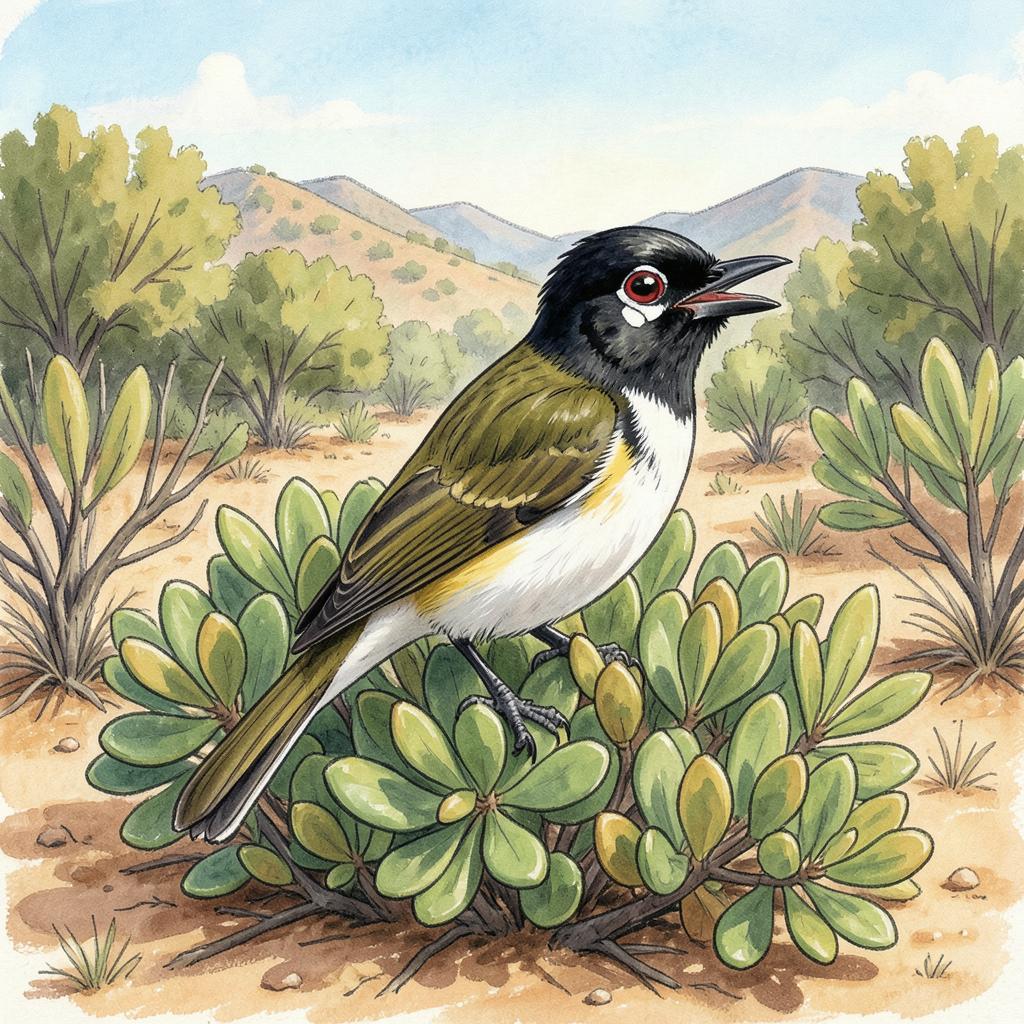
Illustrated Species Ambassador
Cinder — Black-capped Vireo
I'm Cinder, an illustrated ambassador for the black-capped vireo. I like land that has recently burned or been browsed — the scruffy stage between bare ground and closed woodland.
- One fact worth knowing
- The black-capped vireo was removed from the United States endangered species list in 2018 after recovery, and still depends on active habitat management to stay recovered.
- What I depend on
- I need low, clumped, broad-leaved shrubs with open ground between the clumps — habitat that disappears without fire, browsing, or mechanical management.
- My greatest threat
- My greatest threats are shrubland growing into closed woodland, and cowbirds laying eggs in my nest.
- One way you can help
- Keep patchy native shrub cover rather than clearing it or letting it close in, and keep cattle feeding sites away from vireo habitat.
This ambassador is an original illustration created for this project. It is an educational character, not a documentary image, and its statements follow the sourced record on this page. Artwork and rights record
Why this species matters
The black-capped vireo is one of the few U.S. birds delisted because it actually recovered. It also shows that some species need periodic disturbance — a landscape left completely alone grows past what they can use.
If it disappears: A renewed decline would undercut confidence in delisting decisions and signal that shrubland management has lapsed across its range.
Conservation status
- IUCN Red List
- Near ThreatenedLast verified 2026-09-08
- U.S. Endangered Species Act
- Delisted due to recovery in 2018Post-delisting monitoring is ongoing; delisting does not remove Migratory Bird Treaty Act protection.Last verified 2026-09-08
- Texas
- Tracked as a species of greatest conservation needLast verified 2026-09-08
Population
More than 14,000 birds documented across Texas, Oklahoma, and Mexico at the time of the 2018 delisting, up from fewer than 350 known birds when listed in 1987.
Trend: Stable
As reported: USFWS delisting rule and post-delisting monitoring plan, 2018
Source: U.S. Fish and Wildlife Service
Uncertainty: The rise reflects both real recovery and far more thorough survey effort, especially in Mexico, where much of the population was previously uncounted.
Historical: Historically bred as far north as Kansas; that northern portion of the range was lost.
Range and distribution
Historic range: From Kansas and Oklahoma south through central Texas into Coahuila and Nuevo León, Mexico.
Current range: Central and west Texas, southern Oklahoma, and northern Mexico; extirpated from Kansas.
Migration: Winters along Mexico's Pacific slope.
Range contraction: Northern range edge lost; core range retained.
Regions occupied
- Texas
- Oklahoma
- Coahuila and Nuevo León, Mexico
Habitat
Primary habitat: Early-successional shrubland with clumped, low, broad-leaved shrubs and open space between clumps.
Breeding habitat: Nests low in shrub clumps, often shin oak, sumac, or Texas persimmon.
Feeding habitat: Gleans insects from shrub foliage.
Habitat dependencies
- Periodic disturbance — fire, browsing, or mechanical management — to keep shrubland from growing into closed woodland
- Cowbird control in fragmented landscapes
Biology and ecology
Indicator of functioning early-successional shrubland, a habitat that disappears without disturbance.
Important adaptations: Distinctive black cap with white spectacles; males sing persistently from within shrub cover.
- Size
- About 4.5 inches long.
- Weight
- Roughly 0.3 ounces.
- Lifespan
- Commonly 4–5 years.
- Diet
- Caterpillars, beetles, and other insects.
- Reproduction
- Both parents build a hanging cup nest and share incubation.
- Offspring
- Typically 3–4 eggs.
- Breeding frequency
- Often attempts two broods per season.
- Age at maturity
- One year.
Primary threats
Habitat succession
Without fire or browsing, shrubland grows into closed juniper woodland the vireo cannot use.
Nest parasitism
Brown-headed cowbirds heavily parasitize vireo nests where habitat is fragmented near livestock and feed.
Habitat loss
Development and land conversion in central Texas remove shrubland outright.
Fire suppression
Suppressing fire eliminates the disturbance that creates suitable shrub structure.
Post-delisting management lapse
Recovery depends on continued cowbird control and habitat management that is no longer legally mandated.
Conservation and recovery
Programs and efforts
- USFWS post-delisting monitoring plan running through the 2020s
- Cowbird trapping programs on military and private lands
- Prescribed fire and mechanical shrubland management
- Binational surveys with Mexican partners
Protected areas
- Balcones Canyonlands National Wildlife Refuge
- Fort Cavazos
- Wichita Mountains Wildlife Refuge, Oklahoma
- Kerr Wildlife Management Area
Legal protections
- Migratory Bird Treaty Act
- State conservation planning designations
Measurable progress
- Delisted in 2018 after a roughly fortyfold increase in documented birds
Continuing challenges
- Recovery depends on continued active management
- Cowbird pressure returns quickly when trapping stops
How people can help
What individuals can do
- Maintain patchy native shrub cover rather than clearing or letting it close in
- Avoid cattle feeding sites near known vireo habitat
What communities can do
- Support prescribed fire programs and the crews that run them
Educational actions
- Use the vireo to teach what delisting means and what it does not
Habitat support
- Manage rangeland for a mosaic of shrub clumps and open ground
Organizations and programs to learn about
- USFWS Texas Coastal Ecological Services
- Texas Parks and Wildlife Department
- The Nature Conservancy in Texas
Educational notes
- One of relatively few species delisted because it recovered rather than because it went extinct or was reclassified.
- Introduces disturbance ecology: some habitats must be disturbed to exist.