Birds
Attwater's Prairie-Chicken
Tympanuchus cupido attwateri
A coastal prairie grouse down to a few dozen wild birds, surviving only through annual captive releases on the Texas Gulf Coast.
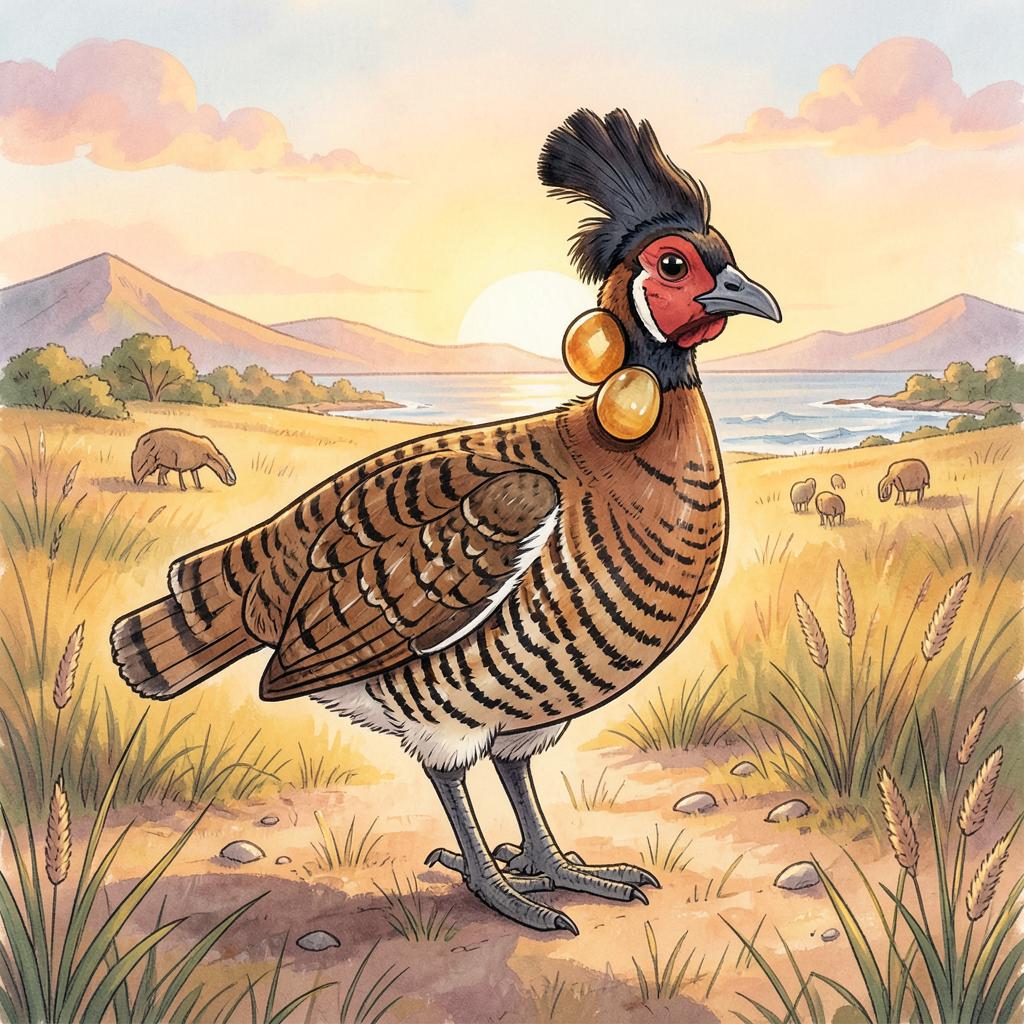
Illustrated Species Ambassador
Boom — Attwater's Prairie-Chicken
I'm Boom, an illustrated ambassador for Attwater's prairie-chicken. Every spring I inflate the golden sacs on my neck and call across the coastal prairie. Fewer and fewer of us answer.
- One fact worth knowing
- Attwater's prairie-chicken is down to a few dozen wild birds and survives only through annual releases of captive-raised birds on the Texas Gulf Coast.
- What I depend on
- I depend on coastal tallgrass and mid-grass prairie kept open by grazing and fire, and on plenty of insects — my chicks eat almost nothing else.
- My greatest threat
- My greatest threat is the loss of coastal tallgrass prairie, with fire ants reducing the insects my chicks need.
- One way you can help
- Restore native coastal prairie grasses and forbs on Gulf Coast land, and keep well away from known lek sites during the spring display season.
This ambassador is an original illustration created for this project. It is an educational character, not a documentary image, and its statements follow the sourced record on this page. Artwork and rights record
Why this species matters
Coastal tallgrass prairie is one of the most reduced habitats in North America — less than one percent remains. The Attwater's prairie-chicken is what that loss looks like in a single species.
If it disappears: Its extinction would be the loss of a distinctly Texas bird and the clearest evidence that Gulf coastal prairie no longer functions as an ecosystem.
Conservation status
- U.S. Endangered Species Act
- EndangeredListed 1967.Last verified 2026-09-08
- Texas
- Endangered (state listed)Last verified 2026-09-08
- IUCN Red List
- Greater prairie-chicken (Tympanuchus cupido) is Least Concern; this subspecies is not separately assessedLast verified 2026-09-08
Population
Fewer than 200 birds in the wild, distributed across a small number of release sites, supported by a captive breeding population at several Texas institutions.
Trend: Unknown
As reported: USFWS Attwater's Prairie Chicken National Wildlife Refuge reporting, 2020s
Source: U.S. Fish and Wildlife Service
Uncertainty: Wild numbers swing sharply with flooding, drought, and fire ant impacts on chick survival; the population is not self-sustaining without releases.
Historical: Estimated at roughly one million birds across six million acres of Gulf coastal prairie in the 1900s; reduced to fewer than 50 wild birds at several points since 2000.
Range and distribution
Historic range: Coastal tallgrass prairie from southwestern Louisiana along the Texas coast to the Nueces River.
Current range: A handful of managed sites in Colorado, Austin, Goliad, and Refugio counties, Texas.
Range contraction: Extirpated from Louisiana; occupies a fraction of one percent of historic prairie.
Regions occupied
- Texas Gulf Coast prairie
Habitat
Primary habitat: Coastal tallgrass and mid-grass prairie with a mix of grass heights.
Breeding habitat: Males display on communal booming grounds called leks in short, open grass; hens nest in taller cover nearby.
Feeding habitat: Chicks depend almost entirely on insects for their first weeks.
Critical habitat: No critical habitat designated.
Habitat dependencies
- Prairie maintained by grazing and fire
- High insect abundance for chicks
- Low red imported fire ant density
Biology and ecology
A grassland grouse whose presence indicates functioning coastal prairie with intact insect communities.
Important adaptations: Males inflate bright orange neck sacs and produce a booming call audible across open prairie.
- Size
- About 17 inches long.
- Weight
- Roughly 1.5–2 pounds.
- Lifespan
- Typically 2–5 years.
- Diet
- Seeds, leaves, and insects; chicks are insectivorous.
- Reproduction
- Lek mating system; hens nest on the ground in grass.
- Offspring
- Clutches of about 10–14 eggs.
- Breeding frequency
- One brood a year with re-nesting after failure.
- Age at maturity
- One year.
Primary threats
Habitat loss
Coastal prairie converted to cropland, pasture, and development; less than one percent of the original prairie remains.
Invasive species
Red imported fire ants reduce the insect supply chicks need and prey on chicks directly.
Habitat degradation
Invasive Chinese tallow and woody encroachment convert prairie into unusable brush.
Flooding and drought
Hurricane flooding has repeatedly wiped out nests and broods; Hurricane Harvey caused severe losses in 2017.
Small population size
The wild population depends on annual captive releases to persist at all.
Predation
Elevated predator numbers in fragmented prairie reduce nest and chick survival.
Conservation and recovery
Programs and efforts
- USFWS Attwater's Prairie Chicken Recovery Program
- Captive breeding at Fossil Rim Wildlife Center, Houston Zoo, Caldwell Zoo, and Abilene Zoo
- Annual release of captive-reared birds
- Fire ant suppression on release sites
- Prescribed burning and grazing management on coastal prairie
Protected areas
- Attwater Prairie Chicken National Wildlife Refuge
- Texas City Prairie Preserve
- Private ranch partnerships in Goliad and Refugio counties
Legal protections
- Endangered Species Act
- Texas state endangered listing
Measurable progress
- Captive breeding reliably produces birds for release
- Some wild-hatched broods survive to fledging in good years
Continuing challenges
- The population is not self-sustaining
- Fire ants and flooding repeatedly reverse gains
- Prairie habitat is scarce and fragmented
How people can help
What individuals can do
- Support prairie conservation on the Texas coast
- Avoid disturbance near known lek sites during spring display season
What communities can do
- Back prescribed burning and invasive Chinese tallow removal
- Support landowner agreements that keep coastal prairie in grass
Educational actions
- Attend a refuge booming-ground viewing event during spring display season
Habitat support
- Restore native coastal prairie grasses and forbs on Gulf Coast property
Organizations and programs to learn about
- Attwater Prairie Chicken National Wildlife Refuge
- Fossil Rim Wildlife Center
- Houston Zoo
Educational notes
- A powerful, local illustration of just how little tallgrass coastal prairie remains.
- Shows how an invasive insect can determine the fate of a bird.