Mammals
Amur Leopard
Panthera pardus orientalis
A cold-adapted leopard of the Russian Far East and northeast China, reduced to a single small population and now slowly increasing under strict protection.
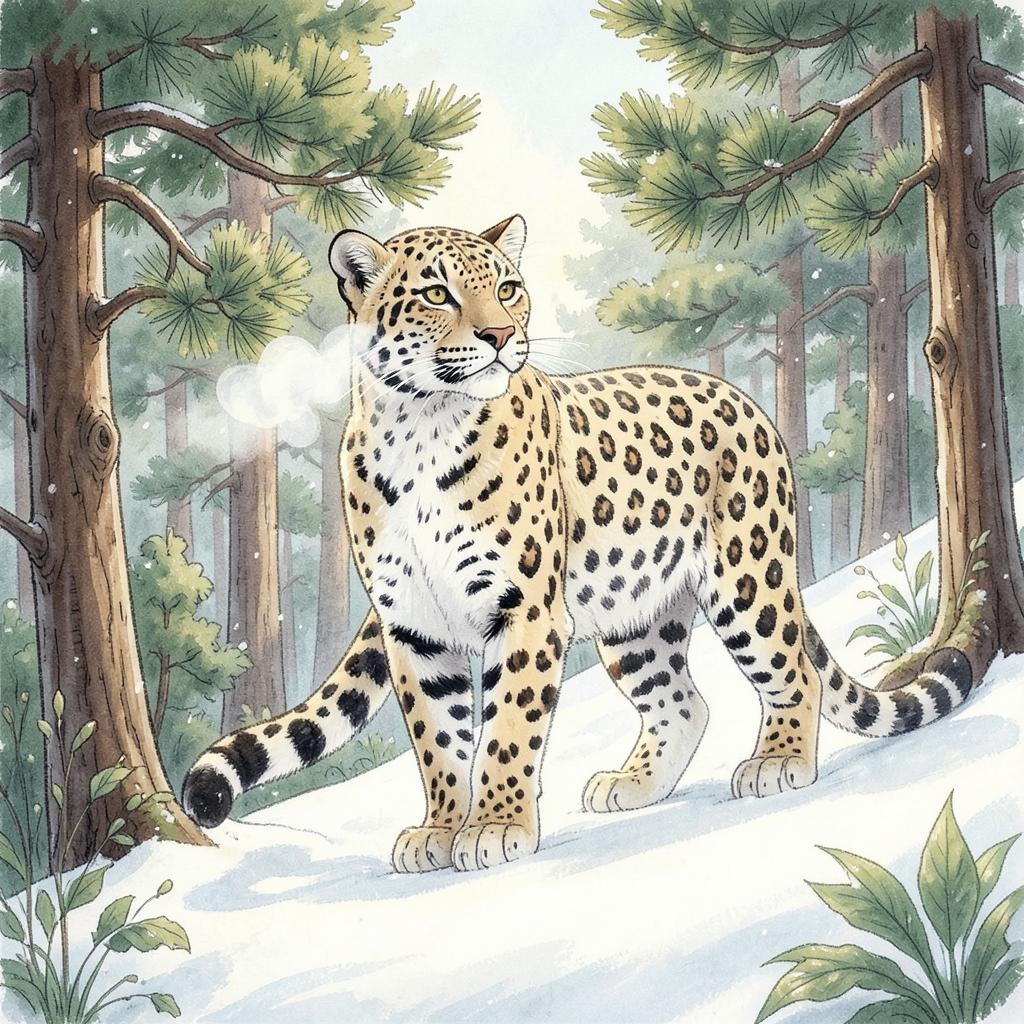
Illustrated Species Ambassador
Zima — Amur Leopard
I am Zima, an illustrated ambassador for the Amur leopard. I hunt in deep snow, alone, and there have never been many of us.
- One fact worth knowing
- The Amur leopard was reduced to one small population in the Russian Far East and northeast China, and is now slowly increasing under strict protection.
- What I depend on
- I depend on temperate Korean pine and broadleaf forest with enough roe and sika deer, little human disturbance, and forest that still connects across the Russia-China border.
- My greatest threat
- My greatest threat is poaching, of me and of the deer I live on, alongside the loss of that forest.
- One way you can help
- Refuse any product made from big cat fur or bone, and support the transboundary protected areas that keep this one population connected.
This ambassador is an original illustration created for this project. It is an educational character, not a documentary image, and its statements follow the sourced record on this page. Artwork and rights record
Why this species matters
The Amur leopard is one of the clearest examples that a subspecies can be pulled back from the brink through strict, well-funded protection of a single landscape. Its numbers have roughly tripled since the founding of Land of the Leopard National Park.
If it disappears: Extinction would end the world's northernmost leopard lineage and remove an apex predator from one of the last large intact temperate forests in Asia.
Conservation status
- IUCN Red List
- Critically EndangeredSubspecies assessment for Panthera pardus orientalis.Last verified 2026-09-08
- CITES
- Appendix ILast verified 2026-09-08
- Russia
- Red Data Book of the Russian Federation — protectedLast verified 2026-09-08
Population
Roughly 100–130 individuals across the Russia-China transboundary range, up from an estimated 30 or fewer in the early 2000s.
Trend: Increasing
As reported: Land of the Leopard National Park camera-trap monitoring, 2020s
Source: Land of the Leopard National Park; IUCN Red List; WWF Russia
Uncertainty: Counts come from camera-trap identification of individual rosette patterns; Russian and Chinese figures overlap because leopards cross the border.
Historical: Historically ranged across the Korean Peninsula, northeast China, and southeastern Russia.
Fragmentation: Effectively a single population, which means one disease outbreak or fire could affect the entire subspecies.
Range and distribution
Historic range: Korean Peninsula, northeastern China, and the Russian Far East.
Current range: Primorsky Krai in southwest Russia and adjacent Jilin and Heilongjiang provinces in China.
Range contraction: Believed extirpated from the Korean Peninsula; occupies a small fraction of the historic range.
Regions occupied
- Primorsky Krai, Russia
- Jilin and Heilongjiang, China
Habitat
Primary habitat: Temperate broadleaf and mixed Korean pine forest with steep terrain and deep winter snow.
Breeding habitat: Dens in rock caves and dense thickets.
Feeding habitat: Hunts roe deer, sika deer, and hares across forested slopes.
Habitat dependencies
- Adequate ungulate prey
- Low human disturbance
- Connectivity across the Russia-China border
Biology and ecology
Top predator of the Manchurian temperate forest, sharing range with the Amur tiger.
Important adaptations: Thick winter coat up to about three inches long and longer legs for moving through deep snow.
- Size
- About 42–54 inches head and body plus a long tail.
- Weight
- Approximately 70–120 pounds.
- Lifespan
- Around 10–15 years in the wild.
- Diet
- Roe deer, sika deer, hares, badgers, and small mammals.
- Reproduction
- Gestation about 90–105 days.
- Offspring
- Typically 1–4 cubs, commonly 2.
- Breeding frequency
- Roughly every two years.
- Age at maturity
- About 2–3 years.
Primary threats
Poaching
Killed for its spotted pelt and bones, and its prey species are also poached, reducing food supply.
Habitat loss
Logging, agricultural conversion, and infrastructure fragment the remaining forest.
Fire
Deliberate grassland burning for agriculture degrades forest edges the leopards use.
Inbreeding
The population is small enough that genetic diversity is a documented concern.
Disease
Canine distemper has been detected in the region's big cats and could affect the whole population at once.
Conservation and recovery
Programs and efforts
- Land of the Leopard National Park, established in Russia in 2012
- Northeast China Tiger and Leopard National Park
- Transboundary Russia-China monitoring and anti-poaching cooperation
- European and global captive breeding program for potential future reintroduction
Protected areas
- Land of the Leopard National Park, Russia
- Northeast China Tiger and Leopard National Park
Legal protections
- CITES Appendix I
- Russian Red Data Book protection
- Chinese national first-class protected species
Measurable progress
- Population roughly tripled from about 30 to over 100 animals since strict protection began
Continuing challenges
- Total numbers remain very low
- Genetic diversity is limited
- A second population is needed to spread risk
How people can help
What individuals can do
- Refuse any product made from big cat fur or bone
- Support reputable transboundary conservation programs
What communities can do
- Back the establishment of a second reintroduced population to spread extinction risk
Educational actions
- Use camera-trap rosette identification to teach individual-animal monitoring methods
Habitat support
- Support Korean pine and broadleaf forest protection in the Russian Far East
Organizations and programs to learn about
- Land of the Leopard National Park
- WWF Russia
- Wildlife Conservation Society
Educational notes
- Each leopard is identified individually by its rosette pattern, like a fingerprint.
- A rare example of measurable population growth in a critically endangered big cat.
Sources and references
- IUCN Red List — Panthera pardus ssp. orientalis — IUCN
- CITES — Appendix I listing for Panthera pardus — CITES
- Land of the Leopard National Park — Land of the Leopard National Park