Mammals
African Forest Elephant
Loxodonta cyclotis
Recognized as a distinct species in 2021 and immediately assessed as Critically Endangered after decades of ivory poaching in Central African forests.
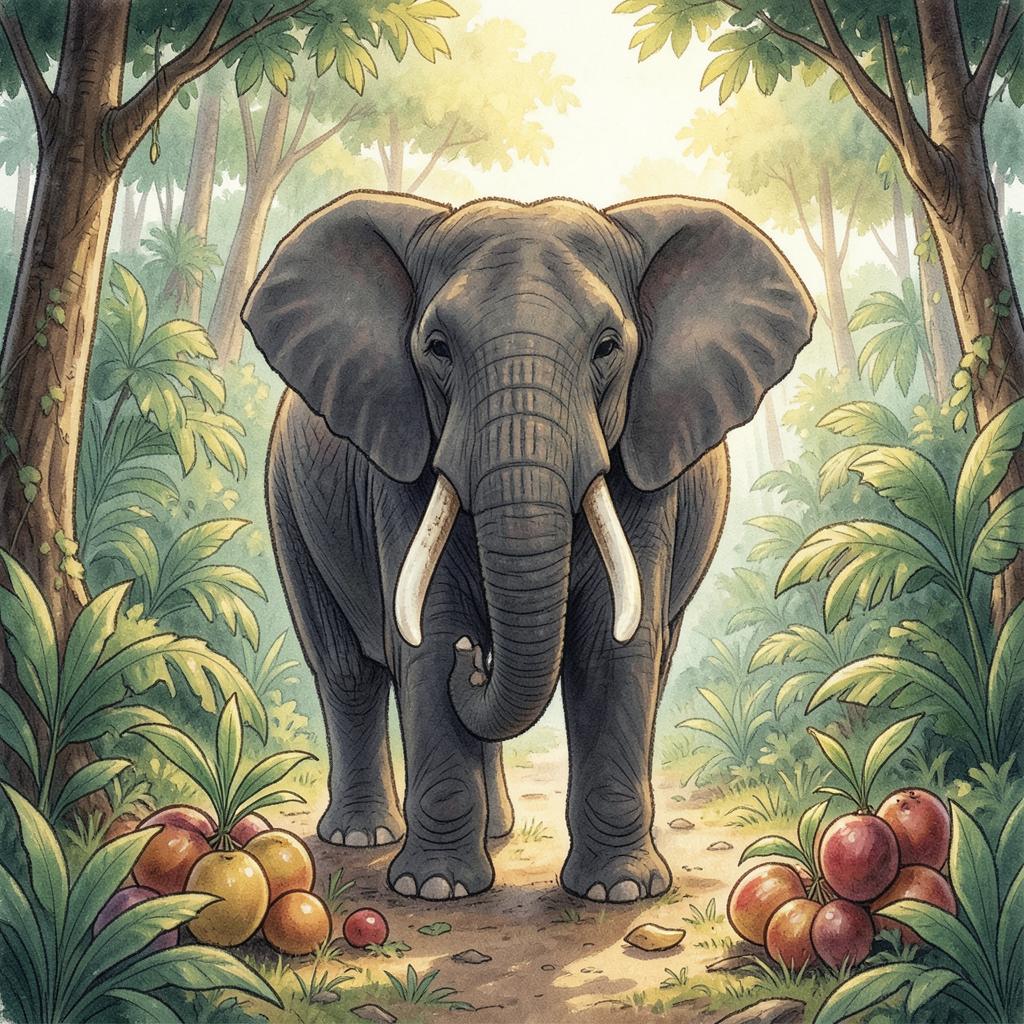
Illustrated Species Ambassador
Bomani — African Forest Elephant
Hello. I am Bomani, an illustrated ambassador for the African forest elephant. I move quietly through the Congo Basin, and most of my work is done before anyone notices it.
- One fact worth knowing
- The forest elephant was only recognized as a species separate from the savanna elephant in 2021, and was assessed as Critically Endangered straight away after decades of ivory poaching.
- What I depend on
- I need large unbroken blocks of lowland rainforest and the mineral-rich clearings we call bais. I carry the seeds of big-fruited trees farther than any other animal can, which is why the forest itself depends on me.
- My greatest threat
- My greatest threat is ivory poaching. Forest loss matters, but the tusk trade is what has emptied whole forests of elephants.
- One way you can help
- Never buy ivory in any form, including antique or certified pieces, and choose certified sustainable tropical timber.
This ambassador is an original illustration created for this project. It is an educational character, not a documentary image, and its statements follow the sourced record on this page. Artwork and rights record
Why this species matters
Forest elephants disperse the seeds of hundreds of tree species, including large hardwoods that store disproportionate amounts of carbon. Research indicates that losing them measurably reduces the Congo Basin's carbon storage capacity.
If it disappears: Without forest elephants, large-seeded trees fail to regenerate, forest composition shifts toward lower-biomass species, and the Congo Basin's role as a global carbon sink weakens.
Conservation status
- IUCN Red List
- Critically EndangeredFirst assessed separately from the savanna elephant in 2021 following taxonomic recognition as a distinct species.Last verified 2026-09-08
- CITES
- Appendix I for most range statesLast verified 2026-09-08
- U.S. Endangered Species Act
- Threatened (African elephant, foreign listing)Last verified 2026-09-08
Population
No precise global count. IUCN documents a population decline of more than 86 percent over 31 years, with tens of thousands of animals remaining, concentrated in Gabon and the Republic of the Congo.
Trend: Decreasing
As reported: IUCN Red List assessment, 2021
Source: IUCN Red List; IUCN SSC African Elephant Specialist Group
Uncertainty: Forest elephants are counted by dung survey rather than aerial census, so estimates carry wide confidence intervals.
Historical: Occupied most of the Congo Basin and West African forest belt; now absent from large portions of that area.
Fragmentation: Remaining strongholds are separated by logging roads, settlements, and heavily hunted zones.
Range and distribution
Historic range: Tropical forests of West and Central Africa from Guinea to the Congo Basin.
Current range: Roughly a quarter of the historic range, with Gabon holding the largest remaining population.
Range contraction: Range reduced by an estimated three quarters or more.
Regions occupied
- Gabon
- Republic of the Congo
- Cameroon
- Central African Republic
- Democratic Republic of the Congo
- West African forest remnants
Habitat
Primary habitat: Dense tropical lowland rainforest, with heavy use of open forest clearings known as bais.
Feeding habitat: Fruit, leaves, and bark; forest elephants are heavily frugivorous.
Seasonal differences: Movements track fruiting seasons across large forest blocks.
Habitat dependencies
- Large intact forest blocks
- Mineral-rich forest clearings
- Low poaching pressure
Biology and ecology
The Congo Basin's principal seed disperser — sometimes called the forest's gardener — moving large seeds distances no other animal can, and shaping forest structure and carbon storage.
Important adaptations: Straighter, downward-pointing tusks and smaller rounded ears suited to dense forest.
- Size
- Shoulder height about 7–8 feet, noticeably smaller than the savanna elephant.
- Weight
- Approximately 4,000–10,000 pounds.
- Lifespan
- Around 60–70 years.
- Diet
- Fruit, leaves, bark, and mineral-rich soil; disperses seeds of many large-fruited trees.
- Reproduction
- Gestation about 22 months, the longest of any land mammal.
- Offspring
- Normally a single calf.
- Breeding frequency
- Calving intervals of roughly five to six years, longer than savanna elephants, making recovery exceptionally slow.
- Age at maturity
- Females often not until their late teens.
Primary threats
Poaching
Ivory poaching drove the documented 86 percent decline and continues in weakly protected areas.
Wildlife trafficking
Organized networks move ivory from forest sites through regional ports to overseas markets.
Habitat loss
Logging, mining, and agricultural conversion open the forest and give hunters road access.
Habitat fragmentation
Roads split populations and expose elephants to hunting along their length.
Human-wildlife conflict
Crop raiding near forest edges produces retaliatory killing.
Slow reproduction
Long gestation and multi-year calving intervals make recovery slower than for any other large mammal.
Conservation and recovery
Programs and efforts
- Gabon's national park network and eco-guard anti-poaching force
- CITES ivory trade prohibition and national ivory market closures
- MIKE (Monitoring the Illegal Killing of Elephants) program
- Community conflict-mitigation and crop-protection programs
Protected areas
- Lopé and Ivindo National Parks, Gabon
- Nouabalé-Ndoki National Park, Republic of the Congo
- Dzanga-Sangha, Central African Republic
Legal protections
- CITES Appendix I
- National protection across range states
- Domestic ivory market closures in major consumer countries
Measurable progress
- Gabon has retained the largest remaining population through sustained park investment
- Major consumer markets have closed domestic ivory trade
Continuing challenges
- Enforcement in remote forest
- Regional instability
- Extremely slow population recovery even where poaching stops
How people can help
What individuals can do
- Never buy ivory in any form, including antique or 'certified' pieces
- Choose certified sustainable tropical timber
What communities can do
- Support ranger training, equipment, and welfare programs in range states
Educational actions
- Teach the 2021 species split as an example of taxonomy changing conservation status
- Use forest elephants to connect wildlife loss to climate and carbon storage
Habitat support
- Support Congo Basin forest protection and community forestry
Organizations and programs to learn about
- IUCN SSC African Elephant Specialist Group
- Wildlife Conservation Society
- Gabon's Agence Nationale des Parcs Nationaux
Educational notes
- A living example of a taxonomic revision: recognized as a separate species in 2021, changing its conservation status overnight.
- Connects biodiversity loss directly to carbon storage and climate.
Sources and references
- IUCN Red List — Loxodonta cyclotis — IUCN, 2021
- CITES — Elephants — CITES
- U.S. Fish and Wildlife Service — African Elephant — USFWS