Fish and Aquatic Life
Sacramento River Winter-run Chinook Salmon
Oncorhynchus tshawytscha
The only salmon run in the world that spawns in summer, cut off from its cold mountain spawning grounds by Shasta Dam.
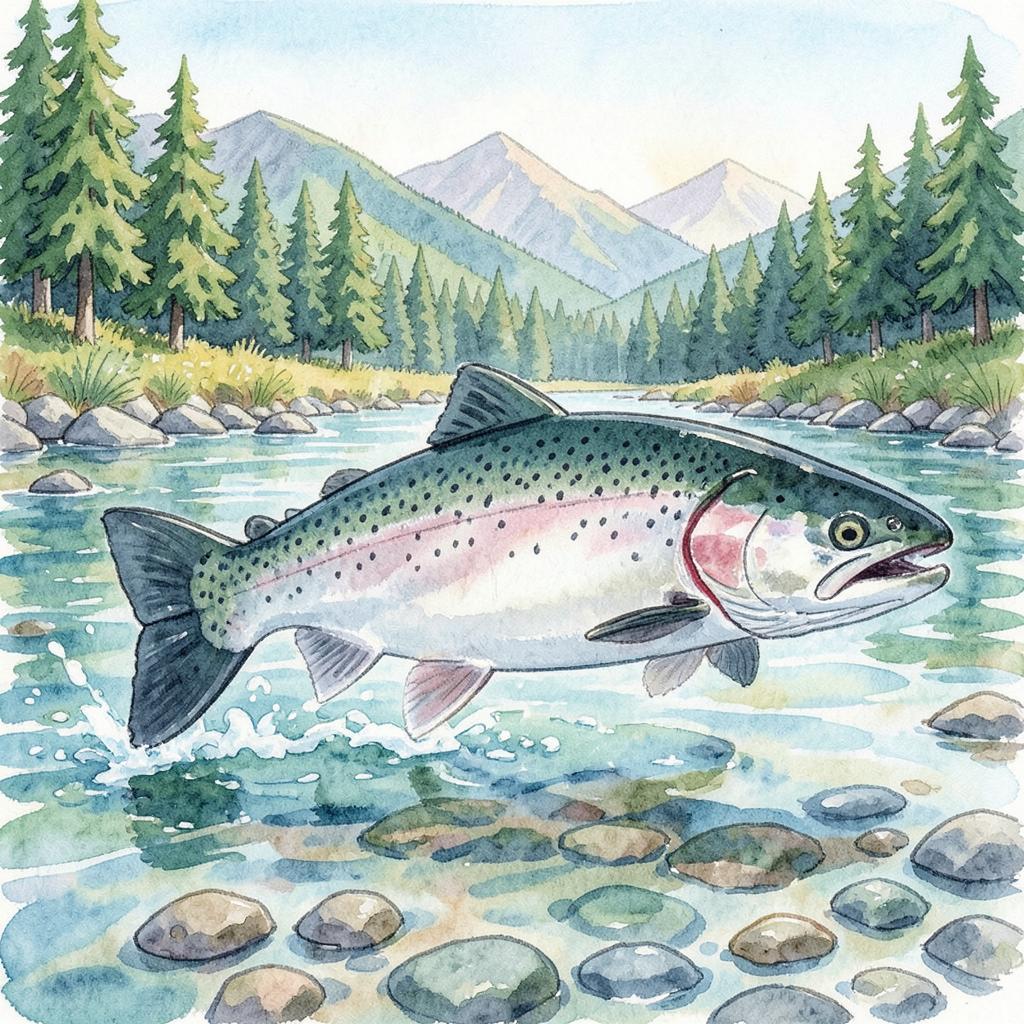
Illustrated Species Ambassador
Redd — Sacramento River Winter-run Chinook Salmon
I'm Redd, an illustrated ambassador for the Sacramento River winter-run Chinook salmon. I am the only salmon run in the world that spawns through the summer.
- One fact worth knowing
- Shasta Dam cut this run off from its cold mountain spawning grounds. It now spawns below the dam and survives on cold water released from deep in Shasta Reservoir through the summer.
- What I depend on
- I depend on cold, gravel-bottomed river reaches for spawning, a functioning Delta for young fish heading to sea, and a productive ocean to grow in.
- My greatest threat
- My greatest threat is the loss of cold-water spawning habitat above dams.
- One way you can help
- Conserve water in California — reservoir storage is directly tied to how much cold water reaches the spawning reach — and back Delta and Central Valley floodplain restoration.
This ambassador is an original illustration created for this project. It is an educational character, not a documentary image, and its statements follow the sourced record on this page. Artwork and rights record
Why this species matters
The winter run exists today only because reservoir operators deliberately manage a cold-water pool for it every summer. It is the most direct example anywhere of a species whose continued existence is a water management decision made annually.
If it disappears: California would lose a genetically unique salmon run, a Delta food web component, and a fishery of significant cultural and economic value.
Cultural and regional note: The Winnemem Wintu Tribe, whose homeland lies in the McCloud River watershed, has worked to return winter-run salmon to their historic spawning waters, including through experimental reintroduction efforts.
Conservation status
- U.S. Endangered Species Act
- Endangered (Sacramento River winter-run evolutionarily significant unit)Listed as threatened in 1989 and reclassified to endangered in 1994.Last verified 2026-09-08
- California Endangered Species Act
- EndangeredLast verified 2026-09-08
- IUCN Red List
- Oncorhynchus tshawytscha is assessed at the species level; this run is not separately assessedLast verified 2026-09-08
Population
Adult returns typically number in the low thousands and have fallen below 1,000 in the worst drought years, compared with runs exceeding 100,000 fish in the 1960s.
Trend: Decreasing
As reported: NOAA Fisheries and California Department of Fish and Wildlife escapement estimates, 2010s–2020s
Source: NOAA Fisheries; California Department of Fish and Wildlife
Uncertainty: Escapement estimates are published annually and swing sharply with drought and reservoir cold-water storage.
Historical: Historic runs used cold spring-fed reaches of the upper Sacramento, McCloud, and Pit rivers, all now above Shasta Dam.
Fragmentation: The entire run now spawns in a single stretch of river below Keswick Dam.
Range and distribution
Historic range: Upper Sacramento, McCloud, and Pit river headwaters fed by cold volcanic springs.
Current range: A short reach of the mainstem Sacramento River below Keswick Dam, near Redding, California.
Migration: Adults enter fresh water in winter, hold through spring, and spawn in summer — a life history unique among salmon.
Range contraction: Entirely excluded from its historic spawning habitat by Shasta and Keswick dams.
Regions occupied
- Sacramento River, California
- San Francisco Bay-Delta
- Pacific Ocean off California
Habitat
Primary habitat: Cold, gravel-bottomed river reaches for spawning; the Pacific Ocean for adult growth.
Breeding habitat: Spawns in summer, which requires water cold enough to incubate eggs through the hottest months.
Feeding habitat: Juveniles rear in the river and Delta; adults feed at sea.
Critical habitat: Critical habitat designated in the Sacramento River and Delta.
Habitat dependencies
- Cold water released from Shasta Reservoir's deep cold-water pool through the summer
- Functioning Delta rearing habitat for outmigrating juveniles
- Ocean productivity
Biology and ecology
Carries marine nutrients inland and supports a wide range of predators and scavengers; historically a mainstay of California fisheries.
Important adaptations: Summer spawning evolved to exploit cold volcanic spring-fed headwaters. With those headwaters behind a dam, the run now depends entirely on managed cold-water releases.
- Size
- Commonly about 3 feet.
- Weight
- Typically 10–30 pounds.
- Lifespan
- About 3 years.
- Diet
- Invertebrates as juveniles; fish and krill at sea.
- Reproduction
- Digs gravel redds; adults die after spawning.
- Offspring
- Several thousand eggs per female.
- Breeding frequency
- Once, at the end of life.
- Age at maturity
- About 3 years.
Primary threats
Dams and barriers
Shasta and Keswick dams block access to all historic cold-water spawning habitat.
Warm water
When the reservoir's cold-water pool is depleted in drought years, egg mortality can approach total loss.
Drought
Consecutive dry years in 2014–2015 and 2021 caused catastrophic egg and juvenile mortality.
Water diversion
Delta pumping entrains juvenile salmon and alters migratory cues.
Habitat loss
Loss of floodplain and Delta rearing habitat reduces juvenile survival.
Predation
Non-native predators concentrate at diversion structures and dam outfalls.
Ocean conditions
Marine heatwaves and poor ocean productivity reduce adult survival at sea.
Conservation and recovery
Programs and efforts
- NOAA Fisheries recovery plan for Sacramento River winter-run Chinook
- Cold-water pool management at Shasta Reservoir under annual temperature management plans
- Livingston Stone National Fish Hatchery conservation propagation program
- Floodplain reactivation projects such as the Yolo Bypass
- Experimental reintroduction to the McCloud River in partnership with the Winnemem Wintu Tribe
Protected areas
- Designated critical habitat in the Sacramento River and Delta
- Sacramento River National Wildlife Refuge
Legal protections
- Endangered Species Act
- California Endangered Species Act
- Central Valley Project Improvement Act requirements
Measurable progress
- Conservation hatchery propagation has prevented extinction during drought years
- Floodplain projects have documented sharply improved juvenile growth
Continuing challenges
- The run depends on annual water management decisions in a fully allocated system
- Climate change reduces the reliability of the cold-water pool
- Historic spawning habitat remains inaccessible
How people can help
What individuals can do
- Conserve water in California — reservoir storage is directly tied to salmon survival
- Choose sustainably sourced salmon and understand the origin
What communities can do
- Support floodplain restoration and fish passage feasibility work above Shasta Dam
Educational actions
- Use the winter run to teach how climate and infrastructure interact for a single species
Habitat support
- Back Delta and Central Valley floodplain restoration
Organizations and programs to learn about
- NOAA Fisheries West Coast Region
- California Department of Fish and Wildlife
- Winnemem Wintu Tribe
Educational notes
- The only salmon run in the world that spawns during summer.
- A concrete example of a species dependent on an annual human management decision.