Freshwater Species
Winged Mapleleaf
Quadrula fragosa
A freshwater mussel once found across a dozen states, now surviving in a handful of river reaches, principally the St. Croix River on the Minnesota-Wisconsin border.
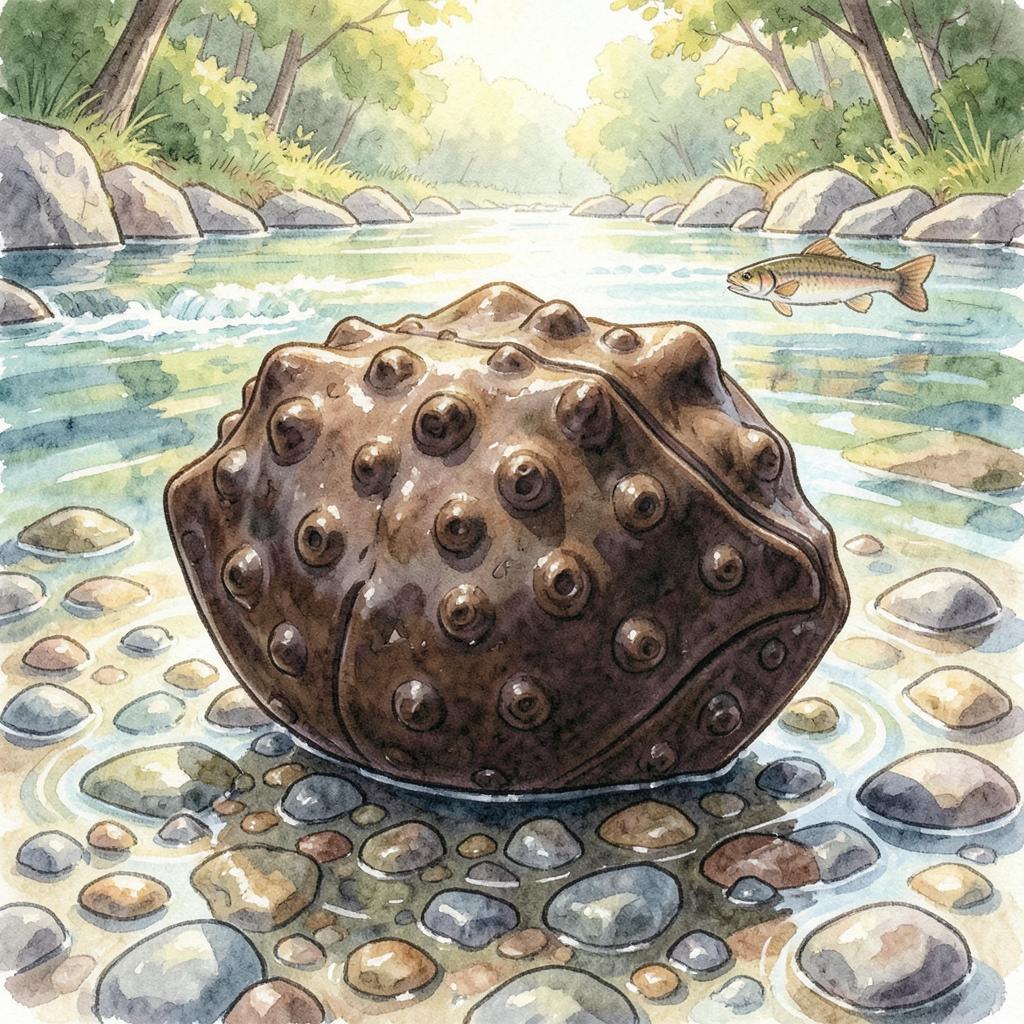
Illustrated Species Ambassador
Croix — Winged Mapleleaf
I'm Croix, an illustrated ambassador for the winged mapleleaf. I was once found across a dozen states; now I hold on in a handful of river reaches.
- One fact worth knowing
- The winged mapleleaf survives principally in the St. Croix River on the Minnesota–Wisconsin border, and depends on catfish to carry its larvae.
- What I depend on
- I depend on clean, well-oxygenated flowing water, stable silt-free gravel and sand, and catfish host species living in the same reach.
- My greatest threat
- My greatest threat is river degradation and sedimentation, along with invasive zebra mussels.
- One way you can help
- Clean, drain and dry every boat, trailer and piece of gear between water bodies — zebra mussel spread is the single most preventable threat — and never collect mussels or shells from rivers.
This ambassador is an original illustration created for this project. It is an educational character, not a documentary image, and its statements follow the sourced record on this page. Artwork and rights record
Why this species matters
The St. Croix is one of the last large rivers in the upper Midwest with a nearly complete native mussel community. The winged mapleleaf's survival there is a measure of how much a protected river can still hold.
If it disappears: The upper Mississippi drainage would lose a species already reduced to a fraction of its range, and one of the strongest indicators of remaining high-quality river habitat.
Conservation status
- U.S. Endangered Species Act
- EndangeredListed 1991.Last verified 2026-09-08
- IUCN Red List
- Critically EndangeredLast verified 2026-09-08
- State
- Endangered in Minnesota and WisconsinLast verified 2026-09-08
Population
The St. Croix River holds the largest known population, with additional populations documented in a small number of Arkansas, Oklahoma, and Kansas river reaches. Populations are assessed by survey density rather than total count.
Trend: Unknown
As reported: USFWS recovery reporting and state mussel surveys
Source: U.S. Fish and Wildlife Service; Minnesota Department of Natural Resources
Uncertainty: Discoveries of additional southern populations changed the understanding of this species' status after listing; treat the range as subject to revision.
Historical: Historically recorded from at least twelve states across the Mississippi River drainage.
Fragmentation: Surviving populations are widely separated with no possibility of natural exchange.
Range and distribution
Historic range: Rivers throughout the Mississippi River drainage from Minnesota to Alabama.
Current range: The St. Croix River in Minnesota and Wisconsin, plus reaches of the Ouachita, Little, and Saline rivers in Arkansas and Oklahoma and the Verdigris system.
Range contraction: Lost from the great majority of its historic drainage.
Regions occupied
- St. Croix River, Minnesota and Wisconsin
- Ouachita River basin, Arkansas
- Little River, Oklahoma
- Kansas river reaches
Habitat
Primary habitat: Clean, flowing rivers with stable gravel and sand substrate and good water quality.
Breeding habitat: Larvae attach to the gills of channel catfish and blue catfish, the known host species.
Feeding habitat: Filter feeds on suspended algae and organic particles.
Critical habitat: No critical habitat designated.
Habitat dependencies
- Stable, silt-free substrate
- Catfish host species present in the same reach
- Clean, well-oxygenated flowing water
Biology and ecology
Filters water, stabilizes substrate, and provides habitat structure for aquatic insects.
Key relationships: Reproduction depends entirely on catfish hosts; the timing of glochidia release is synchronized to host availability.
Important adaptations: Autumn release of larvae distinguishes it from most co-occurring mussels and reduces competition for host fish.
- Size
- Shell up to about 4 inches.
- Lifespan
- Potentially several decades.
- Diet
- Suspended algae, bacteria, and detritus.
- Reproduction
- Releases glochidia in autumn, unusually late in the season, which must attach to a catfish host.
- Offspring
- Large numbers of glochidia with extremely low survival.
- Breeding frequency
- Annually.
- Age at maturity
- Several years.
Primary threats
Invasive species
Zebra mussels attach to native mussel shells in dense clusters, smothering them; a St. Croix infestation prompted major response efforts.
Sedimentation
Agricultural and construction runoff buries substrate and clogs filtering structures.
Water quality
Nutrient loading and chemical contaminants affect a filter feeder directly.
Dams and barriers
Impoundments block host fish movement and convert flowing reaches to still water.
Channel modification
Dredging and bank armoring remove the stable substrate the species requires.
Small isolated populations
Widely separated populations cannot recolonize one another after a loss.
Climate change
Increased extreme rainfall drives sediment pulses and scouring flows.
Conservation and recovery
Programs and efforts
- USFWS winged mapleleaf recovery program
- Captive propagation and juvenile release at the Genoa National Fish Hatchery
- St. Croix River zebra mussel monitoring and control efforts
- Reintroduction of propagated juveniles to historic reaches
- Watershed sediment reduction programs
Protected areas
- St. Croix National Scenic Riverway
- Ouachita National Forest river reaches
Legal protections
- Endangered Species Act
- State endangered listings in Minnesota and Wisconsin
- National Scenic Riverway protections
Measurable progress
- Captive propagation has succeeded in producing juveniles for release
- Discovery of additional southern populations improved the outlook relative to what was known at listing
Continuing challenges
- Zebra mussels cannot be eradicated once established
- Propagation is technically demanding
- Populations remain few and isolated
How people can help
What individuals can do
- Clean, drain, and dry all boats, trailers, and gear between water bodies — zebra mussel spread is the single most preventable threat
- Never collect mussels or shells from rivers
What communities can do
- Support watershed sediment and nutrient reduction
- Fund and staff boat inspection stations at river access points
Educational actions
- Use the catfish host relationship to teach that protecting a mussel means protecting a fish
Habitat support
- Support riparian buffer establishment in agricultural watersheds
Organizations and programs to learn about
- USFWS Midwest Region
- Genoa National Fish Hatchery
- Minnesota and Wisconsin departments of natural resources
Educational notes
- Releases its larvae in autumn, unlike most co-occurring mussels.
- The St. Croix River is one of the most intact large-river mussel systems remaining in the United States.
Sources and references
- U.S. Fish and Wildlife Service — Winged Mapleleaf — USFWS
- IUCN Red List — Quadrula fragosa — IUCN
- National Park Service — St. Croix National Scenic Riverway Mussels — National Park Service