Plants
Whitebark Pine
Pinus albicaulis
A high-elevation tree that holds mountain snowpack, feeds grizzly bears, and depends on a single bird species to plant its seeds.
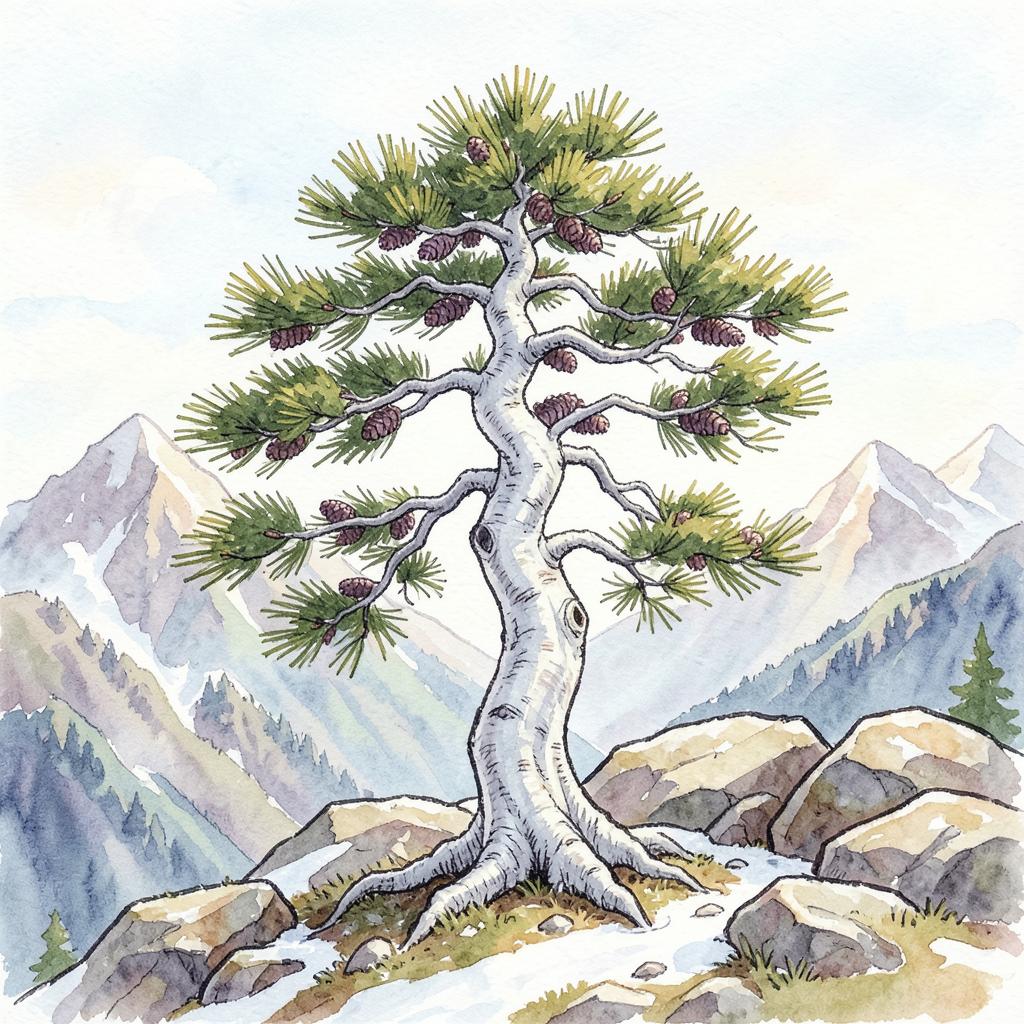
Illustrated Species Ambassador
Cairn — Whitebark Pine
I'm Cairn, an illustrated ambassador for the whitebark pine. I grow on exposed ridges near treeline, twisted by wind and holding the snow in place.
- One fact worth knowing
- Whitebark pine cannot regenerate at scale without Clark's nutcracker, the bird that opens its cones and caches the seeds. Its high-fat seeds are also important food for grizzly bears preparing for hibernation.
- What I depend on
- I depend on cold high-elevation conditions, on Clark's nutcracker to plant my seeds, and on escaping severe blister rust infection.
- My greatest threat
- My greatest threat is white pine blister rust, together with mountain pine beetle.
- One way you can help
- Support high-elevation restoration planting, volunteer for seedling planting projects, and follow fire restrictions in subalpine areas.
This ambassador is an original illustration created for this project. It is an educational character, not a documentary image, and its statements follow the sourced record on this page. Artwork and rights record
Why this species matters
Whitebark pine is water infrastructure. Its shade holds mountain snowpack later into the summer, feeding rivers when they are lowest. It also feeds grizzly bears and depends on a single bird to reproduce. Few species link so many others together.
If it disappears: Mountain snowpack would melt earlier and faster, reducing late-summer streamflow across the west. Grizzly bears would lose a critical pre-hibernation food, and treeline forests would lose the tree that makes their establishment possible.
Conservation status
- IUCN Red List
- EndangeredLast verified 2026-09-08
- U.S. Endangered Species Act
- ThreatenedListed in 2022 with a 4(d) rule.Last verified 2026-09-08
- Canada (SARA)
- EndangeredLast verified 2026-09-08
Population
Widespread across western mountains but declining sharply. Mortality rates exceeding 50 percent have been documented across large portions of the U.S. range, with the highest losses in the northern Rockies.
Trend: Decreasing
As reported: USFWS species status assessment and U.S. Forest Service inventory data
Source: U.S. Fish and Wildlife Service; U.S. Forest Service Forest Inventory and Analysis; IUCN Red List
Uncertainty: Measured as tree mortality rates and stand condition across the range rather than as an individual count.
Historical: Historically dominant at treeline across much of the western mountains.
Fragmentation: Populations occur on separated mountain ranges — high-elevation islands that cannot exchange easily.
Range and distribution
Historic range: High elevations from British Columbia and Alberta south through the Rockies, Cascades, and Sierra Nevada.
Current range: The same range, with widespread mortality and stand decline throughout.
Range contraction: Functional loss of many stands, with treeline positions shifting.
Regions occupied
- Northern Rockies — Montana, Idaho, Wyoming
- Cascades — Washington, Oregon
- Sierra Nevada, California
- British Columbia and Alberta
Habitat
Primary habitat: Subalpine and treeline forest, often on exposed ridges and harsh sites where few other trees survive.
Breeding habitat: Produces large, wingless, high-fat seeds in cones that do not open on their own.
Feeding habitat: Autotrophic.
Seasonal differences: Retains snowpack in its shade, releasing meltwater more slowly into summer.
Habitat dependencies
- Clark's nutcracker, the bird that opens the cones and caches seeds — the tree cannot regenerate at scale without it
- Cold high-elevation conditions
- Absence of severe blister rust infection
Biology and ecology
A keystone and foundation species of the high mountains. It stabilizes soil, shades and retains snowpack that feeds downstream rivers through summer, creates shelter that allows other trees to establish at treeline, and provides high-fat seeds critical to grizzly bears preparing for hibernation.
Key relationships: A mutualism with Clark's nutcracker so complete that neither species functions well without the other.
Important adaptations: Extreme cold and wind tolerance, and a seed dispersal strategy outsourced entirely to a bird.
- Size
- Typically 30 to 60 feet, often twisted and stunted at treeline.
- Lifespan
- Commonly 500 years, with individuals documented beyond 1,000.
- Diet
- Autotrophic.
- Reproduction
- Cones do not open to release seed. Clark's nutcrackers tear them apart and cache tens of thousands of seeds in the soil each year; forgotten caches become the next generation of trees.
- Offspring
- Large seed crops in mast years, with regeneration entirely dependent on nutcracker caching.
- Breeding frequency
- Cone production varies year to year, with heavy mast years at intervals.
- Age at maturity
- Cone production typically begins after 30 to 50 years, and heavy production much later.
Primary threats
Disease
White pine blister rust, an introduced fungus from Europe, kills trees of all ages and has infected a majority of stands across much of the range. There is no treatment for infected trees.
Insect outbreak
Mountain pine beetle outbreaks, intensified by warmer winters that no longer kill overwintering beetles, have killed vast numbers of mature trees.
Climate change
Warming compresses suitable high-elevation habitat and enables beetles to reach elevations previously too cold.
Fire suppression
A century of suppression allowed shade-tolerant firs and spruces to crowd out whitebark pine on many sites.
Severe wildfire
High-severity fires kill mature seed-producing trees across large areas.
Loss of the seed disperser
Where cone crops fail, Clark's nutcrackers leave the area, and regeneration stops entirely.
Slow maturity
Trees need decades to produce cones, so recovery is measured in centuries.
Conservation and recovery
Programs and efforts
- National Whitebark Pine Restoration Plan coordinating federal, tribal, and nonprofit efforts
- Identification and propagation of rust-resistant individuals for planting
- Seed collection, cone caging, and nursery production for restoration planting
- Prescribed fire and competing conifer removal to open stands
- Verbenone pheromone application to deter beetles from high-value trees
Protected areas
- Yellowstone and Glacier National Parks
- Crater Lake National Park
- Extensive national forest and wilderness lands across the west
Legal protections
- Endangered Species Act threatened listing with a 4(d) rule
- Canadian Species at Risk Act
- Wilderness and park protections
Measurable progress
- Rust-resistant trees have been identified and are being propagated and planted
- Large-scale coordinated restoration planning is now in place
- Millions of seedlings have been planted across the range
Continuing challenges
- Blister rust cannot be eliminated from the landscape
- Restoration is slow because trees take decades to produce cones
- Climate warming continues to shrink suitable habitat
How people can help
What individuals can do
- Support high-elevation restoration planting programs
- Follow fire restrictions in subalpine areas
- Report whitebark pine observations to citizen science projects tracking stand condition
What communities can do
- Support forest restoration funding and wilderness protection
- Back watershed programs that recognize snowpack retention as infrastructure
Educational actions
- Use the whitebark pine and Clark's nutcracker relationship to teach obligate mutualism
Habitat support
- Volunteer for seedling planting projects with the Forest Service or restoration groups
Organizations and programs to learn about
- Whitebark Pine Ecosystem Foundation
- U.S. Forest Service
- American Forests
- National Park Service
Educational notes
- Its cones do not open on their own; a bird must tear them apart for the tree to reproduce.
- Its shade holds snowpack later into summer, directly affecting downstream water supply.
- Grizzly bears depend heavily on whitebark pine seeds in years when the crop is good.