Plants
Western Prairie Fringed Orchid
Platanthera praeclara
A tallgrass prairie orchid pollinated only by night-flying hawkmoths, declining with the prairie it depends on.
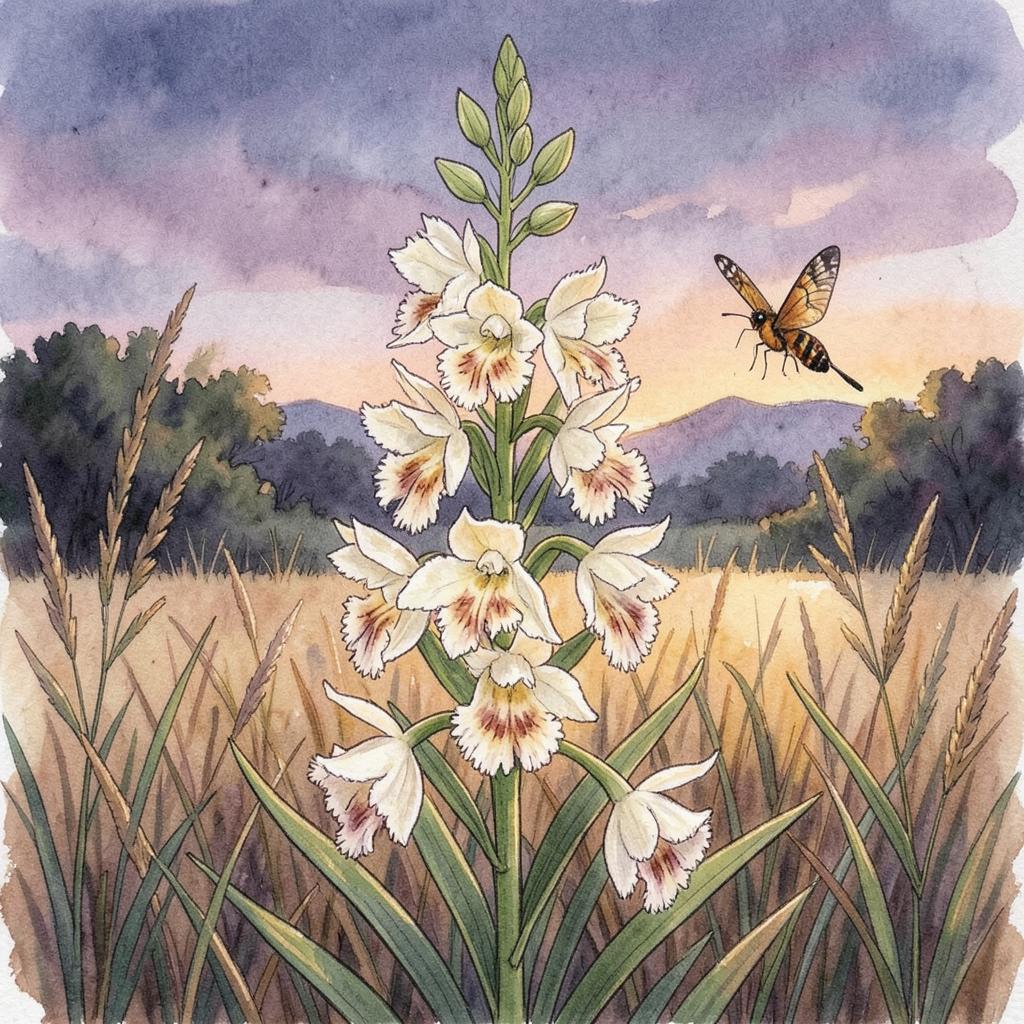
Illustrated Species Ambassador
Vesper — Western Prairie Fringed Orchid
I'm Vesper, an illustrated ambassador for the western prairie fringed orchid. My flowers open pale and scented because the pollinators I need fly at night.
- One fact worth knowing
- This orchid is pollinated by hawkmoths with a proboscis long enough to reach its deep nectar spur, and has essentially no alternative pollinator.
- What I depend on
- I depend on moist tallgrass prairie and fen hydrology, soil mycorrhizal fungi, and periodic fire or haying applied outside my flowering period.
- My greatest threat
- My greatest threat is tallgrass prairie conversion and the loss of hawkmoth pollinators.
- One way you can help
- Reduce outdoor lighting at night, which disrupts the moths I depend on, never collect wild orchids, and support prairie land trusts.
This ambassador is an original illustration created for this project. It is an educational character, not a documentary image, and its statements follow the sourced record on this page. Artwork and rights record
Why this species matters
This orchid can only be pollinated by hawkmoths with tongues long enough to reach its nectar spur. Protecting the plant means protecting a night-flying insect most people never see, on prairie that has already been reduced by more than 99 percent.
If it disappears: Northern tallgrass prairie would lose one of its most distinctive flowering plants and a documented example of a highly specialized pollination relationship.
Conservation status
- U.S. Endangered Species Act
- ThreatenedListed 1989.Last verified 2026-09-08
- Canada (SARA)
- EndangeredLast verified 2026-09-08
- NatureServe
- ImperiledLast verified 2026-09-08
- CITES
- Appendix II (all orchids)Last verified 2026-09-08
Population
Known from scattered sites across the northern Great Plains, with the largest populations in North Dakota, Minnesota, and Manitoba. Annual flowering counts swing dramatically with rainfall and dormancy.
Trend: Decreasing
As reported: USFWS five-year review and state and provincial monitoring
Source: U.S. Fish and Wildlife Service; state natural heritage programs; Environment and Climate Change Canada
Uncertainty: Like other orchids, plants may not flower every year, so counts of flowering stems understate the number of living plants.
Historical: Historically present across the tallgrass prairie region from Manitoba south to Oklahoma.
Fragmentation: Sites are isolated remnants in a landscape now dominated by cropland.
Range and distribution
Historic range: Tallgrass prairie from Manitoba south through the Dakotas, Minnesota, Iowa, Nebraska, Missouri, Kansas, and Oklahoma.
Current range: North Dakota, Minnesota, Nebraska, Kansas, Missouri, Iowa, and Manitoba, at scattered remnant sites.
Range contraction: Extirpated from much of the southern portion of its historic range.
Regions occupied
- Sheyenne National Grassland, North Dakota
- Tallgrass prairie remnants in Minnesota and Manitoba
- Scattered sites in the central plains
Habitat
Primary habitat: Moist to wet tallgrass prairie, sedge meadow, and calcareous fen.
Breeding habitat: Flowers in early summer, opening in the evening and releasing fragrance at night.
Feeding habitat: Depends on soil mycorrhizal fungi, especially for germination.
Critical habitat: No critical habitat designated.
Habitat dependencies
- Hawkmoths with a proboscis long enough to reach the deep nectar spur — this orchid has essentially no alternative pollinator
- Moist prairie soils and appropriate hydrology
- Periodic fire or haying to keep the prairie open, applied outside the flowering period
- Soil mycorrhizal fungi
Biology and ecology
A prairie forb dependent on and supporting night-flying pollinators, and an indicator of high-quality moist prairie.
Important adaptations: White flowers that reflect moonlight and a fragrance released only at night — a form specifically shaped for nocturnal moth pollination.
- Size
- Flowering stem 1 to 4 feet tall.
- Lifespan
- Long-lived perennial, capable of extended dormancy.
- Diet
- Autotrophic, with mycorrhizal dependence.
- Reproduction
- Pollinated at night by hawkmoths, which transfer pollen sacs attached to their eyes as they feed at the deep nectar spur.
- Offspring
- Tens of thousands of dust-like seeds per capsule.
- Breeding frequency
- Flowers when conditions allow; skips years in drought.
Primary threats
Habitat loss
Tallgrass prairie conversion to cropland eliminated the overwhelming majority of habitat.
Loss of pollinators
Hawkmoth declines from pesticide use and light pollution directly reduce seed set even where the plant survives.
Altered hydrology
Drainage and tiling of wet prairie change the soil moisture the orchid requires.
Woody encroachment
Without fire, shrubs and trees invade prairie and shade out the orchid.
Invasive plants
Leafy spurge, reed canary grass, and smooth brome displace native prairie vegetation.
Haying and grazing timing
Mowing or grazing during flowering removes the flowering stems before seed set.
Climate change
Drought reduces flowering, and extreme rainfall alters prairie hydrology.
Light pollution
Artificial light disrupts the nocturnal moths the orchid depends on.
Conservation and recovery
Programs and efforts
- USFWS recovery program and periodic status reviews
- Sheyenne National Grassland management for orchid habitat
- Prescribed fire and haying schedules timed around flowering
- Hand pollination at some sites where moth pollinators are scarce
- Seed banking and symbiotic propagation research
- Canadian recovery strategy for the Manitoba populations
Protected areas
- Sheyenne National Grassland, North Dakota
- Tallgrass Prairie Preserve areas in Minnesota
- Manitoba Tall Grass Prairie Preserve
Legal protections
- Endangered Species Act
- Canadian Species at Risk Act
- CITES Appendix II
Measurable progress
- Managed grassland sites support some of the largest known populations
- Timing haying and burning around flowering has measurably improved seed set
Continuing challenges
- Prairie habitat cannot be readily recreated
- Hawkmoth populations are poorly monitored
- Dormancy complicates monitoring
How people can help
What individuals can do
- Reduce outdoor lighting, which disrupts night-flying moth pollinators
- Never collect wild orchids
- Support prairie land trusts
What communities can do
- Adopt dark-sky lighting near prairie preserves
- Support haying schedules that allow orchids to set seed
Educational actions
- Use the hawkmoth relationship to teach how tightly a plant and an insect can be bound together
Habitat support
- Support prairie restoration, prescribed fire, and wet prairie hydrology protection
Organizations and programs to learn about
- USFWS Midwest Region
- The Nature Conservancy prairie programs
- state natural heritage programs
Educational notes
- Flowers open and release fragrance at night, timed to hawkmoth activity.
- Pollen sacs attach to the moth's eyes, which is how pollen moves between plants.
- Over 99 percent of tallgrass prairie has been converted.
Sources and references
- U.S. Fish and Wildlife Service — Western Prairie Fringed Orchid — USFWS
- NatureServe Explorer — NatureServe
- CITES Appendices — CITES