Pollinators
Western Bumble Bee
Bombus occidentalis
Once among the most common bumble bees in the western United States, now largely absent from the Pacific coast portion of its range.
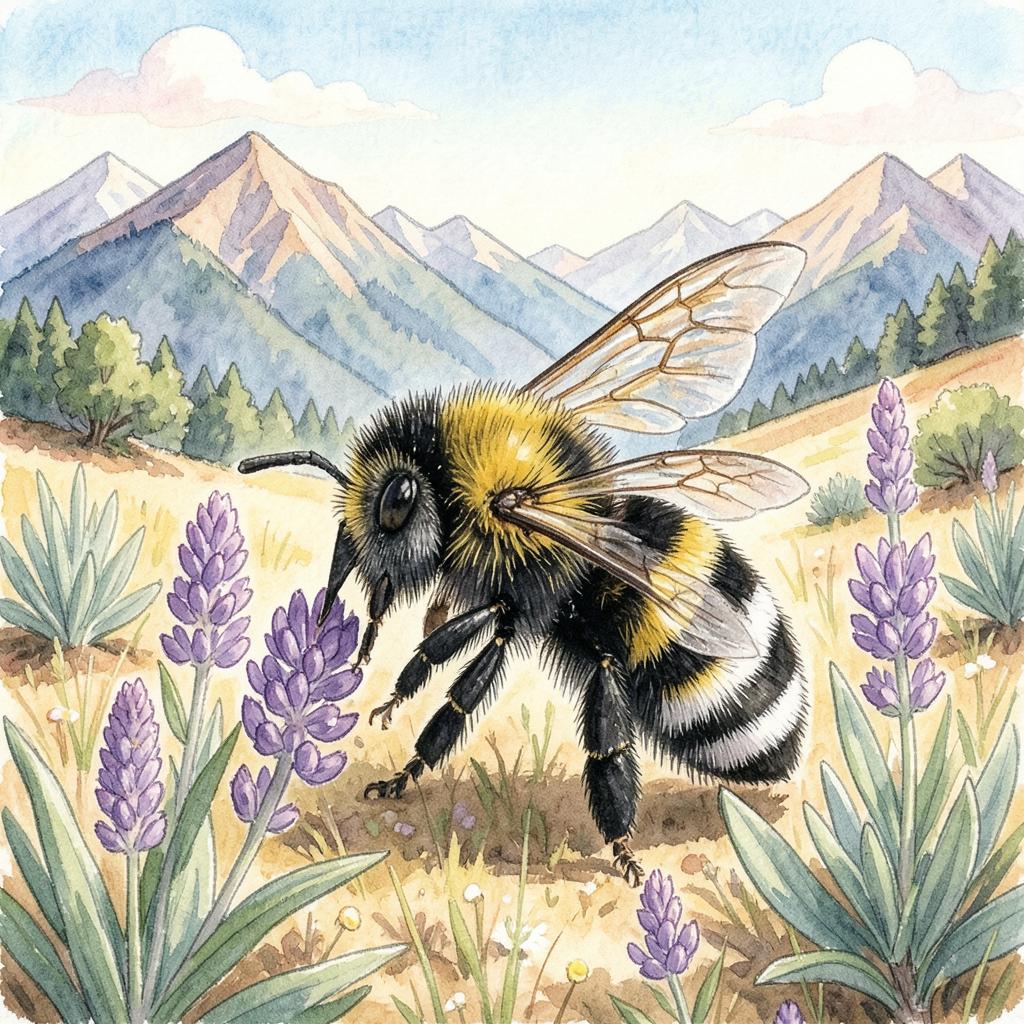
Illustrated Species Ambassador
Occi — Western Bumble Bee
I'm Occi, an illustrated ambassador for the western bumble bee. You can know me by the white patch at the end of my abdomen.
- One fact worth knowing
- Once among the most common bumble bees in the western United States, the western bumble bee is now largely absent from the Pacific coast portion of its range.
- What I depend on
- I depend on flowers blooming right through the season, rodent burrows and undisturbed ground to nest in, and soil or leaf litter to overwinter in.
- My greatest threat
- My greatest threat is pathogen spillover, alongside habitat loss.
- One way you can help
- Plant native western wildflowers with staggered bloom times, avoid neonicotinoid-treated nursery plants, and photograph and report bumble bee sightings to the regional Bumble Bee Atlas.
This ambassador is an original illustration created for this project. It is an educational character, not a documentary image, and its statements follow the sourced record on this page. Artwork and rights record
Why this species matters
The western bumble bee's decline coincided closely with the commercial rearing and transport of bumble bee colonies for greenhouse pollination. It is one of the clearest available illustrations of how managed pollinators can harm wild ones.
If it disappears: High-elevation and cool-climate plant communities would lose a pollinator that operates in conditions honey bees cannot, and western agriculture would lose an important native pollinator.
Conservation status
- IUCN Red List
- VulnerableLast verified 2026-09-08
- U.S. Endangered Species Act
- Under reviewUSFWS has conducted a species status assessment and has been evaluating listing; confirm the current determination before publication.Last verified 2026-09-08
- Canada (COSEWIC)
- Threatened (Bombus occidentalis occidentalis)Last verified 2026-09-08
- NatureServe
- Imperiled to Vulnerable, varying by stateLast verified 2026-09-08
Population
Broadly declined, with the sharpest losses in the western and coastal portion of its range. Populations persist in parts of the Rocky Mountains and interior west, and monitoring is occurrence-based rather than a total count.
Trend: Decreasing
As reported: USFWS species status assessment and Bumble Bee Atlas survey records
Source: U.S. Fish and Wildlife Service; Xerces Society; IUCN Red List
Uncertainty: Relative abundance and occupancy, not headcount, are the metrics. Declines are uneven across the range.
Historical: Formerly one of the most abundant bumble bees from California to British Columbia; commercially reared for greenhouse pollination in the 1990s before colonies collapsed.
Fragmentation: Coastal and lowland populations are largely gone; remaining strongholds are montane and interior.
Range and distribution
Historic range: Western North America from central California and the Great Basin north to Alaska and east to the Rockies and Great Plains.
Current range: Persisting mainly at higher elevations and in the interior west and northern portions of the range.
Range contraction: Substantially lost from coastal California, Oregon, and Washington lowlands.
Regions occupied
- Rocky Mountains
- Great Basin
- Pacific Northwest interior
- Western Canada and Alaska
Habitat
Primary habitat: Meadows, sagebrush steppe, montane grasslands, forest openings, and gardens with abundant flowering plants.
Breeding habitat: Nests underground in abandoned rodent burrows and occasionally above ground in cavities.
Feeding habitat: A generalist forager on a wide range of native wildflowers and crops.
Seasonal differences: Annual colony cycle; only mated queens overwinter.
Habitat dependencies
- Season-long floral resources
- Rodent burrows and undisturbed ground for nesting
- Overwintering sites in soil or duff
Biology and ecology
A key pollinator of western native plants and of crops including cranberry, clover, alfalfa, blueberry, and greenhouse tomato.
Important adaptations: Cold tolerance allows foraging at higher elevations and in cooler conditions than most bees, including honey bees.
- Size
- Workers roughly half an inch; queens larger.
- Lifespan
- Workers weeks; queens about a year.
- Diet
- Nectar and pollen.
- Reproduction
- One overwintered queen founds a colony each spring.
- Offspring
- Colonies of dozens to a few hundred workers.
- Breeding frequency
- One colony cycle annually.
- Age at maturity
- Weeks from egg to worker.
Primary threats
Disease
Nosema bombi and pathogen spillover from commercially reared bumble bees are strongly implicated in the collapse.
Pesticides
Neonicotinoids and other insecticides impair colony development and foraging.
Habitat loss
Grassland conversion, development, and intensive grazing remove floral resources and nesting sites.
Climate change
Warming and drought shift and shorten bloom periods in montane meadows, and high-elevation species have nowhere further to move.
Competition
Dense managed honey bee placement can reduce floral resources available to native bees.
Altered fire regimes
Severe wildfire and fire suppression both alter the meadow and forest-opening habitat the species uses.
Conservation and recovery
Programs and efforts
- Pacific Northwest and Rocky Mountain Bumble Bee Atlas community science surveys
- USFWS species status assessment and listing evaluation
- Pollinator habitat restoration on federal rangelands and national forests
- Improved pathogen screening requirements for commercial bumble bee shipments
Protected areas
- National forests and montane meadow systems across the interior west
- Bureau of Land Management pollinator habitat areas
Legal protections
- Canadian assessment as Threatened
- State-level species of concern designations
- ESA listing evaluation in progress
Measurable progress
- Volunteer atlas surveys have produced a detailed picture of where the species persists
- Public land pollinator seeding programs have expanded
Continuing challenges
- No effective way to remove an established pathogen from the wild
- Range spans multiple states and countries
- Listing status remains unresolved
How people can help
What individuals can do
- Plant native western wildflowers with staggered bloom times
- Avoid neonicotinoid-treated nursery plants
- Report bumble bee sightings with photographs to the regional Bumble Bee Atlas
What communities can do
- Reduce pesticide use in parks and rights-of-way
- Support native seeding in restoration after wildfire
Educational actions
- Join a Bumble Bee Atlas training — western bumble bee records depend heavily on volunteers
Habitat support
- Protect montane meadows and sagebrush steppe from conversion and overgrazing
Organizations and programs to learn about
- Xerces Society
- USFWS Pacific Region
- state natural heritage programs
Educational notes
- Shows how commercial pollination practice can affect wild pollinators.
- Cold-tolerant bees matter for crops that bloom early or in cool climates.