Plants
Venus Flytrap
Dionaea muscipula
The world's most famous carnivorous plant grows wild only within about a 75-mile radius of Wilmington, North Carolina.
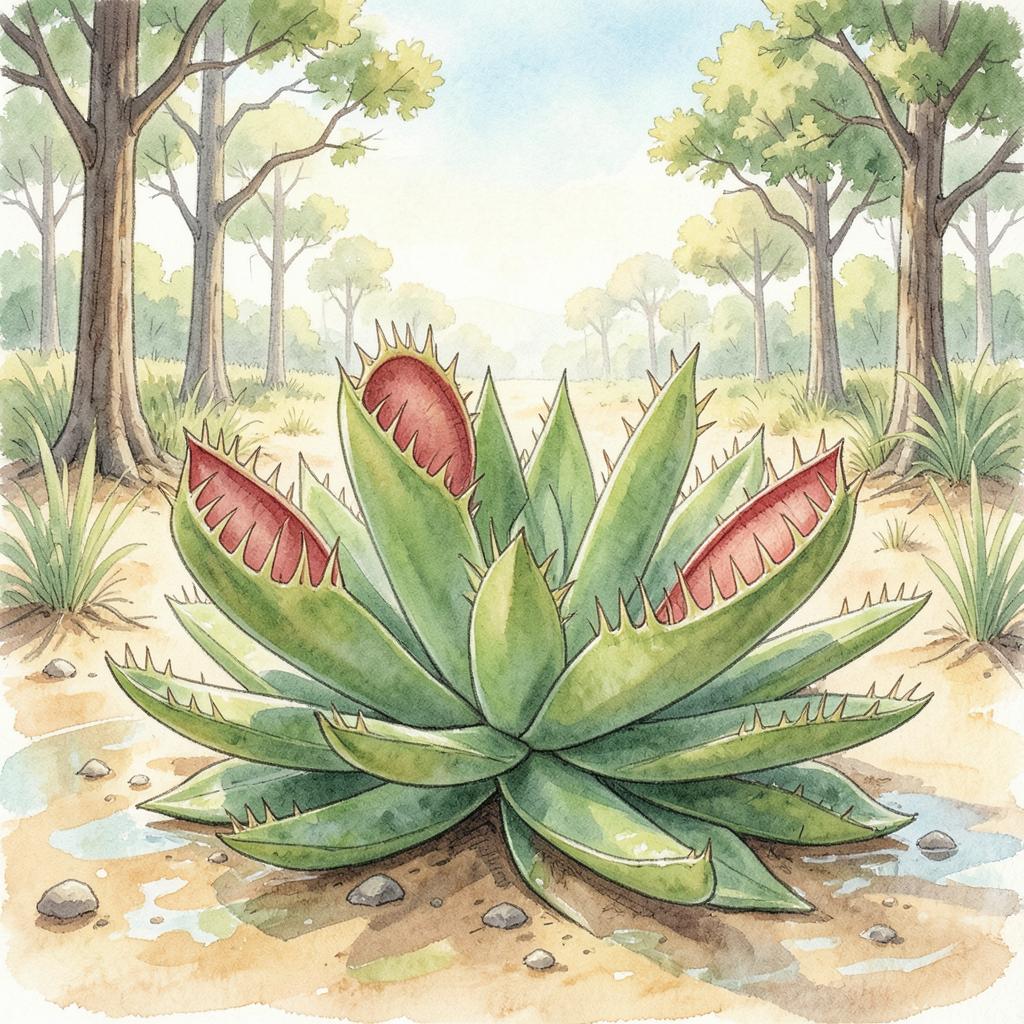
Illustrated Species Ambassador
Kindle — Venus Flytrap
I'm Kindle, an illustrated ambassador for the Venus flytrap. Everyone knows me from a windowsill, but in the wild I grow in only one small region.
- One fact worth knowing
- The Venus flytrap grows wild only within roughly a 75-mile radius of Wilmington, North Carolina, in wet longleaf pine savanna kept open by frequent fire.
- What I depend on
- I depend on fire roughly every one to three years, on permanently saturated but nutrient-poor acidic soil, and on full sun — shrubs shade me out quickly.
- My greatest threat
- My greatest threat is habitat loss, fire suppression, and poaching.
- One way you can help
- Buy flytraps only from nurseries that propagate them, never take a wild plant — in North Carolina it is a felony — and support prescribed fire programs that keep the savanna open.
This ambassador is an original illustration created for this project. It is an educational character, not a documentary image, and its statements follow the sourced record on this page. Artwork and rights record
Why this species matters
The Venus flytrap is known worldwide and grows wild in one small corner of the Carolinas. Its survival depends on regular fire — a management practice that is difficult near neighborhoods and easy for the public to oppose.
If it disappears: One of the most recognizable plants on earth would exist only in cultivation, and the wet pine savanna that supports it would lose its clearest indicator of health.
Conservation status
- IUCN Red List
- VulnerableLast verified 2026-09-08
- U.S. Endangered Species Act
- Not listedUSFWS has evaluated the species for listing; verify the current status of any petition or finding before publication.Last verified 2026-09-08
- North Carolina
- Species of Special Concern; poaching from the wild is a felonyLast verified 2026-09-08
- CITES
- Appendix IILast verified 2026-09-08
Population
Roughly 300,000 plants are estimated to remain in the wild, across a small number of documented sites within a limited coastal plain area.
Trend: Decreasing
As reported: North Carolina Natural Heritage Program and USFWS assessments
Source: North Carolina Natural Heritage Program; U.S. Fish and Wildlife Service; IUCN Red List
Uncertainty: Site-level counts are used; the total is an aggregate estimate rather than a census.
Historical: Historic populations were far larger and more widespread across the Carolina coastal plain before development and fire suppression.
Fragmentation: Populations are isolated in small habitat remnants, many surrounded by development.
Range and distribution
Historic range: Wet pine savannas and pocosin edges within roughly 75 miles of Wilmington, North Carolina, extending into South Carolina.
Current range: The same area at greatly reduced extent, plus naturalized populations established elsewhere from plantings.
Range contraction: Estimated loss of the large majority of historic sites.
Regions occupied
- Southeastern North Carolina
- Northeastern South Carolina
Habitat
Primary habitat: Wet longleaf pine savanna and sandy pocosin edges with saturated, nutrient-poor, acidic soil and full sun.
Breeding habitat: Produces white flowers on a tall stalk held well above the traps, so pollinators are not eaten.
Feeding habitat: Captures insects and spiders to obtain nitrogen the soil cannot supply.
Critical habitat: Not applicable — not federally listed.
Habitat dependencies
- Frequent fire, roughly every one to three years, to keep the savanna open and sunlit
- Permanently saturated but not flooded, nutrient-poor soil
- Full sun — the plant is quickly shaded out by encroaching shrubs
Biology and ecology
A specialist of nutrient-poor fire-maintained savanna, and an indicator that the fire regime is intact.
Important adaptations: Each trap has trigger hairs and closes only when two hairs are touched, or one hair twice within about twenty seconds — a simple counting mechanism that prevents wasting energy on raindrops and debris. A trap can only open and close a limited number of times before it dies.
- Size
- Rosettes typically 4 to 6 inches across; traps roughly an inch long.
- Lifespan
- Perennial, potentially living decades.
- Diet
- Photosynthesis for energy, plus insects and spiders for nitrogen and phosphorus.
- Reproduction
- Insect-pollinated flowers producing small black seeds; also spreads by rhizome division.
- Offspring
- Modest seed production per flowering stalk.
- Breeding frequency
- Flowers in spring.
Primary threats
Fire suppression
Without frequent low-intensity fire, shrubs and trees close in and shade out the flytrap. This is the leading cause of decline at otherwise intact sites.
Habitat loss
Coastal development, drainage, and conversion have eliminated the great majority of wet pine savanna.
Illegal collection
Poachers dig thousands of plants from the wild for sale. North Carolina made flytrap poaching a felony in 2014 in response.
Altered hydrology
Ditching and drainage dry the saturated soils the plant requires.
Invasive species
Invasive shrubs and grasses displace native savanna vegetation.
Sea level rise
Saltwater intrusion threatens low-lying coastal savanna habitat.
Small range
A global range of a few dozen miles offers no buffer against any regional event.
Conservation and recovery
Programs and efforts
- Prescribed fire programs on state, federal, and Nature Conservancy lands in the Carolina coastal plain
- North Carolina felony poaching statute and enforcement
- Land acquisition and conservation easements protecting wet pine savanna
- Nursery propagation making inexpensive plants widely available, reducing poaching incentive
- Population monitoring by the North Carolina Natural Heritage Program
Protected areas
- Green Swamp Preserve, North Carolina
- Carolina Beach State Park
- Holly Shelter Game Land
- Croatan National Forest
Legal protections
- North Carolina felony statute for wild collection
- CITES Appendix II
- State species of special concern designation
Measurable progress
- Making poaching a felony substantially raised the deterrent
- Prescribed fire programs have restored savanna condition at protected sites
- Widespread nursery propagation means no one needs a wild plant
Continuing challenges
- Prescribed fire near residential areas is difficult
- Habitat continues to be lost to development
- Poaching still occurs
How people can help
What individuals can do
- Buy flytraps only from nurseries that propagate them — they are inexpensive and widely available, so there is never a reason to take a wild one
- Never collect a wild plant; in North Carolina it is a felony
- Support prescribed fire programs, which neighbors often oppose without understanding why they are needed
What communities can do
- Support land acquisition for wet pine savanna
- Back prescribed fire programs and public education about them
Educational actions
- Use the trigger hair counting mechanism to teach that plants can respond to information, not just stimuli
Habitat support
- Volunteer with savanna restoration and invasive shrub removal
Organizations and programs to learn about
- North Carolina Natural Heritage Program
- The Nature Conservancy North Carolina
- North Carolina Botanical Garden
Educational notes
- Grows wild only within roughly 75 miles of Wilmington, North Carolina.
- A trap counts touches before closing, so it does not waste energy on raindrops.
- Poaching wild flytraps has been a felony in North Carolina since 2014.
Sources and references
- IUCN Red List — Dionaea muscipula — IUCN
- North Carolina Wildlife Resources Commission and Natural Heritage Program — North Carolina Natural Heritage Program
- CITES Appendices — CITES