Plants
Running Buffalo Clover
Trifolium stoloniferum
A clover that evolved alongside bison herds, nearly vanished when they did, and has since recovered enough to be removed from the endangered species list.
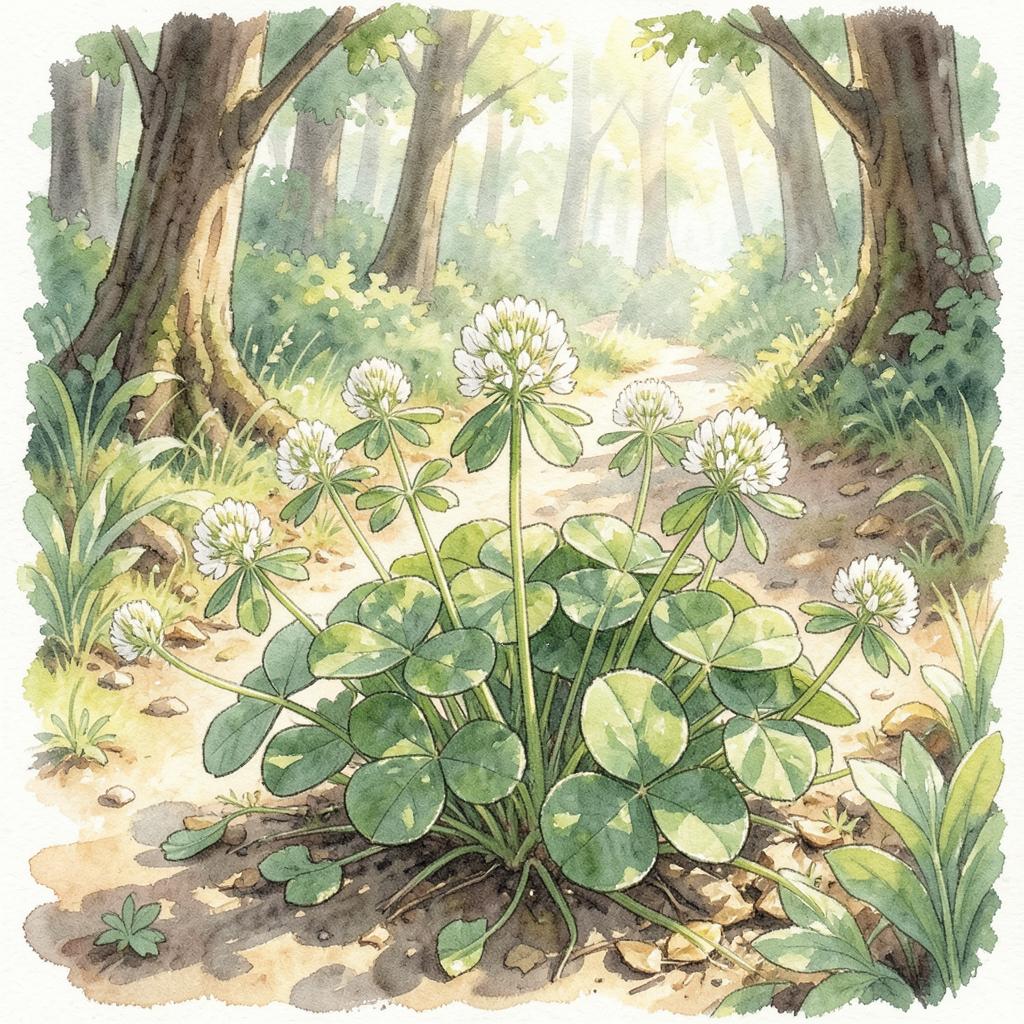
Illustrated Species Ambassador
Stolon — Running Buffalo Clover
I'm Stolon, an illustrated ambassador for running buffalo clover. I evolved alongside bison, and I nearly vanished when they did.
- One fact worth knowing
- Running buffalo clover recovered sufficiently to be removed from the endangered species list, having nearly disappeared when the bison herds it evolved with were lost.
- What I depend on
- I depend on partial shade, and on periodic moderate disturbance — trampling, mowing, light grazing — that opens the ground without destroying it.
- My greatest threat
- My greatest threats are the loss of that moderate disturbance and competition from invasive ground cover.
- One way you can help
- Stay on established trails where this clover grows, avoid broadcast herbicide along woodland edges and trails, and report populations to your state natural heritage program.
This ambassador is an original illustration created for this project. It is an educational character, not a documentary image, and its statements follow the sourced record on this page. Artwork and rights record
Why this species matters
Running buffalo clover declined not because its habitat was destroyed but because the disturbance it evolved with disappeared. Its recovery came from recognizing that some species need moderate disturbance, and it is one of relatively few plants ever delisted from the Endangered Species Act because it recovered.
If it disappears: The Ohio Valley would lose an ecological link to the vanished eastern bison herds, and one of the clearest examples that too little disturbance can endanger a species.
Cultural and regional note: The species' association with bison trails, salt licks, and later with early settler stock routes makes it a living record of how the eastern landscape was once used.
Conservation status
- U.S. Endangered Species Act
- Delisted due to recovery in 2021Listed as endangered in 1987 and removed from the list in 2021 after populations increased substantially. Post-delisting monitoring is ongoing.Last verified 2026-09-08
- NatureServe
- Vulnerable to Imperiled, varying by stateLast verified 2026-09-08
- State
- Still protected under several state endangered species lawsLast verified 2026-09-08
Population
Populations increased from a handful of known occurrences at listing to a substantially larger number of documented sites across several states by the time of delisting.
Trend: Increasing
As reported: USFWS delisting rule and post-delisting monitoring plan
Source: U.S. Fish and Wildlife Service; state natural heritage programs
Uncertainty: Part of the increase reflects genuine population growth and part reflects greatly increased survey effort. Both should be acknowledged; a delisting is not the same as a return to historic abundance.
Historical: Believed once widespread across the Ohio Valley in association with bison trails and grazing. It was thought extinct for much of the twentieth century and was rediscovered in West Virginia in 1983.
Fragmentation: Populations remain scattered and depend on continued appropriate management.
Range and distribution
Historic range: Ohio Valley and surrounding states, associated with bison trails, salt licks, and grazed woodland openings.
Current range: West Virginia, Ohio, Kentucky, Indiana, Missouri, and Arkansas.
Range contraction: Absent from much of the historic range, though recovering within it.
Regions occupied
- West Virginia and Ohio
- Kentucky and Indiana
- Missouri and Arkansas
Habitat
Primary habitat: Partially shaded woodland, mesic forest openings, stream terraces, old logging roads, trails, and lightly grazed pasture.
Breeding habitat: Produces white flower heads in late spring and early summer.
Feeding habitat: A legume that fixes nitrogen through root nodule bacteria.
Habitat dependencies
- Periodic moderate disturbance — trampling, mowing, light grazing — that opens the ground without destroying it
- Partial shade rather than deep forest or full sun
- Absence of heavy competition from invasive ground cover
Biology and ecology
A nitrogen-fixing legume of woodland openings and an indicator of moderate, historically appropriate disturbance.
Important adaptations: Spreading runners let it colonize freshly disturbed ground quickly — an adaptation to a landscape once regularly churned by bison hooves.
- Size
- Low-growing, spreading by runners; flower stalks a few inches tall.
- Lifespan
- Perennial, spreading clonally by stolons.
- Diet
- Autotrophic, with nitrogen fixation through symbiotic bacteria.
- Reproduction
- Reproduces both by seed and by rooting runners, which is how it spreads along trails.
- Offspring
- Modest seed production supplemented heavily by vegetative spread.
- Breeding frequency
- Flowers annually in late spring.
Primary threats
Loss of moderate disturbance
The eastern bison herds are gone. Without some form of comparable disturbance — trail use, mowing, light grazing — the clover is outcompeted and shaded out.
Too much disturbance
Heavy grazing, off-road vehicles, and development destroy plants outright; the species needs a narrow middle ground.
Invasive plants
Japanese stiltgrass, garlic mustard, and other invasives outcompete it in woodland openings.
Deer browsing
High deer densities can suppress flowering and reduce seed set.
Habitat conversion
Development and forest conversion eliminate the woodland opening habitat it requires.
Herbicide use
Broad-spectrum herbicide along trails, roadsides, and utility corridors kills plants directly.
Small population effects
Many populations remain small and locally vulnerable despite the overall recovery.
Conservation and recovery
Programs and efforts
- USFWS post-delisting monitoring plan tracking populations for years after removal from the list
- Conservation agreements with land managers on national forests and state lands
- Trail, road, and utility corridor management timed to allow flowering and seed set
- Invasive species control at occupied sites
- Continued state-level protection in several states
Protected areas
- Monongahela National Forest, West Virginia
- Wayne National Forest, Ohio
- State forests and parks across the recovered range
Legal protections
- Post-delisting monitoring under the Endangered Species Act
- State endangered species protection in several states
Measurable progress
- One of a small number of plants delisted from the ESA due to genuine recovery
- Land management agencies adopted mowing and trail practices that maintain the species
Continuing challenges
- Delisting removes federal protection while the species still depends on active management
- Invasive plants continue to spread
- Appropriate disturbance must be deliberately maintained indefinitely
How people can help
What individuals can do
- Stay on established trails in occupied areas
- Avoid broadcast herbicide use along woodland edges and trails
- Report populations to state natural heritage programs
What communities can do
- Ask land managers to time mowing on trails and utility corridors to allow flowering and seed set
- Support invasive plant control on public land
Educational actions
- Use this clover to teach that some species are endangered by too little disturbance, not too much
Habitat support
- Support woodland opening management and invasive control
Organizations and programs to learn about
- USFWS Midwest and Northeast Regions
- state natural heritage programs
- U.S. Forest Service
Educational notes
- Thought extinct for much of the twentieth century, then rediscovered in 1983.
- One of relatively few plants ever removed from the endangered list because it recovered.
- Its decline traces directly to the disappearance of eastern bison herds.
Sources and references
- U.S. Fish and Wildlife Service — Running Buffalo Clover — USFWS
- USFWS delisting and post-delisting monitoring documents — USFWS ECOS
- NatureServe Explorer — NatureServe