Marine Life
Rice's Whale
Balaenoptera ricei
A baleen whale recognized as a distinct species only in 2021, found solely in the Gulf of Mexico, with fewer than 100 individuals believed to remain.
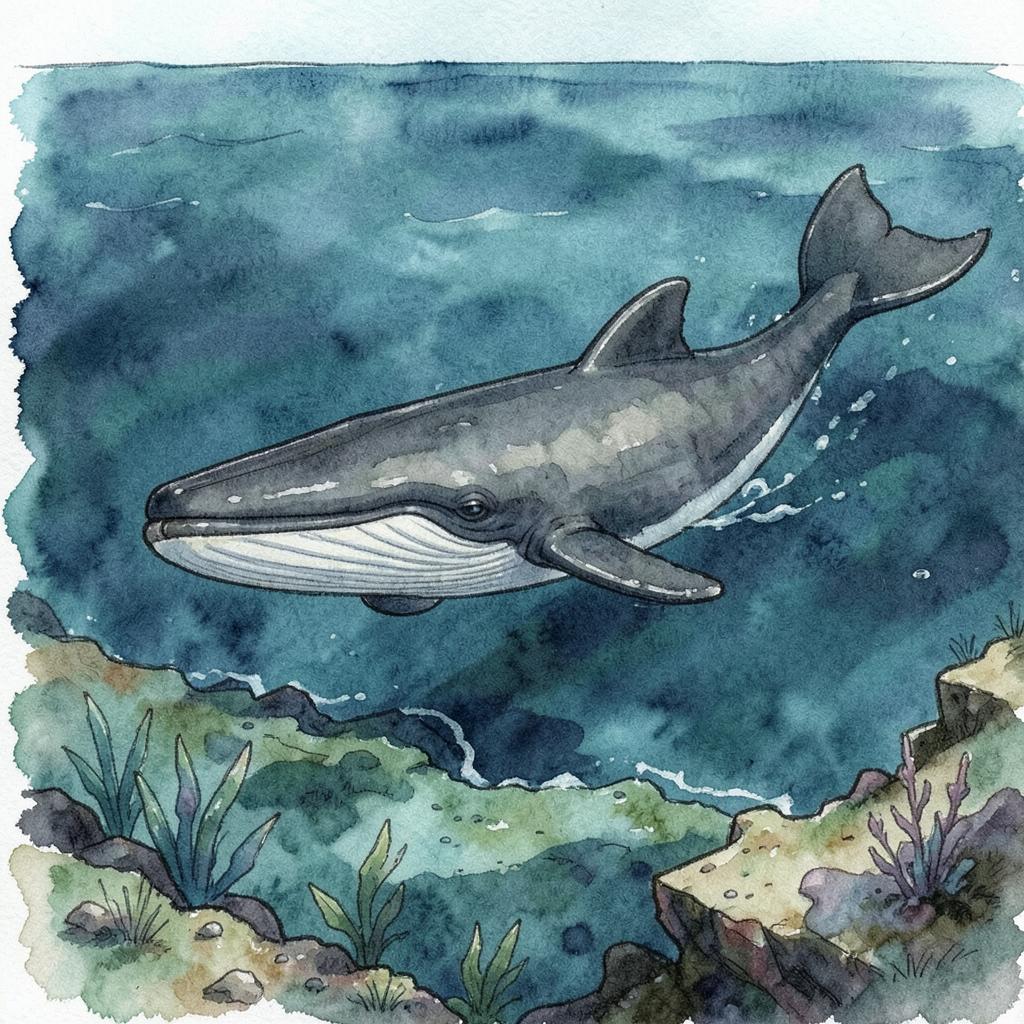
Illustrated Species Ambassador
Marisol — Rice's Whale
I'm Marisol, an illustrated ambassador for Rice's whale. People only recognised us as a separate species in 2021, and there are fewer than a hundred of us.
- One fact worth knowing
- Rice's whale was recognised as a distinct species in 2021, lives only in the Gulf of Mexico, and is believed to number fewer than 100 individuals.
- What I depend on
- I depend on prey gathering along the Gulf's continental shelf break, at roughly 100 to 400 metres depth, in a very small core area.
- My greatest threat
- My greatest threats are vessel strikes, oil and gas activity, and simply how few of us there are.
- One way you can help
- If you boat in the northeastern Gulf, slow down in shelf-break waters and report whale sightings, and support Gulf restoration funded through the Deepwater Horizon settlements.
This ambassador is an original illustration created for this project. It is an educational character, not a documentary image, and its statements follow the sourced record on this page. Artwork and rights record
Why this species matters
Rice's whale was recognized as its own species only in 2021 and may already be among the most endangered whales on earth. It shows that species are still being discovered, sometimes in heavily industrialized waters, and sometimes already at the edge.
If it disappears: It would be the first extinction of a whale species described in the twenty-first century, and the Gulf of Mexico would lose its only resident baleen whale.
Conservation status
- IUCN Red List
- Critically EndangeredLast verified 2026-09-08
- U.S. Endangered Species Act
- EndangeredListed in 2019 as the Gulf of Mexico Bryde's whale, then formally recognized as the distinct species Balaenoptera ricei in 2021.Last verified 2026-09-08
- Marine Mammal Protection Act
- Depleted and strategic stockLast verified 2026-09-08
Population
Fewer than 100 individuals, with published estimates generally in the range of roughly 50 to 100 animals and wide uncertainty.
Trend: Unknown
As reported: NOAA Fisheries stock assessment reports
Source: NOAA Fisheries Southeast Fisheries Science Center
Uncertainty: This is one of the smallest populations of any whale species. Estimates come from limited survey effort in a large area and carry substantial uncertainty.
Historical: Historic abundance is unknown; the species was not recognized as distinct until 2021, so no historic baseline exists.
Fragmentation: A single population, historically concentrated along the northeastern Gulf shelf break.
Range and distribution
Historic range: Believed to have occurred more broadly along the continental shelf break across the Gulf of Mexico.
Current range: Primarily a narrow band along the shelf break in the northeastern Gulf, at depths of roughly 100 to 400 meters.
Range contraction: Now concentrated in a small portion of the Gulf, though whether this reflects contraction or limited survey coverage is not fully resolved.
Regions occupied
- Northeastern Gulf of Mexico shelf break, principally off the Florida panhandle
Habitat
Primary habitat: Continental shelf break waters of the Gulf of Mexico at roughly 100 to 400 meters depth.
Breeding habitat: Not documented in detail; calving is presumed to occur in the same waters.
Feeding habitat: Feeds at depth, apparently on schooling fish near the sea floor.
Critical habitat: NOAA has proposed critical habitat in the Gulf of Mexico; verify the current rule status.
Habitat dependencies
- Shelf break prey aggregations
- Low vessel strike risk
- Absence of major oil spills in a very small core area
Biology and ecology
The only resident baleen whale in the Gulf of Mexico and its sole large filter-feeding predator.
Important adaptations: Dives to the sea floor to feed, unusual among rorquals, and rests at the surface at night, which raises vessel strike risk.
- Size
- Up to about 42 feet.
- Weight
- Roughly 30 tons.
- Lifespan
- Not established; presumed comparable to related baleen whales.
- Diet
- Schooling fish taken in deep dives near the bottom.
- Reproduction
- A single calf; reproductive details are largely unknown.
- Offspring
- One.
- Breeding frequency
- Not established.
- Age at maturity
- Not established.
Primary threats
Vessel strikes
The whales rest near the surface at night in an area with heavy vessel traffic; a confirmed ship strike death has been documented.
Oil and gas activity
The core habitat overlaps oil and gas operations. The Deepwater Horizon spill is estimated to have affected a substantial share of the population's habitat.
Underwater noise
Seismic surveys and vessel noise disrupt communication and feeding in a small, acoustically sensitive population.
Extremely small population
With fewer than 100 animals, every individual death is significant to the species.
Entanglement
Fishing gear entanglement is a documented risk.
Ocean debris
A stranded individual was found to have ingested plastic debris.
Low genetic diversity
A population this small is genetically vulnerable.
Conservation and recovery
Programs and efforts
- NOAA Fisheries stock assessment, acoustic monitoring, and survey effort
- Proposed critical habitat designation in the Gulf of Mexico
- Recommended vessel speed restrictions and nighttime transit guidance in core habitat
- Consultation requirements on oil and gas activity in the whale's range
Protected areas
- Proposed critical habitat along the Gulf shelf break
Legal protections
- Endangered Species Act
- Marine Mammal Protection Act
Measurable progress
- Genetic and acoustic work established the species as distinct, enabling targeted protection
- Passive acoustic monitoring has clarified distribution
Continuing challenges
- Core habitat overlaps an intensively industrialized ocean area
- Very little is known about the species' biology
- Population is too small to absorb any regular mortality
How people can help
What individuals can do
- If boating in the northeastern Gulf, reduce speed in shelf break waters and report whale sightings
- Support marine debris reduction in the Gulf
What communities can do
- Support vessel speed measures and critical habitat designation in the Gulf
Educational actions
- Use this whale to teach that new species are still being described, sometimes already endangered
Habitat support
- Support Gulf restoration funded through Deepwater Horizon settlements
Organizations and programs to learn about
- NOAA Fisheries Southeast Region
- Gulf of Mexico Alliance
- marine mammal stranding networks
Educational notes
- Formally described as a new species in 2021 and named for biologist Dale Rice.
- Possibly the most endangered whale species in the world.
- Resting at the surface at night is exactly the behavior that makes vessel strikes likely.
Sources and references
- IUCN Red List — Balaenoptera ricei — IUCN
- NOAA Fisheries — Rice's Whale — NOAA Fisheries
- NOAA Fisheries — Gulf of Mexico Marine Mammal Stock Assessments — NOAA Fisheries