Pollinators
Regal Fritillary
Argynnis idalia
A large prairie butterfly, once found across the eastern grasslands, now essentially gone east of the Mississippi except for a single military installation.
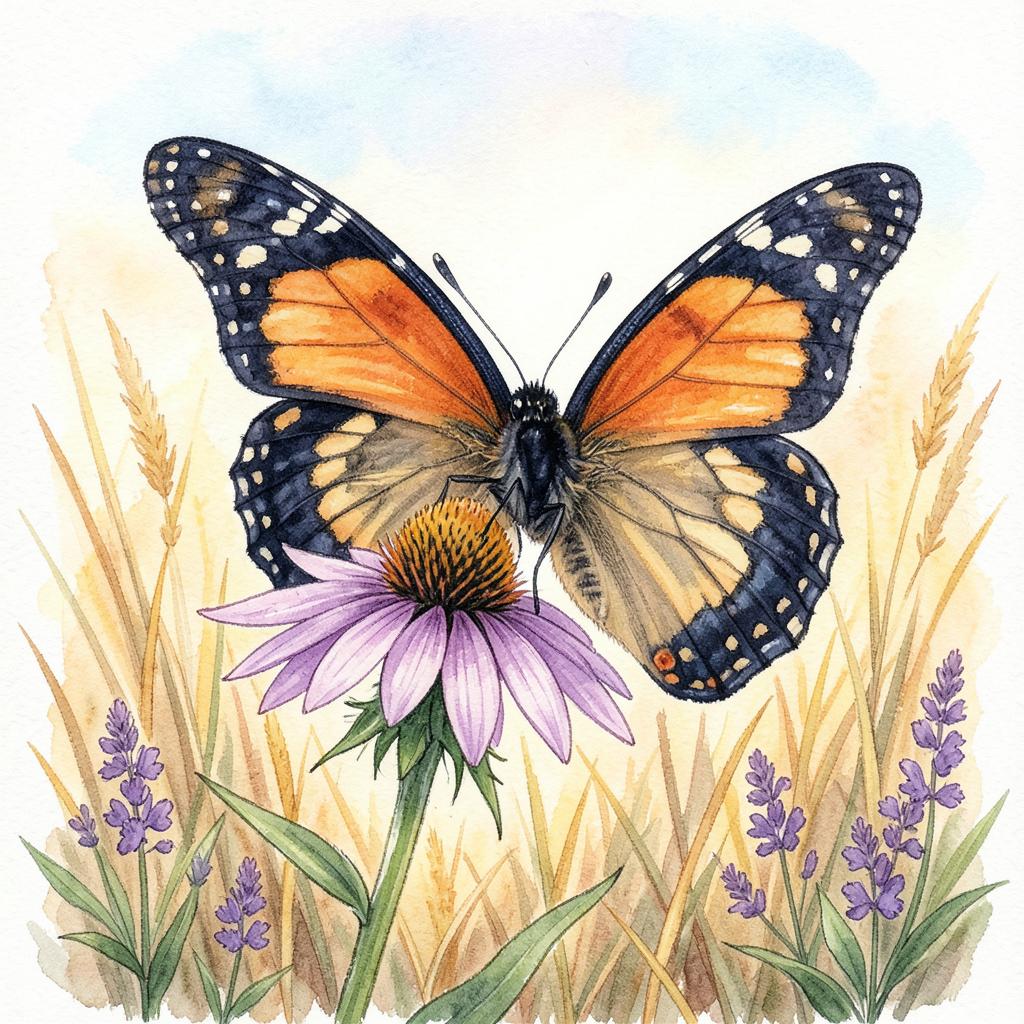
Illustrated Species Ambassador
Idalia — Regal Fritillary
I'm Idalia, an illustrated ambassador for the regal fritillary. I am one of the largest prairie butterflies, and I need grassland measured in acres, not flower beds.
- One fact worth knowing
- Once found across the eastern grasslands, the regal fritillary is now essentially gone east of the Mississippi except for a single military installation.
- What I depend on
- I depend on native violets for my caterpillars, on large connected grassland rather than fragments, and on fire or grazing applied in patches rather than all at once.
- My greatest threat
- My greatest threat is the loss of tallgrass prairie and the decline of violets within it.
- One way you can help
- Support prairie restoration that actually includes violets — they are often left out of seed mixes — and back grassland land trusts and preserves.
This ambassador is an original illustration created for this project. It is an educational character, not a documentary image, and its statements follow the sourced record on this page. Artwork and rights record
Why this species matters
The regal fritillary needs large, connected prairie rather than a preserved corner. Its eastern collapse to a single site, on land managed by the military for training rather than for butterflies, is a striking illustration of how much prairie is actually left.
If it disappears: The eastern grasslands would lose their largest remaining specialist butterfly, and one of the last direct links to the pre-settlement eastern prairie.
Conservation status
- U.S. Endangered Species Act
- Threatened (eastern regal fritillary, Argynnis idalia idalia)USFWS finalized a listing for the eastern subspecies as threatened; the western subspecies was found not to warrant listing. Verify the current rule text before publication.Last verified 2026-09-08
- NatureServe
- Vulnerable to Imperiled, varying by stateLast verified 2026-09-08
- IUCN Red List
- Not assessedLast verified 2026-09-08
Population
The eastern subspecies survives in essentially one population, at Fort Indiantown Gap in Pennsylvania. The western subspecies persists across Great Plains grasslands in numbers that vary widely by site and year.
Trend: Decreasing
As reported: USFWS species status assessment and state monitoring
Source: U.S. Fish and Wildlife Service; Pennsylvania Game Commission; state natural heritage programs
Uncertainty: The two subspecies must be discussed separately; conflating them badly misstates the species' status.
Historical: Historically ranged from Maine and Virginia west to Montana and Colorado, and was locally common in eastern grasslands.
Fragmentation: The eastern subspecies is reduced to a single site; western populations are scattered across remaining prairie.
Range and distribution
Historic range: Grasslands from the Atlantic states across the tallgrass prairie to the eastern Rockies.
Current range: Great Plains grasslands for the western subspecies; a single Pennsylvania site for the eastern subspecies.
Range contraction: Effectively extirpated from the entire eastern United States apart from one site.
Regions occupied
- Kansas, Nebraska, the Dakotas, Missouri, Iowa, Minnesota (western)
- Fort Indiantown Gap, Pennsylvania (eastern)
Habitat
Primary habitat: Tallgrass and mixed-grass prairie, wet meadows, and grassland with abundant native violets.
Breeding habitat: Larvae feed only on violets (Viola species); females scatter eggs in grassland near violets rather than laying directly on them.
Feeding habitat: Adults nectar on milkweeds, thistles, blazing star, and coneflowers.
Critical habitat: Refer to the current USFWS rule for any designated habitat.
Habitat dependencies
- Native violets in grassland
- Large, connected grassland — this butterfly needs area, not fragments
- Periodic disturbance by fire or grazing, applied in patches
Biology and ecology
A large-bodied prairie pollinator and an indicator of extensive, high-quality grassland.
Important adaptations: Newly hatched larvae overwinter without feeding and must find violets in the spring on their own — a strategy that requires violets to be widespread rather than concentrated.
- Size
- Wingspan about 3 to 4 inches — one of the largest prairie butterflies.
- Lifespan
- Adults live several weeks; females live into late summer.
- Diet
- Violets as larvae; nectar as adults.
- Reproduction
- One generation per year; females lay up to a thousand or more eggs scattered in grassland in late summer.
- Offspring
- Very high egg numbers with correspondingly high mortality.
- Breeding frequency
- Once yearly.
Primary threats
Habitat loss
Tallgrass prairie conversion to cropland eliminated the vast majority of habitat.
Fragmentation
The species requires large areas; small preserves cannot sustain populations.
Loss of host plants
Native violets decline under intensive grazing, dense thatch, or heavy shading.
Fire management
Burning an entire site kills overwintering larvae; patchwork burning is required.
Pesticides
Insecticide drift from surrounding cropland reduces populations in remnant grassland.
Overgrazing
Season-long heavy grazing removes both violets and nectar plants.
Climate change
Drought reduces violet availability and nectar supply during the long adult flight period.
Conservation and recovery
Programs and efforts
- Fort Indiantown Gap regal fritillary management program, integrating grassland management with military training
- Captive rearing and translocation of the eastern subspecies to additional sites
- USFWS species status assessment and listing rule for the eastern subspecies
- Prairie restoration and violet establishment across the Great Plains
Protected areas
- Fort Indiantown Gap, Pennsylvania
- Tallgrass Prairie National Preserve, Kansas
- Nature Conservancy prairie preserves across the plains
Legal protections
- Endangered Species Act listing of the eastern subspecies
- State conservation designations across the plains
Measurable progress
- Fort Indiantown Gap has sustained the eastern population for decades through patch-burn management
- Captive rearing has enabled translocation to establish additional eastern populations
Continuing challenges
- The eastern subspecies has virtually no genetic reserve
- Large prairie is scarce
- Management must serve grassland birds, plants, and insects simultaneously
How people can help
What individuals can do
- Plant native violets and prairie nectar plants where regionally appropriate
- Support grassland land trusts and prairie preserves
What communities can do
- Advocate for patch-burn grazing rather than whole-site burns on public grassland
- Support conservation easements on working ranchland
Educational actions
- Use this species to teach that some wildlife needs scale, not just protection
Habitat support
- Support prairie restoration projects that include violets, which are often omitted from seed mixes
Organizations and programs to learn about
- USFWS
- Pennsylvania Game Commission
- The Nature Conservancy prairie programs
Educational notes
- The eastern population persists on an active military training range — disturbance from training helps keep the grassland open.
- Violets are commonly left out of prairie seed mixes, which quietly excludes this butterfly from restorations.
Sources and references
- U.S. Fish and Wildlife Service — Regal Fritillary — USFWS
- Pennsylvania Game Commission — Regal Fritillary — Pennsylvania Game Commission
- NatureServe Explorer — NatureServe