Birds
Red-cockaded Woodpecker
Dryobates borealis
The only woodpecker that excavates its nest in living pines, downlisted from endangered to threatened in 2024 after decades of longleaf pine restoration.
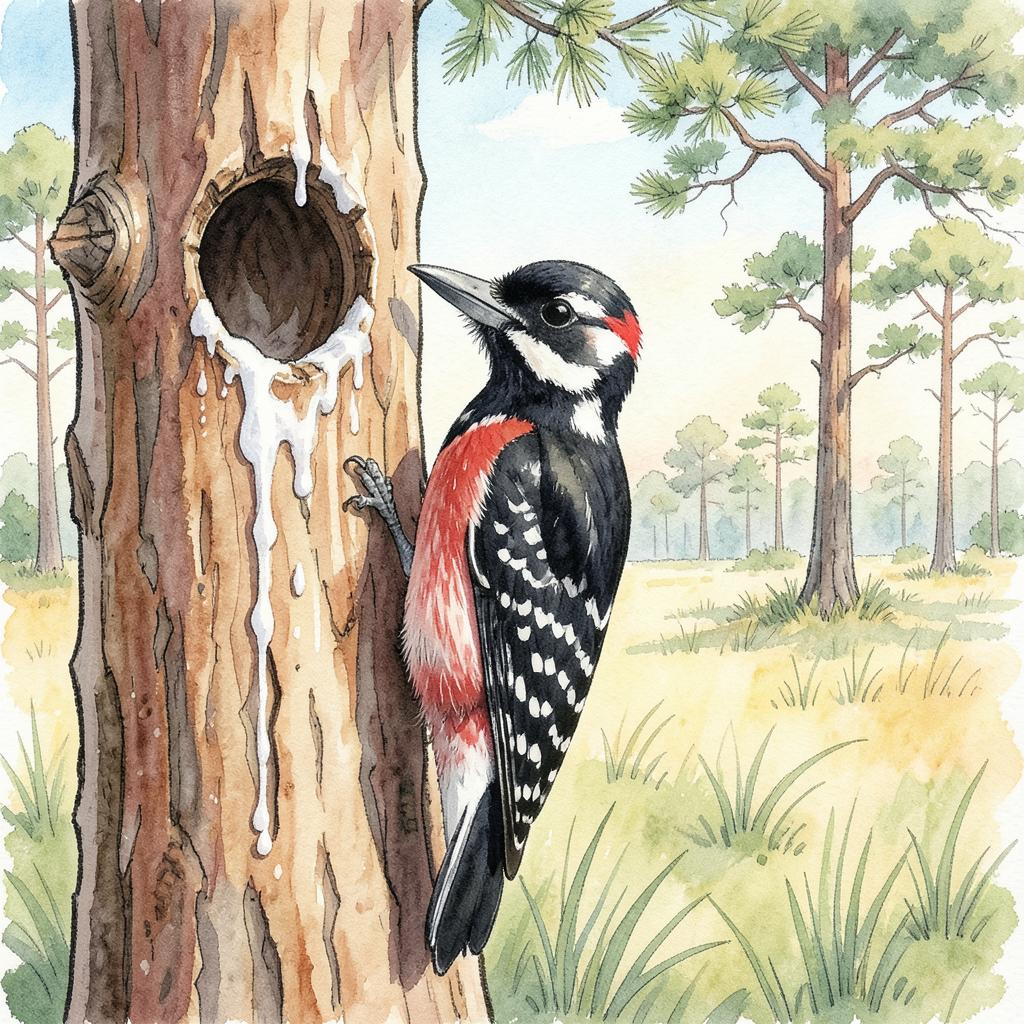
Illustrated Species Ambassador
Resin — Red-cockaded Woodpecker
I'm Resin, an illustrated ambassador for the red-cockaded woodpecker. I am the only woodpecker that carves its nest into a living pine, and it can take years.
- One fact worth knowing
- The red-cockaded woodpecker was downlisted from endangered to threatened in 2024 after decades of longleaf pine restoration, and its abandoned cavities are used by dozens of other species.
- What I depend on
- I depend on old living pines to excavate in and on frequent low-intensity fire keeping the understory open.
- My greatest threat
- My greatest threat is the loss of old longleaf pine and the suppression of fire.
- One way you can help
- Support prescribed burning in southeastern pine forests, and if you own woodland, keep old pines standing rather than harvesting on short rotations.
This ambassador is an original illustration created for this project. It is an educational character, not a documentary image, and its statements follow the sourced record on this page. Artwork and rights record
Why this species matters
Because it is the only woodpecker excavating in living pines, everything else that needs a tree cavity in southeastern pine forest depends on it. Its recovery also required restoring fire to the landscape, which benefits an entire suite of pine savanna species.
If it disappears: Cavity-dependent species across southeastern pine forest would lose their principal source of nest holes, and the case for fire-maintained longleaf restoration would lose its most compelling example.
Conservation status
- IUCN Red List
- Near ThreatenedLast verified 2026-09-08
- U.S. Endangered Species Act
- ThreatenedListed as endangered in 1970 and reclassified to threatened in 2024 following documented recovery.Last verified 2026-09-08
Population
Roughly 7,800 active clusters — family groups — across 11 southeastern states, representing an estimated 15,000 or more birds.
Trend: Increasing
As reported: USFWS reclassification rule, 2024
Source: U.S. Fish and Wildlife Service
Uncertainty: Populations are counted as 'active clusters' rather than individuals, because the species lives in cooperative family groups.
Historical: Estimated at roughly 1.5 million groups before European settlement; reduced to about 1,470 known clusters when listed.
Fragmentation: Most birds occur on federal lands — military installations and national forests — with private-land populations more isolated.
Range and distribution
Historic range: Longleaf pine savanna from Virginia and Florida west to east Texas and north to Missouri and Kentucky.
Current range: Scattered populations across 11 states, largely on public and military land.
Range contraction: Longleaf pine forest declined from roughly 90 million acres to a small fraction of that extent.
Regions occupied
- Florida
- Georgia
- the Carolinas
- Alabama
- Mississippi
- Louisiana
- East Texas
- Arkansas
- Oklahoma
- Virginia
Habitat
Primary habitat: Open, fire-maintained pine savanna dominated by longleaf, loblolly, and shortleaf pine.
Breeding habitat: Excavates cavities in living pines, typically 60 to 100 years old and often affected by red heart fungus, which softens the heartwood.
Feeding habitat: Gleans insects from pine bark across open stands.
Critical habitat: No critical habitat designated; habitat management occurs through recovery units.
Habitat dependencies
- Old living pines for cavity excavation
- Frequent low-intensity fire to keep the understory open
Biology and ecology
A keystone cavity excavator — its abandoned cavities are used by dozens of other species including bluebirds, flying squirrels, and snakes.
Important adaptations: Drills resin wells around its cavity so flowing pine sap forms a sticky barrier against climbing rat snakes.
- Size
- About 8–9 inches long.
- Weight
- Roughly 1.5–1.8 ounces.
- Lifespan
- Commonly 5–8 years.
- Diet
- Ants, beetles, roaches, spiders, and other bark insects, with some fruit and seeds.
- Reproduction
- Cooperative breeders: a breeding pair is assisted by male helpers, usually their own sons from prior years.
- Offspring
- Typically 3–4 eggs.
- Breeding frequency
- One brood a year.
- Age at maturity
- One year, though many males spend years as helpers before breeding.
Primary threats
Habitat loss
Conversion of longleaf pine savanna to agriculture, development, and short-rotation pine plantation.
Fire suppression
Without frequent low-intensity fire, hardwood midstory grows in and the birds abandon cavity clusters.
Loss of old trees
Short harvest rotations remove the 60- to 100-year-old pines required for cavity excavation.
Habitat fragmentation
Isolated clusters lose the helper-male social structure the species depends on.
Storms
Hurricanes can destroy large numbers of cavity trees in a single event.
Competition
Other species, including flying squirrels and larger woodpeckers, take over excavated cavities.
Conservation and recovery
Programs and efforts
- USFWS Red-cockaded Woodpecker Recovery Program
- Artificial cavity insert installation, which allows new clusters to be established quickly
- Translocation of young birds to under-populated clusters
- Department of Defense habitat management on southeastern military installations
- Safe Harbor agreements with private forest landowners
Protected areas
- Apalachicola National Forest
- Fort Liberty and Fort Stewart
- Francis Marion National Forest
- Sam Houston National Forest, Texas
Legal protections
- Endangered Species Act (threatened, with a 4(d) rule)
- Migratory Bird Treaty Act
Measurable progress
- Increase from about 1,470 clusters at listing to roughly 7,800
- Reclassified from endangered to threatened in 2024
- Artificial cavity technology transformed the pace of recovery
Continuing challenges
- Dependence on continued prescribed fire
- Private-land habitat is limited
- Hurricanes remain a major setback risk
How people can help
What individuals can do
- Support prescribed burning in southeastern pine forests
- Retain old pines on private forest land rather than harvesting on short rotations
What communities can do
- Back Safe Harbor agreements that give landowners certainty for hosting the species
Educational actions
- Use the resin well behavior to teach animal-built defenses
Habitat support
- Plant and restore longleaf pine where it historically occurred
Organizations and programs to learn about
- USFWS Southeast Region
- The Longleaf Alliance
- state forestry agencies
Educational notes
- Artificial cavity inserts are a rare case of an engineering solution directly rescuing a species.
- Demonstrates cooperative breeding, where offspring help raise later siblings.