Pollinators
Poweshiek Skipperling
Oarisma poweshiek
A small prairie butterfly that went from locally abundant to a handful of surviving sites in about a decade, for reasons still not fully understood.
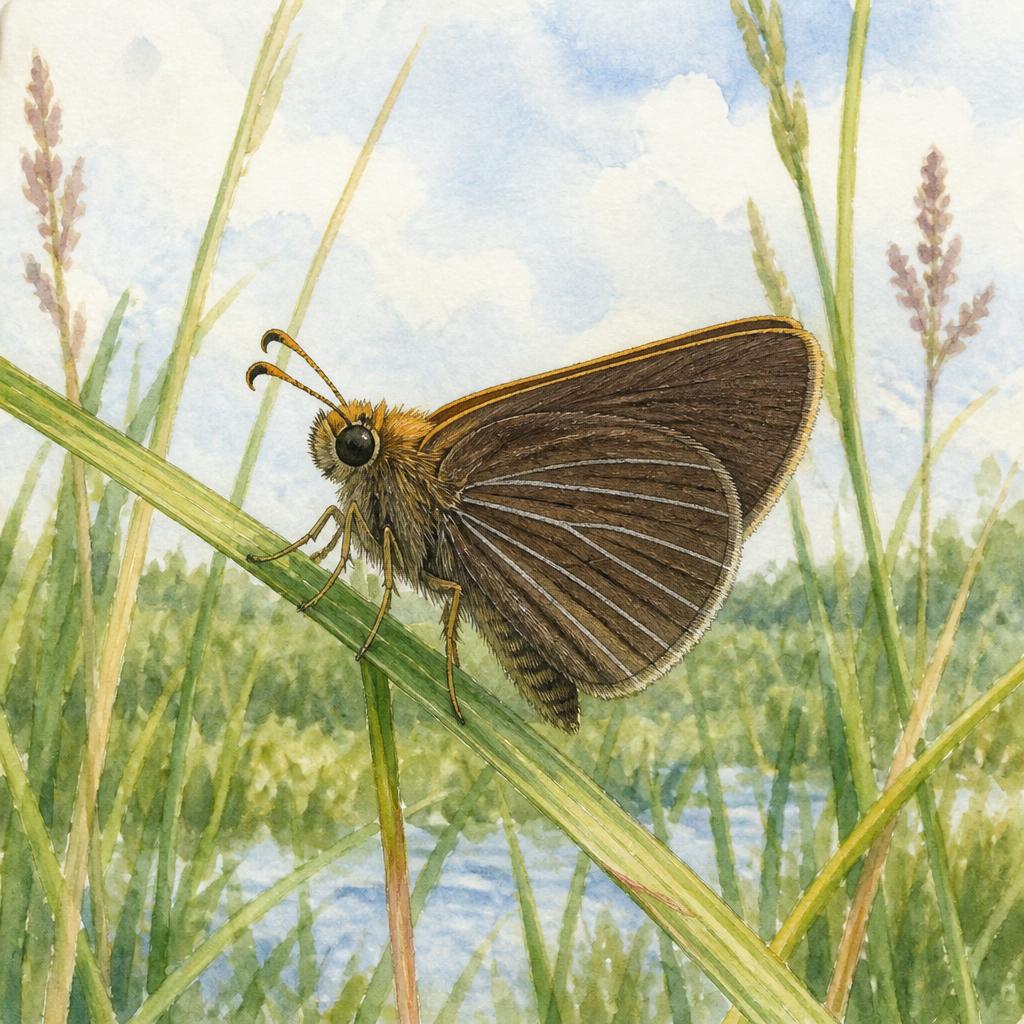
Illustrated Species Ambassador
Sedge — Poweshiek Skipperling
I'm Sedge, an illustrated ambassador for the Poweshiek skipperling. I am about an inch across, and I live only in prairie that has never been plowed.
- One fact worth knowing
- The Poweshiek skipperling went from locally abundant to a handful of surviving sites in roughly a decade, and the cause of that collapse is still not fully explained.
- What I depend on
- I depend on high-quality remnant tallgrass prairie and calcareous fen, on native bunch grasses for my caterpillars, and at Michigan sites on groundwater-fed fen hydrology. I do not readily move into restored prairie.
- My greatest threat
- My greatest threat is the loss of remnant prairie and fen, combined with a rapid decline that remains unexplained.
- One way you can help
- Support prairie preserve organizations, avoid insecticide use near remnant prairie and fen, and volunteer for invasive shrub removal in prairie fens.
This ambassador is an original illustration created for this project. It is an educational character, not a documentary image, and its statements follow the sourced record on this page. Artwork and rights record
Why this species matters
The Poweshiek skipperling disappeared from protected, well-managed prairie preserves — places doing everything right. That makes it one of the most important unexplained declines in North American conservation, and a warning that protection alone may not be sufficient.
If it disappears: It would confirm that even actively conserved prairie remnants cannot hold their specialist insect fauna, with implications for every prairie species.
Conservation status
- IUCN Red List
- Critically EndangeredLast verified 2026-09-08
- U.S. Endangered Species Act
- EndangeredListed 2014, with designated critical habitat.Last verified 2026-09-08
- Canada (SARA)
- EndangeredLast verified 2026-09-08
Population
Very few known populations remain, concentrated in a small number of Michigan prairie fens, one Wisconsin site, and remnant prairie in Manitoba. Site counts are low and are reported individually rather than combined.
Trend: Decreasing
As reported: USFWS recovery reporting and Canadian recovery strategy monitoring
Source: U.S. Fish and Wildlife Service; Environment and Climate Change Canada
Uncertainty: The decline was extraordinarily abrupt, occurring across sites in good habitat condition, and the cause is not established.
Historical: Occurred across the tallgrass prairie region in Iowa, Minnesota, North and South Dakota, Wisconsin, Michigan, and Manitoba, sometimes in large numbers.
Fragmentation: Surviving sites are widely separated and cannot exchange individuals.
Range and distribution
Historic range: Tallgrass prairie and prairie fen across the upper Midwest and southern Manitoba.
Current range: A small number of sites in Michigan, Wisconsin, and Manitoba.
Range contraction: Extirpated from Iowa, Minnesota, and the Dakotas — including the county in Iowa the species is named for.
Regions occupied
- Southern Michigan prairie fens
- Southeastern Wisconsin
- Manitoba tallgrass prairie preserve
Habitat
Primary habitat: High-quality remnant tallgrass prairie and calcareous prairie fen.
Breeding habitat: Larvae feed on prairie dropseed and mat muhly grasses.
Feeding habitat: Adults nectar on black-eyed Susan, pale purple coneflower, and other prairie forbs.
Critical habitat: Critical habitat designated in Michigan, Wisconsin, Iowa, Minnesota, North Dakota, and South Dakota.
Habitat dependencies
- Undisturbed remnant prairie — the species does not colonize restored prairie readily
- Native bunch grasses for larvae
- Groundwater-fed fen hydrology at Michigan sites
Biology and ecology
A prairie pollinator and an indicator of remnant, never-plowed prairie.
Important adaptations: Larvae overwinter exposed on grass stems, a strategy that depends on the vegetation being left standing through winter.
- Size
- Wingspan about one inch.
- Lifespan
- Adults fly for roughly two to three weeks in early summer.
- Diet
- Prairie grasses as larvae; nectar as adults.
- Reproduction
- One generation per year; larvae overwinter on grass.
- Offspring
- Small numbers of eggs laid singly.
- Breeding frequency
- Once yearly.
Primary threats
Habitat loss
Tallgrass prairie is among the most reduced ecosystems in North America; over 99 percent has been converted.
Unexplained rapid decline
The species vanished from high-quality protected sites in the 2000s; the cause has not been established.
Pesticides
Drift of insecticides from surrounding agriculture into small prairie remnants is a leading hypothesis.
Fire management
Prescribed fire kills overwintering larvae on grass stems if applied to an entire site at once.
Altered hydrology
Groundwater changes degrade prairie fen habitat in Michigan.
Invasive plants
Glossy buckthorn and reed canary grass displace native fen and prairie vegetation.
Climate change
Extreme rainfall and drought affect fen hydrology and larval survival.
Conservation and recovery
Programs and efforts
- USFWS recovery program and designated critical habitat
- Captive rearing at the Minnesota Zoo and the John Ball Zoo
- Reintroduction efforts in Michigan
- Prairie fen restoration and invasive shrub removal
- Canadian recovery strategy at the Manitoba tallgrass prairie preserve
Protected areas
- Michigan prairie fen preserves
- Manitoba Tall Grass Prairie Preserve
- Designated critical habitat across six states
Legal protections
- Endangered Species Act
- Canadian Species at Risk Act
- State endangered listings
Measurable progress
- Captive rearing has succeeded in producing adults for release
- Fen restoration has improved habitat condition at remaining sites
Continuing challenges
- The cause of the collapse remains unknown
- Very few source individuals exist for captive breeding
- Remnant prairie cannot be recreated quickly
How people can help
What individuals can do
- Support prairie preserve organizations
- Avoid insecticide use near remnant prairie and fen
What communities can do
- Advocate for pesticide buffer zones around protected prairie remnants
- Support burn plans that leave unburned refuge areas each year
Educational actions
- Use this species to teach that protected land is not automatically safe land
Habitat support
- Volunteer for invasive shrub removal in prairie fens
Organizations and programs to learn about
- USFWS Midwest Region
- Minnesota Zoo conservation program
- Nature Conservancy prairie programs
Educational notes
- Named for Poweshiek County, Iowa, where it no longer occurs.
- One of the most abrupt and least explained insect declines documented in North America.