Fish and Aquatic Life
Pallid Sturgeon
Scaphirhynchus albus
A Missouri and Mississippi River sturgeon that has largely stopped reproducing in the wild because the rivers no longer flow the way its eggs require.
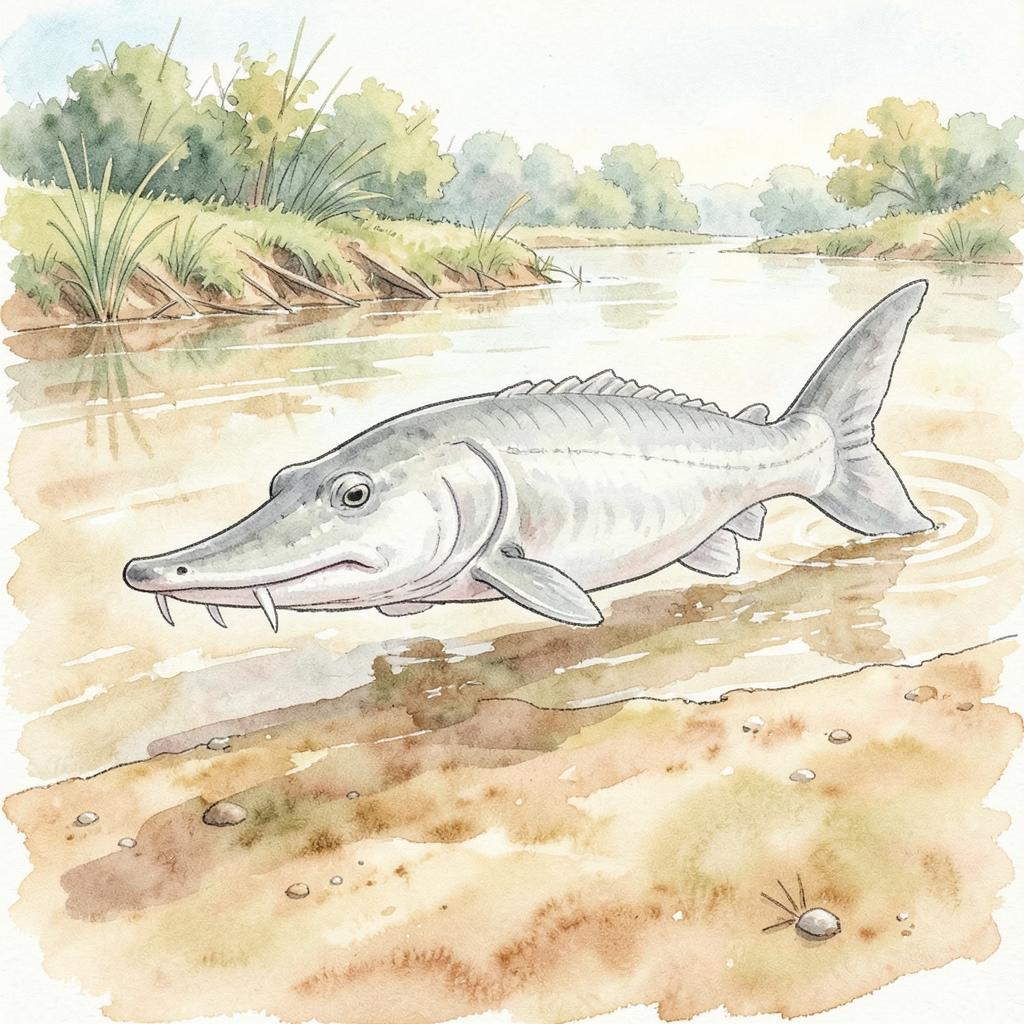
Illustrated Species Ambassador
Silt — Pallid Sturgeon
I'm Silt, an illustrated ambassador for the pallid sturgeon. My kind is very old, and I am shaped for a muddy, moving river that mostly no longer exists.
- One fact worth knowing
- Pallid sturgeon have largely stopped reproducing successfully in the wild, because their larvae must drift for hundreds of miles of free-flowing river before settling.
- What I depend on
- I depend on long free-flowing reaches of large turbid river, natural sediment movement, and the flow and temperature cues that trigger spawning.
- My greatest threat
- My greatest threat is river channelization and altered flow.
- One way you can help
- Learn to tell pallid from shovelnose sturgeon before keeping any fish, release any sturgeon immediately and report it to the state agency, and back floodplain reconnection on the lower Missouri.
This ambassador is an original illustration created for this project. It is an educational character, not a documentary image, and its statements follow the sourced record on this page. Artwork and rights record
Why this species matters
The pallid sturgeon's larvae must drift downstream for many days before they can settle and feed. Reservoirs interrupt that drift, so eggs hatch and the larvae die in still water. It is one of the clearest illustrations that a river's behavior — not just its water — is habitat.
If it disappears: Extinction would mark the loss of the Missouri River's largest native fish and confirm that the engineered river can no longer reproduce its own native life.
Conservation status
- IUCN Red List
- Critically EndangeredLast verified 2026-09-08
- U.S. Endangered Species Act
- EndangeredListed 1990.Last verified 2026-09-08
- CITES
- Appendix IILast verified 2026-09-08
Population
Wild-origin adults number in the low thousands basin-wide and are aging, with very little documented natural recruitment in the upper basin. Most fish encountered today are hatchery-reared.
Trend: Decreasing
As reported: USFWS pallid sturgeon recovery reporting and Missouri River monitoring, 2010s–2020s
Source: U.S. Fish and Wildlife Service; U.S. Geological Survey Missouri River research
Uncertainty: The critical measure is not adult numbers but recruitment: wild-spawned juveniles are rarely found in the upper Missouri.
Historical: Historically widespread and commercially caught across the Missouri and Mississippi systems.
Fragmentation: Dams divide the basin into segments; fish in the upper basin cannot reach downstream habitat and vice versa.
Range and distribution
Historic range: Missouri River from Montana to its mouth, the Mississippi from Missouri to Louisiana, and the lower Yellowstone.
Current range: Same rivers, but fragmented by dams into isolated segments with different levels of reproduction.
Range contraction: Functional loss of natural reproduction across much of the upper basin.
Regions occupied
- Montana
- North and South Dakota
- Nebraska
- Iowa
- Missouri
- Arkansas
- Louisiana
- Yellowstone River
Habitat
Primary habitat: Large, turbid, free-flowing rivers with sand and gravel bars and diverse current.
Breeding habitat: Spawns over hard substrate in strong current.
Feeding habitat: Bottom-feeds on invertebrates and small fish in turbid water.
Critical habitat: No critical habitat designated.
Habitat dependencies
- Long free-flowing river reaches — larvae drift for hundreds of miles before settling
- Turbid water and natural sediment transport
- Natural flow and temperature cues to trigger spawning
Biology and ecology
A large native river predator adapted to the historic turbid, sediment-rich Missouri River.
Important adaptations: Flattened shovel snout and barbels for feeding by touch and taste in water too muddy for sight — an adaptation that becomes a disadvantage in reservoirs where the water is clear.
- Size
- Up to about 6 feet.
- Weight
- Up to roughly 85 pounds.
- Lifespan
- Estimated 50 years or more.
- Diet
- Aquatic insects, crustaceans, and small fish taken from the river bottom.
- Reproduction
- Broadcast spawner over hard substrate in swift current.
- Offspring
- Tens of thousands of eggs per female.
- Breeding frequency
- Females spawn only every two to three years or less often.
- Age at maturity
- Females at roughly 15 years.
Primary threats
Dams and barriers
Mainstem dams block movement and convert flowing river into reservoir.
Altered streamflow
Flow regulation eliminates the spring rise and temperature cues that trigger spawning.
Channelization
The lower Missouri was straightened and narrowed, removing sandbars, backwaters, and slack-water nursery habitat.
Loss of larval drift distance
Larvae need many days of downstream drift; reservoirs interrupt that and larvae settle into anoxic sediment and die.
Hybridization
Interbreeding with the more common shovelnose sturgeon dilutes the species where habitat overlaps.
Bycatch
Commercial shovelnose sturgeon fishing incidentally caught pallid sturgeon before restrictions were introduced.
Water quality
Contaminants and reduced turbidity alter feeding and survival conditions.
Conservation and recovery
Programs and efforts
- USFWS Pallid Sturgeon Recovery Program and hatchery propagation across multiple facilities
- Missouri River Recovery Program habitat construction, including shallow-water and chute habitat
- Experimental flow releases from mainstem dams to mimic natural spring rises
- Genetic management to preserve distinct population lineages in hatchery stock
Protected areas
- Missouri National Recreational River
- Upper Missouri River Breaks National Monument
- Yellowstone River free-flowing reaches
Legal protections
- Endangered Species Act
- Restrictions on commercial shovelnose sturgeon fishing in overlap areas
- CITES Appendix II
Measurable progress
- Hatchery propagation has prevented outright extinction and maintained genetic lineages
- Documented natural spawning has occurred in some reaches
Continuing challenges
- Natural recruitment remains near zero in the upper basin
- Restoring flow conflicts with navigation, flood control, and hydropower
- The population is aging and largely hatchery-supported
How people can help
What individuals can do
- Release any sturgeon caught immediately and report it to the state agency
- Learn to distinguish pallid from shovelnose sturgeon before keeping any fish
What communities can do
- Support Missouri River habitat restoration and side-channel reconnection projects
Educational actions
- Use larval drift to teach why a river's length and flow are habitat in themselves
Habitat support
- Back floodplain reconnection and sandbar restoration on the lower Missouri
Organizations and programs to learn about
- USFWS Missouri River Fish and Wildlife Conservation Office
- U.S. Geological Survey
- state fish and wildlife agencies
Educational notes
- Demonstrates the difference between a species being alive and a species being able to reproduce.
- A concrete example of how flood control and navigation reshape ecosystems.