Birds
Northern Spotted Owl
Strix occidentalis caurina
An old-growth forest owl still declining despite decades of logging restrictions, now displaced by the invading barred owl.
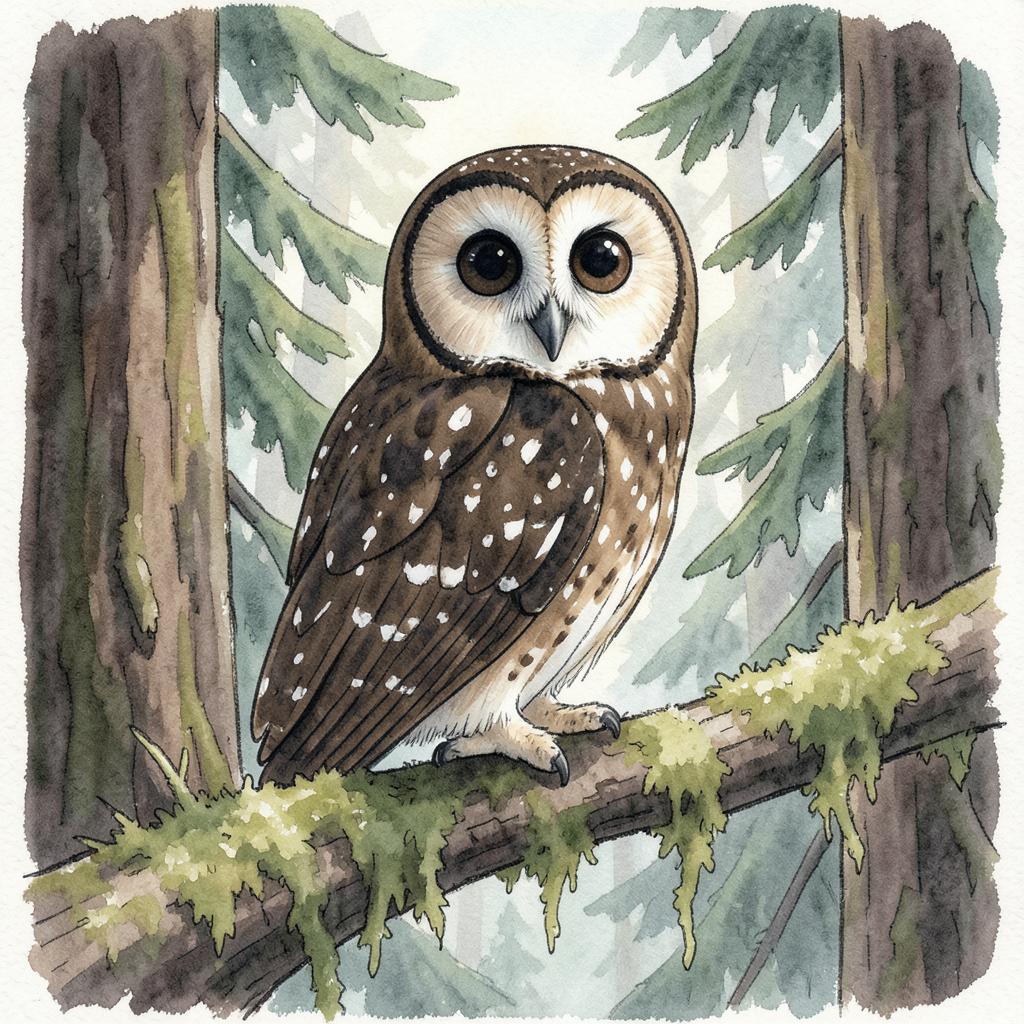
Illustrated Species Ambassador
Hollis — Northern Spotted Owl
I'm Hollis, an illustrated ambassador for the northern spotted owl. I need forests that took centuries to grow, and I am not doing well even where those forests remain.
- One fact worth knowing
- The northern spotted owl continues to decline despite decades of logging restrictions, largely because the larger, more aggressive barred owl has spread into its range.
- What I depend on
- I depend on structurally complex old-growth conifer forest — large old trees, big snags, and a closed multi-layered canopy to hunt beneath.
- My greatest threat
- My greatest threat is competition from invading barred owls.
- One way you can help
- Support protection of remaining mature and old-growth forest and responsible wood sourcing — and read carefully about the barred owl question before forming a view, because it is genuinely difficult.
This ambassador is an original illustration created for this project. It is an educational character, not a documentary image, and its statements follow the sourced record on this page. Artwork and rights record
Why this species matters
The spotted owl became the defining symbol of old-growth forest protection in the United States, and the Northwest Forest Plan reshaped federal forest management around it. Its continued decline despite that protection is an important, uncomfortable lesson: protecting habitat is necessary but sometimes not sufficient.
If it disappears: Losing it would mean the loss of the Pacific Northwest's signature old-growth predator and the failure of the most ambitious ecosystem-scale forest plan in U.S. history.
Conservation status
- IUCN Red List
- Near ThreatenedSpecies-level assessment for Strix occidentalis.Last verified 2026-09-08
- U.S. Endangered Species Act
- ThreatenedListed 1990; USFWS has found uplisting to endangered warranted but precluded by higher priorities.Last verified 2026-09-08
- Canada (SARA)
- EndangeredLast verified 2026-09-08
- Washington and Oregon
- State endangered / threatenedLast verified 2026-09-08
Population
Declining across all monitored study areas, with declines of roughly 50 to 75 percent over recent decades and fewer than 10 known wild birds remaining in British Columbia.
Trend: Decreasing
As reported: Northwest Forest Plan effectiveness monitoring and USFWS status reviews, 2010s–2020s
Source: U.S. Fish and Wildlife Service; U.S. Forest Service Northwest Forest Plan monitoring
Uncertainty: Monitoring reports rates of decline across long-term demographic study areas rather than a single range-wide population count.
Fragmentation: Remaining owls are increasingly isolated in old-growth patches as barred owls occupy the intervening forest.
Range and distribution
Historic range: Old-growth conifer forest from southwestern British Columbia through Washington and Oregon into northern California.
Current range: Same range with sharply reduced occupancy, and near-extirpation in British Columbia.
Range contraction: The Canadian population has collapsed to single digits in the wild.
Regions occupied
- British Columbia, Canada
- Washington
- Oregon
- Northern California
Habitat
Primary habitat: Structurally complex old-growth and mature conifer forest with multi-layered canopy and large snags.
Breeding habitat: Nests in tree cavities, broken tree tops, and abandoned raptor nests in old trees.
Feeding habitat: Hunts northern flying squirrels and woodrats in closed-canopy forest at night.
Critical habitat: Extensive critical habitat designated across federal forest lands.
Habitat dependencies
- Large-diameter old trees and snags
- Closed canopy for hunting cover
- Absence of dominant barred owl competition
Biology and ecology
A nocturnal predator of the old-growth canopy and the best-known indicator of old-growth forest condition.
Important adaptations: Silent flight and dark eyes suited to hunting under dense canopy; large territories of one to several thousand acres per pair.
- Size
- About 16–19 inches long with a 3.5-foot wingspan.
- Weight
- Roughly 1.2–1.6 pounds.
- Lifespan
- Around 10–15 years.
- Diet
- Northern flying squirrels, woodrats, voles, and other small mammals.
- Reproduction
- Nests in cavities and broken-topped old trees; does not nest every year.
- Offspring
- Usually 2 eggs.
- Breeding frequency
- Irregular — pairs skip breeding entirely in poor prey years.
- Age at maturity
- About 2–3 years.
Primary threats
Invasive species
Barred owls, which expanded westward across the continent, are larger, more aggressive, and more generalist, and they displace spotted owls from territories. This is now the dominant threat.
Habitat loss
Historic old-growth logging removed the majority of suitable forest before protections took effect.
Wildfire
Severe stand-replacing fire destroys remaining old-growth patches.
Habitat fragmentation
Isolated patches cannot support the very large territories a pair needs.
Climate change
Warming and drying increase fire severity and stress prey populations.
Low reproduction
Pairs frequently skip breeding, so populations recover slowly even under good conditions.
Conservation and recovery
Programs and efforts
- Northwest Forest Plan federal land management
- Long-term demographic monitoring across study areas since the 1980s
- USFWS barred owl management strategy, finalized in 2024, authorizing targeted removal
- Habitat restoration and thinning to accelerate old-growth characteristics
Protected areas
- Designated critical habitat across federal forests in Washington, Oregon, and California
- Olympic and Mount Rainier National Parks
Legal protections
- Endangered Species Act (threatened)
- Northwest Forest Plan land allocations
- Canada's Species at Risk Act
Measurable progress
- Old-growth logging on federal land was dramatically curtailed
- One of the longest continuous demographic datasets for any wild bird
Continuing challenges
- Barred owl competition continues
- Barred owl removal is scientifically supported but publicly contentious
- Wildfire severity is increasing
How people can help
What individuals can do
- Support old-growth forest protection and responsible wood sourcing
- Learn the barred owl issue carefully before forming a view — it is genuinely difficult
What communities can do
- Back forest restoration and fuels management that protects remaining old-growth
Educational actions
- Use the spotted owl to teach the difference between habitat protection and species recovery
Habitat support
- Support acquisition and protection of remaining mature forest on private land
Organizations and programs to learn about
- USFWS Pacific Region
- U.S. Forest Service Pacific Northwest Research Station
Educational notes
- Illustrates a hard conservation dilemma: managing one native owl to save another.
- Shows that habitat protection alone does not guarantee recovery.