Marine Life
North Atlantic Right Whale
Eubalaena glacialis
A large baleen whale whose entire population is individually catalogued by photograph, and which is dying faster from ship strikes and rope entanglement than it can reproduce.
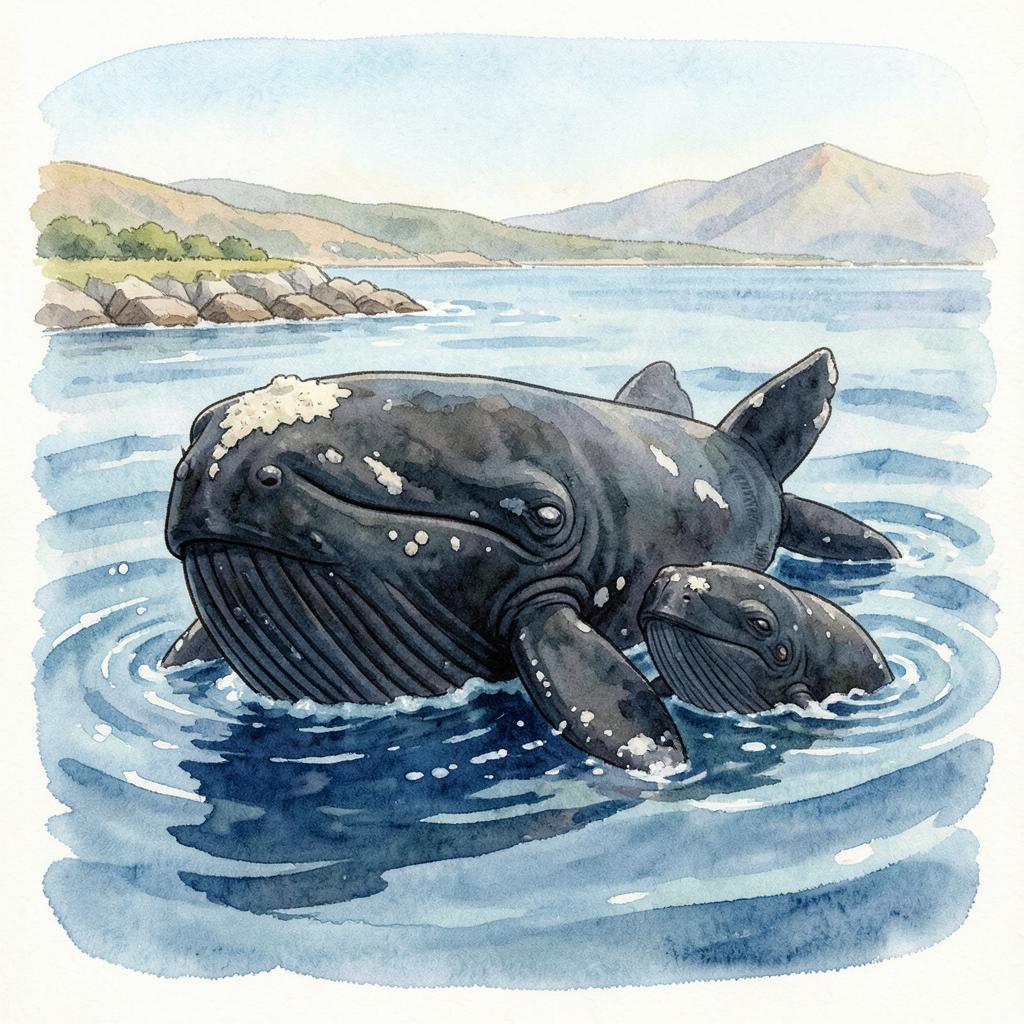
Illustrated Species Ambassador
Callis — North Atlantic Right Whale
I'm Callis, an illustrated ambassador for the North Atlantic right whale. Every one of us is catalogued by photograph, by the rough pale patches on our heads.
- One fact worth knowing
- North Atlantic right whales are dying from ship strikes and rope entanglement faster than the population can replace itself.
- What I depend on
- I depend on dense swarms of copepods to feed on, quiet low-traffic calving waters, and migratory corridors free of vertical fishing rope.
- My greatest threat
- My greatest threats are vessel strikes and entanglement in fishing gear.
- One way you can help
- If you operate a vessel on the Atlantic coast, observe the speed restrictions and report sightings through Whale Alert; support fisheries moving to ropeless gear.
This ambassador is an original illustration created for this project. It is an educational character, not a documentary image, and its statements follow the sourced record on this page. Artwork and rights record
Why this species matters
This is a whale population small enough that researchers know each animal by name. That intimacy makes the losses undeniable and traceable, and it makes the two causes — ships and rope — unusually clear and unusually solvable.
If it disappears: It would be the extinction of a great whale in some of the best-monitored, best-regulated waters on earth, despite full legal protection.
Cultural and regional note: Named the 'right' whale by whalers because it swam slowly, floated when killed, and was therefore the right whale to hunt — a name that still describes why it remains vulnerable to slow-moving hazards.
Conservation status
- IUCN Red List
- Critically EndangeredLast verified 2026-09-08
- U.S. Endangered Species Act
- EndangeredLast verified 2026-09-08
- Marine Mammal Protection Act
- Depleted and strategic stockLast verified 2026-09-08
- Canada (SARA)
- EndangeredLast verified 2026-09-08
Population
Approximately 370 individuals, including roughly 70 reproductively active females, based on the photo-identification catalog maintained by the North Atlantic Right Whale Consortium.
Trend: Decreasing
As reported: North Atlantic Right Whale Consortium annual report card, most recent year
Source: North Atlantic Right Whale Consortium; NOAA Fisheries
Uncertainty: Nearly every individual is known by name and photograph, so this estimate is exceptionally precise for a wild whale population. An Unusual Mortality Event has been declared and remains in effect.
Historical: Numbered in the tens of thousands before commercial whaling; roughly 480 individuals in 2010 before the recent decline.
Fragmentation: A single population that must transit heavily trafficked shipping and fishing waters along its entire migration.
Range and distribution
Historic range: The western North Atlantic from Florida to the Gulf of St. Lawrence, and formerly the eastern Atlantic.
Current range: The same coastal corridor, with feeding distribution shifting northward into the Gulf of St. Lawrence in recent years.
Migration: Migrates between southeastern U.S. calving grounds in winter and northern feeding grounds in spring and summer.
Range contraction: Functionally extinct in the eastern North Atlantic.
Regions occupied
- Florida and Georgia (calving)
- Mid-Atlantic (migration)
- Cape Cod Bay and Gulf of Maine (feeding)
- Gulf of St. Lawrence, Canada (feeding)
Habitat
Primary habitat: Coastal and continental shelf waters.
Breeding habitat: Calves are born in warm shallow waters off Florida, Georgia, and South Carolina.
Feeding habitat: Skim-feeds at the surface and at depth on dense patches of copepods, especially Calanus finmarchicus.
Seasonal differences: Feeding distribution has shifted north as warming has altered copepod distribution.
Critical habitat: Critical habitat designated in the Gulf of Maine feeding areas and the southeastern calving grounds.
Habitat dependencies
- Dense copepod aggregations
- Quiet, low-traffic calving waters
- Rope-free feeding and migratory corridors
Biology and ecology
A large baleen whale that cycles nutrients through the water column and supports ocean productivity.
Important adaptations: Callosities on the head form patterns unique to each whale, which is why the entire population can be individually identified from photographs.
- Size
- Up to about 52 feet.
- Weight
- Up to roughly 70 tons.
- Lifespan
- Potentially over 70 years, though few now reach old age.
- Diet
- Copepods and other zooplankton filtered through baleen.
- Reproduction
- A single calf after roughly a year of gestation.
- Offspring
- One.
- Breeding frequency
- Historically about every three years; the interval has lengthened to as much as six to ten years, a sign of stress and entanglement injury.
- Age at maturity
- Females around ten years.
Primary threats
Vessel strikes
Collisions with ships are a leading cause of death and serious injury; the whales feed at the surface in busy shipping lanes.
Entanglement
Vertical buoy lines from lobster and crab traps wrap around flippers, tails, and mouths. Most living right whales bear entanglement scars; entanglement can kill slowly over months and suppresses reproduction.
Underwater noise
Shipping noise masks communication between mothers and calves and raises measurable stress hormone levels.
Climate change
Warming has shifted copepod distribution north, moving whales into Canadian waters that lacked protective measures until recently.
Low reproduction
Calving intervals have lengthened substantially, so births no longer offset deaths.
Small population
With roughly 70 breeding females, the loss of a single female is significant to the species.
Conservation and recovery
Programs and efforts
- NOAA Fisheries vessel speed restrictions in seasonal management areas
- Dynamic management areas triggered by whale sightings
- Ropeless and on-demand fishing gear development and testing
- Canadian fishery closures and speed restrictions in the Gulf of St. Lawrence
- Aerial and acoustic survey networks and the photo-identification catalog
- Large whale disentanglement response teams
Protected areas
- Designated critical habitat in the Gulf of Maine and the southeastern calving grounds
- Stellwagen Bank National Marine Sanctuary
Legal protections
- Endangered Species Act
- Marine Mammal Protection Act
- Canadian Species at Risk Act
- Mandatory vessel speed rules in seasonal areas
Measurable progress
- Canadian measures adopted after a 2017 mortality spike measurably reduced deaths in the Gulf of St. Lawrence
- Ropeless gear has moved from concept to field testing
- Voluntary and mandatory speed compliance has improved in some corridors
Continuing challenges
- Speed rules and gear changes impose real costs on shipping and fishing
- Whales have shifted into areas without established protections
- Deaths continue to outpace births
How people can help
What individuals can do
- If you operate a vessel on the Atlantic coast, observe speed restrictions and report right whale sightings through the Whale Alert app
- Support fisheries transitioning to ropeless gear
- Never approach a right whale — federal law requires staying 500 yards away
What communities can do
- Support port and shipping speed compliance programs
- Fund ropeless gear transition for local fishing fleets
Educational actions
- Use the photo-identification catalog to teach that individual animals, not just populations, can be tracked
Habitat support
- Support marine protected area management and noise reduction measures
Organizations and programs to learn about
- NOAA Fisheries
- New England Aquarium Anderson Cabot Center
- North Atlantic Right Whale Consortium
- Canadian Department of Fisheries and Oceans
Educational notes
- Almost every individual has a catalog number and many have names.
- Most surviving right whales carry visible entanglement scars.
- An Unusual Mortality Event has been in effect since 2017.
Sources and references
- IUCN Red List — Eubalaena glacialis — IUCN
- NOAA Fisheries — North Atlantic Right Whale — NOAA Fisheries
- North Atlantic Right Whale Consortium — NARWC