Pollinators
Miami Blue Butterfly
Cyclargus thomasi bethunebakeri
Once common along the entire South Florida coast, now reduced to a few remote islands in the Florida Keys.
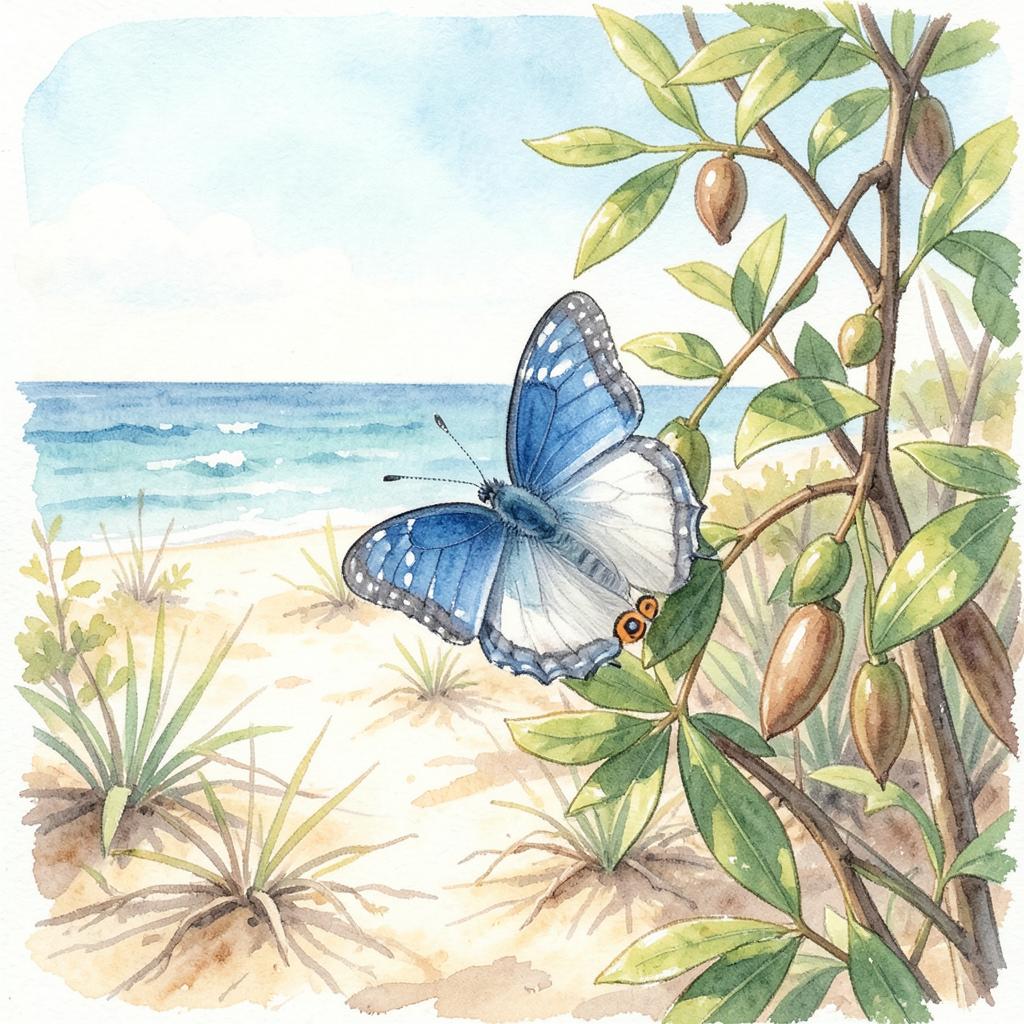
Illustrated Species Ambassador
Cyan — Miami Blue Butterfly
I'm Cyan, an illustrated ambassador for the Miami blue butterfly. I was once common along the whole South Florida coast. Now I hold on in a few remote keys.
- One fact worth knowing
- The Miami blue, once widespread along the South Florida coast, is now reduced to a handful of remote islands in the Florida Keys.
- What I depend on
- I depend on nickerbean thickets for my caterpillars, open sunny coastal scrub, and the absence of invasive fire ants.
- My greatest threat
- My greatest threats are coastal habitat loss, hurricanes and invasive ants.
- One way you can help
- If you live in South Florida, plant nickerbean and native coastal legumes, never collect butterflies in the Keys, and support targeted rather than broadcast mosquito spraying.
This ambassador is an original illustration created for this project. It is an educational character, not a documentary image, and its statements follow the sourced record on this page. Artwork and rights record
Why this species matters
The Miami blue shows how quickly a common coastal species can be reduced to a handful of islands by development, and how a single hurricane can then threaten everything that remains.
If it disappears: It would be a documented U.S. butterfly extinction in a heavily developed and closely watched region, and coastal scrub would lose a specialist pollinator.
Conservation status
- U.S. Endangered Species Act
- EndangeredEmergency listed in 2011 and listed as endangered in 2012.Last verified 2026-09-08
- Florida
- State endangeredLast verified 2026-09-08
- IUCN Red List
- Not separately assessed at the subspecies levelLast verified 2026-09-08
Population
Extremely small. Known wild populations are restricted to a small number of islands in the Key West National Wildlife Refuge, with counts reported by survey rather than as a range-wide total.
Trend: Unknown
As reported: USFWS and University of Florida monitoring, recent survey seasons
Source: U.S. Fish and Wildlife Service; Florida Museum of Natural History McGuire Center
Uncertainty: Numbers fluctuate sharply with storms and host plant condition; single-year counts should not be read as a trend.
Historical: Formerly ranged along coastal southern Florida from the Daytona area south through the Keys and was once considered common.
Fragmentation: The species now exists on a handful of small islands with no natural connectivity to the mainland.
Range and distribution
Historic range: Coastal southern Florida, the Florida Keys, and the Dry Tortugas.
Current range: A few islands within the Key West National Wildlife Refuge, plus reintroduction attempts elsewhere in the Keys.
Range contraction: Lost from essentially the entire mainland coast.
Regions occupied
- Lower Florida Keys
- Historic range along both Florida coasts
Habitat
Primary habitat: Coastal tropical hardwood hammock edges, beachside scrub, and open sunny areas with host plants.
Breeding habitat: Larvae feed on nickerbean (Caesalpinia bonduc) and, historically, blackbead and other legumes.
Feeding habitat: Adults nectar on small coastal flowering plants.
Critical habitat: No critical habitat designated.
Habitat dependencies
- Nickerbean thickets in coastal areas
- Open, sunny coastal scrub
- Absence of invasive fire ants
Biology and ecology
A pollinator of coastal plant communities and an indicator of intact coastal scrub.
Key relationships: Like many blues, larvae are tended by ants — but invasive fire ants attack rather than tend them.
- Size
- Wingspan under one inch.
- Lifespan
- Adults live roughly a week.
- Diet
- Nickerbean and related legumes as larvae; nectar as adults.
- Reproduction
- Multiple broods per year in the subtropical climate.
- Offspring
- Dozens of eggs per female.
- Breeding frequency
- Several generations annually.
Primary threats
Habitat loss
Coastal development removed nearly all mainland habitat in southern Florida.
Hurricanes
A single major storm can destroy host plants and populations on the small islands where the species remains.
Invasive species
Red imported fire ants prey on eggs and larvae; invasive plants displace nickerbean.
Mosquito control spraying
Aerial insecticide application in the Keys kills non-target butterflies.
Sea level rise
The remaining island habitat is low-lying and directly threatened by rising seas.
Illegal collection
Rarity increases the value of specimens to collectors.
Small population effects
Very low numbers reduce genetic diversity and increase vulnerability to any single event.
Conservation and recovery
Programs and efforts
- Captive rearing at the Florida Museum of Natural History McGuire Center for Lepidoptera
- Reintroduction attempts at multiple Keys sites
- Host plant (nickerbean) restoration in the Keys
- Coordination with mosquito control districts to limit spraying in butterfly habitat
Protected areas
- Key West National Wildlife Refuge
- Great White Heron National Wildlife Refuge
- Bahia Honda State Park (historic site)
Legal protections
- Endangered Species Act
- Florida state endangered listing
- Refuge access restrictions on occupied islands
Measurable progress
- A captive population has been established and maintained
- Nickerbean plantings have expanded available habitat
Continuing challenges
- Reintroductions have repeatedly failed to establish
- Hurricanes are unpredictable and increasingly severe
- Habitat is a few acres on remote islands
How people can help
What individuals can do
- Plant nickerbean and native coastal legumes if you live in South Florida
- Never collect butterflies in the Keys
- Support targeted rather than broadcast mosquito control
What communities can do
- Encourage mosquito control districts to adopt butterfly-safe treatment windows and buffer zones
Educational actions
- Use the Miami blue to teach how quickly a common species can become critically rare
Habitat support
- Support coastal hammock and scrub restoration in the Keys
Organizations and programs to learn about
- USFWS South Florida Ecological Services
- Florida Museum McGuire Center
- Florida Fish and Wildlife Conservation Commission
Educational notes
- Believed possibly extinct after Hurricane Andrew in 1992, then rediscovered in 1999.
- An unusually clear case where invasive ants, not habitat alone, drive the decline.
Sources and references
- U.S. Fish and Wildlife Service — Miami Blue Butterfly — USFWS
- Florida Fish and Wildlife Conservation Commission — Miami Blue — FWC
- Florida Museum McGuire Center for Lepidoptera and Biodiversity — Florida Museum of Natural History