Mammals
Mexican Gray Wolf
Canis lupus baileyi
The most endangered gray wolf subspecies in North America, restored to Arizona and New Mexico from seven founders.
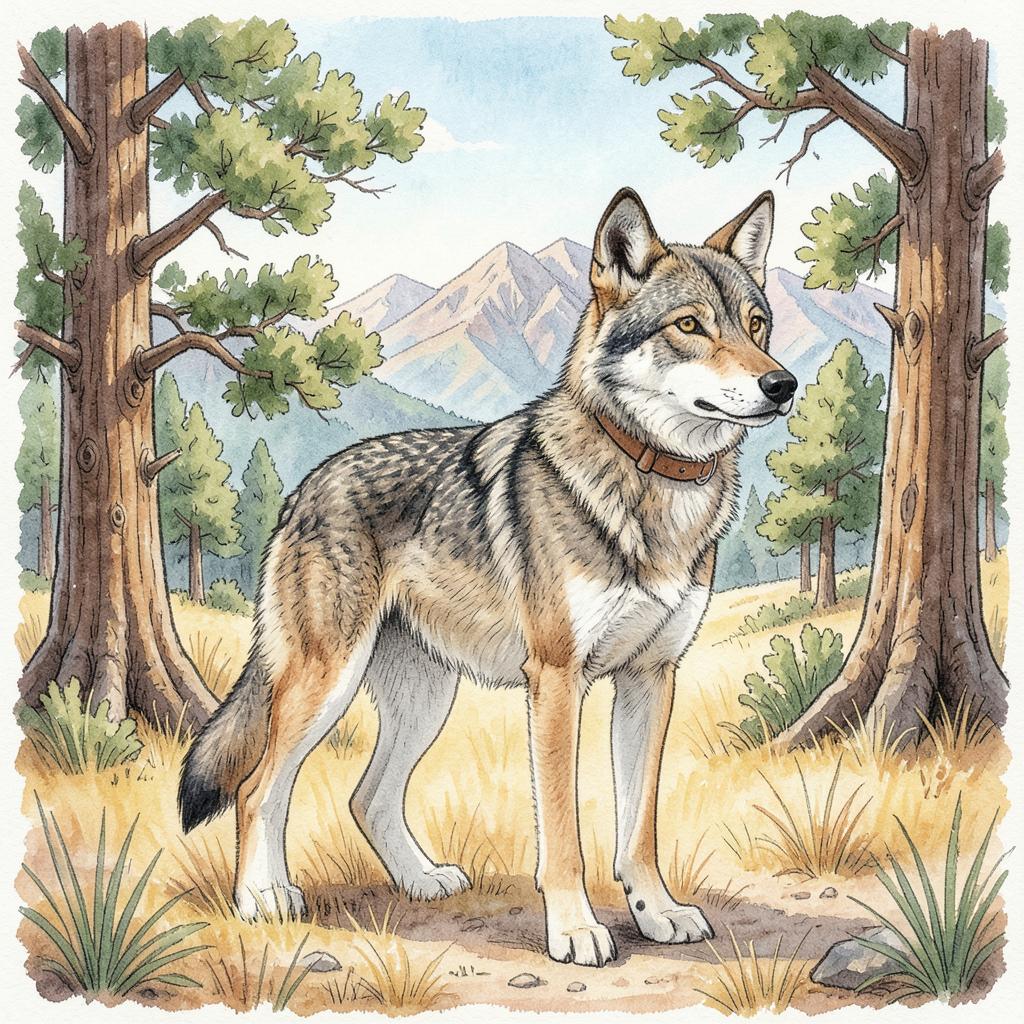
Illustrated Species Ambassador
Lobo — Mexican Gray Wolf
I'm Lobo, an illustrated ambassador for the Mexican gray wolf. I am the smallest and most southerly gray wolf, and I live in family groups in mountain country.
- One fact worth knowing
- The Mexican gray wolf was eliminated from the wild and every wolf now living in the Southwest descends from a small captive-breeding population.
- What I depend on
- I depend on mountain woodland and grassland with enough wild prey — elk and deer — and on being able to move between habitat patches.
- My greatest threat
- My greatest threats are illegal killing, very limited genetic diversity, and conflict with livestock.
- One way you can help
- Support the coexistence tools that actually reduce conflict — range riders, carcass removal, guard animals and compensation programs — and report illegal killing.
This ambassador is an original illustration created for this project. It is an educational character, not a documentary image, and its statements follow the sourced record on this page. Artwork and rights record
Why this species matters
Mexican wolves were removed from the southwest deliberately and returned deliberately. Their recovery is one of the clearest tests of whether people can share working landscapes with a large predator.
If it disappears: Losing them again would end North America's most genetically distinct wolf lineage and remove the last native large canid from the southwestern sky islands.
Conservation status
- U.S. Endangered Species Act
- EndangeredListed as an endangered subspecies; the U.S. population is managed as a nonessential experimental population.Last verified 2026-09-08
- IUCN Red List
- Gray wolf (Canis lupus) is Least Concern range-wide; this subspecies is not separately assessedLast verified 2026-09-08
- Mexico (NOM-059)
- Probably extinct in the wild historically; under active reintroductionLast verified 2026-09-08
Population
At least 286 wild Mexican wolves counted in Arizona and New Mexico in the 2024 annual survey, plus a smaller reintroduced population in Mexico and roughly 350 wolves in captivity.
Trend: Increasing
As reported: Interagency Field Team annual count, published 2025 for calendar year 2024
Source: U.S. Fish and Wildlife Service Mexican Wolf Recovery Program
Uncertainty: Counts are minimum known numbers, not total population; the true figure is somewhat higher.
Historical: Extirpated from the wild in the United States by the mid-twentieth century; the entire living subspecies descends from seven founder animals.
Range and distribution
Historic range: Central and northern Mexico north into Arizona, New Mexico, and western Texas.
Current range: The Mexican Wolf Experimental Population Area in east-central Arizona and west-central New Mexico, plus reintroduction sites in Chihuahua and Sonora, Mexico.
Range contraction: Absent from the wild entirely between the late 1970s and the 1998 reintroduction.
Regions occupied
- Arizona
- New Mexico
- Chihuahua and Sonora, Mexico
Habitat
Primary habitat: Montane pine, oak, and mixed-conifer woodland with adjacent grassland.
Breeding habitat: Dens in burrows, rock crevices, and hollow logs at moderate elevation.
Feeding habitat: Elk, deer, and smaller mammals across open woodland and meadow.
Habitat dependencies
- Abundant elk and deer
- Low levels of human-caused mortality
- Large, connected public land blocks
Biology and ecology
Apex predator regulating elk distribution and browsing pressure, which in turn affects streamside vegetation.
Key relationships: Lives in family packs of a breeding pair and their offspring.
Important adaptations: Smaller body size suited to the warmer, drier southwestern mountains.
- Size
- About 4.5–5.5 feet long including tail; roughly 26–32 inches at the shoulder.
- Weight
- Approximately 50–80 pounds.
- Lifespan
- Around 6–8 years in the wild.
- Diet
- Primarily elk, with mule deer, javelina, rabbits, and small mammals.
- Reproduction
- One breeding pair per pack; breeding in February, births in April and May.
- Offspring
- Typically 4–6 pups.
- Breeding frequency
- One litter per year.
- Age at maturity
- About 2 years.
Primary threats
Illegal killing
Unlawful shooting remains the leading known cause of Mexican wolf mortality.
Low genetic diversity
Descent from seven founders produces measurable inbreeding effects, which cross-fostering of captive pups is designed to reduce.
Human-wildlife conflict
Livestock depredation drives removals and opposition to releases.
Vehicle mortality
Highway strikes remove wolves from a small breeding population.
Habitat fragmentation
Interstate highways and development limit movement between recovery areas.
Conservation and recovery
Programs and efforts
- USFWS Mexican Wolf Recovery Program and Interagency Field Team
- Mexican Wolf Species Survival Plan captive breeding
- Cross-fostering captive-born pups into wild litters to improve genetics
- Livestock depredation compensation and range-rider programs
Protected areas
- Apache-Sitgreaves National Forests
- Gila National Forest
Legal protections
- Endangered Species Act listing
- Revised 10(j) management rule
Measurable progress
- Wild population has increased for nine consecutive years through 2024
- Multiple cross-fostered pups have survived to breeding age in the wild
Continuing challenges
- Genetic diversity remains the limiting factor
- Continued illegal mortality
- Recovery requires connectivity with Mexico
How people can help
What individuals can do
- Report illegal killing or suspicious wolf deaths to USFWS law enforcement
- Never feed or habituate wild canids
What communities can do
- Support range riders, carcass removal, and non-lethal livestock protection funded through compensation programs
Educational actions
- Follow the published annual count as a real example of population monitoring
Habitat support
- Support connectivity planning between the Arizona-New Mexico and Mexican recovery areas
Organizations and programs to learn about
- USFWS Mexican Wolf Recovery Program
- Arizona Game and Fish Department
- New Mexico Department of Game and Fish
Educational notes
- An annual, publicly published population count makes this an unusually teachable recovery program.
- Cross-fostering is a concrete example of genetic management in the wild.